[Overview of the year 2023
An excellent year with 79 species recorded, equalling 2019, and several additions to the list - pr Grey Partridge flying over the house on 2 March, Cuckoo W over on 30 April, Hobby S over on 17 June (subject to acceptance by LBRC), ad Little Gull on 10 August (part of huge influx), Red Kite thermalling high over on 30 August and a skua sp. W through on 19 October (probably Arctic); new species total will be 119, plus now two not confirmed to species; also first winter record of Woodcock, bombing down Douglas Road on 28 January and several Waxwings in early winter period including 70 low over on 18 November; a juv Whitethroat among sparrows on 4-5 August (32 of latter the previous day) was also a second record; on nocturals, Coot on 19 March, Moorhen on 18 March (90 mins before the Coot), 24 April, 6 & 10 June; not so many waders but Ringed Plover(s) calling over early evening 6 September, Whimbrel early evening 24 June and nocturnal Common Sand 18 July; drake Mallard on 20 March, Nuthatch on 2 April and 10 September, and ad Med Gulls flycatching over on 10 August and flying S over on 15 August; Tawny Owl regular in spring but not later in the year; a much better year for Crossbills with several flocks in July but Willow Warbler absent for second year running and very poor numbers of Sandwich Tern, logged on only two dates.
On insects, yet another Hummingbird Hawkmoth, nectaring on honeysuckle on 9 July, with Holly Blue also regular in July; on mammals, a cute juv Wood Mouse playing on patio, and Soprano Pipistrelle confirmed on detector on several dates June to October.
Not wildlife, but nacreous cloud showed up in December.
]
Small groups of Fieldfare (up to 24) heading S over in afternoon or at dusk Christmas Day to New Year, suggesting may be an inland roost again.
Nacreous cloud showed various appearances towards dusk on 21 December
Single Waxwing over 15:15hrs 17 December.
Another 2 Waxwings trilling over 08:51hrs 8 December.
25 Redwing over on 3 December.
A Crossbill SW over on 22 November.
The sky darkened with Waxwings on 18 November when a wave of 70+ went through trilling low SW at 10:30hrs, just a couple of seconds to count them, could have been 80 or 90.
Having missed a few locally good to hear Waxwings again over on morning 4 November; checking records, have now logged these in 8 of the 20 winters we have been here, though nearly all of the 135 "bird-days" from garden were in Nov-Dec 2008, Dec 2012 and Jan 2017 - and actually not seen one in Lothian since last over garden on 2 January 2019! Also redpolls over, would be good to get a look at them.
One that got away - all dark slender falcon-shaped bird gliding through west 15:12hrs 19 October with Storm Babet blowing from behind, too late for Hobby so I suspected it was a small skua sp. - went down to Seton and found a juv Arctic sat on sea out beyond crashing surf!
Daily commutes by noisy Greylag Geese, and also Canadas, between Gosford and feeding areas south-west/Blindwells Princes Loch in September, with over 400 Greylags on morning 20 September.
Young Bullfinch in rowan eating honeysuckle berries 13 September; Blackcap heard often in same period with male also eating honeysuckle berries, rather than rowan, 19 September.
Nuthatch call week of 10 September, heard in song several times over summer in Fernyness Wood.
Calls of Ringed Plover(s) heard over at 18:24hrs on 6 September, only previously logged nocturnally.
An excellent year for new species continues with the first Red Kite seen thermalling high over the village on afternoon of 20 August, eventually drifting off south; with two or more previous records in recent years this species was looking like a bogey bird, so very pleasing to have finally seen it, species 119. Just Raven to go now!
Another ad Med Gull, this timing flying S over garden with BHG 10:00hrs on 15 August.
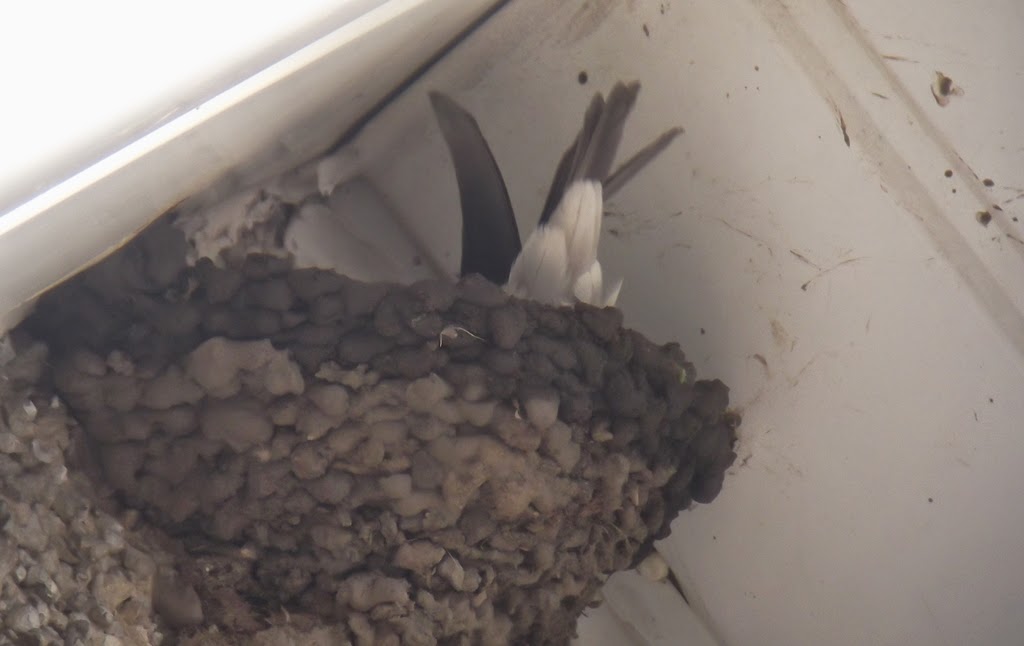
A Little Gull hawking for insects in large gathering of gulls and hirundines (and Swift) on 10 August is first record for the garden,
species 118. Part of a huge influx along the coast (
thread) with 10-20 hawking over coastal woods (1-2 juv), 52+ feeding offshore and 44 (6 ad-sum, 1 juv) down on shore at mouth of Seton Burn (and even more, 200+, at Musselburgh in preceding days, not quite matching
record influx peaking at 276 late July 2007). Image above is a video grab of one over Seton Burn, pic right another high over Longniddry club house top left in image.
32 House Sparrows (16+ ad m) in buddleja 3 August is best count for several years, preening, sunbathing and nibbling the bark. Even better the following day when they were joined by a juv Whitethroat, just second record for garden (first in 2009), also seen on 5 August.
Over 100 Common Swift feeding over coastal woods 23 July, with hirundines, part of the regular late summer build-up of presumed mainly post-breeding birds. 220+ logged on 28 July.
Migrant Common Sandpiper calling low over 02:32hrs 18 July.
A Hummingbird Hawkmoth seen nectaring at honeysuckle flowers high in rowan tree at dusk on 9 July, 3rd record and second year running (1st was on honeysuckle in September 2006).
Several flocks of Crossbills SW over 26 June to 17 July, historical graphs for context:
Whimbrel calling over 19:23hrs on 24 June - an early failed breeder?
Another red letter day - excellent view of a Hobby heading south over 18:55hrs 17 June (several previous "presumed" Hobby but none accepted from garden, more hopeful for this one [subsequently accepted by LBRC, batch 111.13, species 117).
Moorhen calling over 6 & 10 June.
Regular sightings of 1-2 Holly Blue 13 May to 3 June.
Cuckoo W over 15:14hrs 30 April, species 116 for the garden.
Magnificent display flight and mewing calls from 3 Buzzards directly over, drifting off east, morning of 2 April.
Small Tortoiseshell fluttering on garage window 2 April, perhaps over-wintered there (not visible when I checked and vast amounts of spider web).
Chiff in front garden on 31 March, song heard over following days.
Chiffchaff feeding on back garden 20 March - a week later than last year but not bad considering weather.
Spring has sprung - big queen Buff-tailed Bumbler on red currants 17 March, m & f Wheatear just down at Ferny Ness (only one of those on garden list) 18 March and first territorial flight calls of both Moorhen and Coot later same evening, Coot heading NE (heard 22:30hrs Dean Wood c/o James, here 01:00hrs 19 March).
Our 2022 breeding male Blackbird has survived - had no idea but the song phrases so familiar from last year are ringing out again, lovely to hear.
Not heard over garden but of note - two sneeze calls from Woodcock in roding flight N over open area at Kings Park 18:55hrs 3 March.
Red-letter day on 2 March - pr Grey Partridge in flight over the house, then down on road nearby in Wemyss Road, brief calls, then flying SW over playing fields towards school! Species 115 for the garden.
Tawny Owl calls nearby again 11 Feb - heard very regularly since early Dec but perhaps just more vocal?
Golden Plover calling over in rain 19:00hrs 31 January.
Out of the blue, literally, a Woodcock bombing along Douglas Road through back gardens on north side, viewed by me from kitchen window - no mistaking it, stocky, brown, long bill and flapping rapidly like on roding flight - 10:05hrs on Sat 28 January - first winter record (previously two roding birds in May 2011) and presumably flushed from Gosford Estate where they can still be found in winter.
Been hearing redpolls many days recentlty but was still surprised to see them literally at the front window for much of morning on 10 January, 3 Lessers feeding on birch catkins.
Tawny Owl again in early hours of 3 & 4 January, resident at present.
More Fieldfares over on New Year's Day.
2022
[Overview of the year 2022
A decline to 71 species recorded with more time back at work and no new additions bird wise (but Common Toad, Common Grasshopper, Wall butterfly and Hummingbird Hawkmoth in the house were all new). Nevertheless there were some nice records during the year with the first diurnal Green Sandpiper calling over 11:05hrs 4/9 and a fairly late nocturnal one 23:10hrs 11/10 (4th & 5th records), another Quail calling low over at 23:57hrs on 25/6, tracking NW (audible above the music pumping out of the gala marquee c. 300m to SE, also 5th record), another Tree Pipit hurrying SW over on 15 May (2nd record); quite few gallinules again but a new thing was hearing interaction between a nocturnal Coot and Moorhen on 16 April - calling apparently in response to each other three times each (reminiscent of apparent response of Moorhen which "replied" to sound of call on xeno-canto on 3/6/16!). Just a sprinkling of other waders with Ringed Plover 17/4, Common Sand 6/5, Whimbrel 4/8 and Ringed Plover 27/8; both swans with 2 Mutes 27/1 and 7 Whoopers high S 7/10; a fantastic ad f Peregrine circling over for several minutes 14/4, and a Barn Owl low W over 02:01hrs 22/7. The best bird passed straight over the village unseen, ad f White-tailed Eagle G542, which roosted nearby at Setonhill on 16 April and continued NW the following morning (spotted by James the following day).
Probably the most remarkable observation of the year was the Robin nest building 8 & 9 February, back and forth with leaves to a log pile, then later grasses for lining. This is extremely early with only one previous Lothian nest in late winter (c3 20/2/05, Musselburgh) - also in a local recorder's garden! The weather was fairly cold at the time of the current attempt and not surprisingly nothing came of it.
Worth mentioning several notable omissions - no Willow Warbler (previously heard in song nearby every year in spring, except 2006 & 2010), no Grey Heron spotted and no Crossbills again (after 13 flocks recorded in 2020!).]
Towards year end Tawny Owl quite vocal on 7 dates in Decemver, Tree Sparrows in garden again on 22 & 23 December and ad & imm Cormorant high S over on 20 November.
Remarkable, another Green Sand 23:10hrs 11 October, "tsee-oo wee-wee-wee", 5th record and latest (previous 3/8/18, 4/9/22, 7/9/21, 19/9/15)
Some lovely fungi appeared in the early autumn.
Multiple calls "COOee swee swee swee" from migrant Green Sandpiper 11:05hrs 4 September, 4th record for garden but first diurnal.
On 29 June daughter mentioned a "funny moth" - the next day this popped up in front room having presumably stayed overnight (Hummingbird Hawkmoth second for garden, first for "in the house" list; also Common Field Grasshopper on parsley first for garden):
Quail calling over 23:57hrs on 25 June, very close and low and receding north-west; at same time the music was still pumping out from the gala marquee about 300m south-east, hence I did not realise how late it was when putting out the report. 5th for garden, previous dates 1/6/07, 10/7/12, 9/6/17, 22/5/19.
Buddleja globosa is Bumblebee central in mid-June, 50 on 12 June included 14 Tree, 4 Early, 2 Carder and 1 Red-tailed, also honey bees, wasps and hoverflies including this Pellucid fly:
At 22:57hrs on Sunday 15 May an innocous "sip" call from a nocturnal migrant - seemed curiously familiar and can't help but think it might have been a Spotted Flycatcher. But no recording. Shortly after calls and hooting from Tawny, good to hear having picked up two dead locally on A198 (Seton Mains & Longniddry Bents) in last month.
A Tree Pipit hurrying SW over calling repeatedly 09:39hrs Sunday 15 May, second for garden after first last year on 14 May. Also one yesterday SW over Fernyness Wood, and a Cuckoo heading W from buckthorn at Longniddry c/p 2 - no calls though and still needed for the garden list. Also on same outing a Wood Sand, fortunately recorded, bringing memories of probable heard over garden 01:33hrs 17/7/18, unconfirmed - still some hope!
As elsewhere, Swift finally appearing on morning of 10 May, first one then later two, late but welcome.
Delightful to have a Blackcap singing away in rowan and buddleija in our tiny back garden at dawn on 2 May, seen previously on several occasions and in song nearby but a first in the garden.
7 House Martins over on 1 May - a very late return with several previous records in second week April, but even later last year.
A Wall butterfly in the garden on 22 April was a first (11th species for garden, plus Hummingbird Hawkmoth), one of several seen locally of yet another range expanding species,
A first for me with interaction between nocturnal calling Coot and Moorhen 21:56hrs 16 April - first heard a distant Moorhen call, went outside only to hear a Coot calling nearby over, it was answered by Moorhen kek-kek-kek calls, this was repeated twice more! Reminiscent of previous instance where Moorhen replied to me playing its call on xeno-canto on my computer (3 June 2016, got two replies!). Hard to keep track of number of records but last year's Coots on 9 & 19 April were 18/19th records, following 6 in first lockdown 1 April to 19 May 2020, while Moorhen logged calling in 34 dates in 2020 but only 3 times last year. Later c. 01:30hrs 17 April a Ringed Plover calling over.
Alerted by alarm calls from trusty Blue Tit picked up a soaring Peregrine high over 14 April, remained in view for 8 minutes for best ever views of this species over house (only 11th record), a female on size. Posted on local WhatsApp and picked up by James at other end of village, think our 3rd success with relaying info on flyovers.
Surprised to uncover a young Common Toad below a board in front garden on 26 March, first record (following adult Common Frog found on front doorstep in September 2015).
Lovely views of Chiffchaff flycatching (!) in garden in light rain on 16 March, following first in song locally down at Old Coast Road on 13 March.
A honey bee pollinated heather in front garden on 26 March.
A joy to hear the full song of Blackbird ringing out at dusk on 21 February, a couple singing against each other, not early but still welcome. Later confirmed this is a new Blackbird, no matches in the song to male with damaged wing which bred successfully 2020 (as first summer) and 2021.
After a few days break Robin again nest building on 20 February - continuously 10:35-11:18hrs, c. 100 trips each with a leaf, from leaving nest to return with leaf 7-40s, generally 15-20s, in nest chamber with leaf 7-11s, probably some even shorter; male perched briefly above nest, no song; windy W5-6 gusting to W8 but milder than yesterday at 10C (suddenly rose from 3C to 9C at 03:00hrs).
Tawny again on evening 9 February, kewick calling in rain, from same area as often previously since December 2018, so presumably a long term resident.
The log pile has paid off - Robins nest building 8 and 9 February! Quite a surprise to see the female with large leaf early on 8 February, took to the pile of leylandii logs and branches I had stacked up optimistically for the hedgehog last summer, thereafter was busily heading back and forth with more leaves, then later some grasses for lining. While working her mate sang about 5m over in rowan tree, and on second day she also paused to sing just above nest site. These behaviours somewhat unusual - one Feb nest documented for Lothian (c3, Musselburgh, 20/2/05) and 3 Jan/Feb nest in Ayrshire (1989, 1981) but most only start in Scotland late March or April (per SBR). In terms of weather, not particularly mild this winter, -1C on morning of 7 February but had risen rapidly to 11C by the evening, sun was shining on morning 8 February but generally down around 2-5C max 8-9 February, with a biting wind and some showers. Will not be approaching nest due to risk of disturbance, Robins very sensitive, but will be interesting to see if this very early breeding attempt continues.


pr Mute Swan E over 10:30hrs 27 January, less than annual.
Redshank low over 10:30hrs 22 January, very rare over by day here, but seen several dates in following weeks feeding on school playing fields, very site faithful at same small patch in east end penalty area!
Pinkfoot flock early evening 19 January.
Unseasonal ad Lesser Blackback SW over on 13 January.
30 Fieldfare over on 12 January.
Robin courtship on 11 January with 3 in garden and some chasing, no fighting.
Buzzard 2 January.
2021
[Overview of the year 2021
78 confirmed species second best on record, only 6 down on 2020 when COVID impact was greater, two additions being a surprise singing Lesser Whitethroat moving through back gardens and a fly over Reed Bunting when snow in late November (list total now 111). Two firsts *in* the garden were Grey Wagtail and Nuthatch, the latter only ever heard previously. A singing Redpoll 11/4-15/5 (and 6/6) was intriguing, but not pinned down - none proved to breed during atlas. More nocturnal gallinules - Coots on 9 & 19 April, but much fewer Moorhen, with records on only on 21/4, 10/5, 14/5, & 30/6. Migrant waders included Barwit (1st spring record) 1/5, Common Sands 13/6, 1/8 & 3/8, Whimbrel 10/7, Dunlin 7/8 and 3rd record of Green Sand 7/9. Also 3rd record of Med Gull, ad, over on 6/9. Blackcaps regular late summer but pr 3/12 presumably winter arrivals. Small flock of Whoopers 4/11 was 6th record, while Wigeon over on 30/12 just 2nd record. Of interest, dusk movements of Fieldfare noted since at least Dec-16 were matched to a large roost at Hoprig Mains, 2 miles inland, on 28 January. A new daylist record set on 1 May with 42 species.
Near misses were a presumed Yellow Wagtail, heard only early on 19 May, and Merlin which passed 250m north along golf course on 12 Feb.
Other species - our local bat was confirmed with detector as a Soprano Pipistrelle, now know that both pipistrelles are frequent around the village. Giant Woodwasp was a garden tick, but sadly picked up dead.]
Wigeon heard calling over 16:45hrs, only 2nd record after call heard in flock of 81 duck during hard weather on 2/12/10; earlier same day 350 were grazing on Seton golf course, less than 1.5 miles WSW, likely source!
Not a bird, but interesting to see a Geminid meteor streaking down to the south-west 22:51hrs 12 December.
ad male and f/imm Blackcaps in garden, near berry bushes, 3 December, first since late Sept, presumably different birds and winter arrivals.
Reed Bunting heard calling over, 4 clear calls probably moving north, morning of Tuesday 30 November - post Storm Arwen and with fresh snow lying, albeit very shallow. A long expected first for garden and species 112.
First Fieldfares over on 5 November, exceptionally late, as elsewhere.
Small group of Whooper Swans heard calling over 19:28hrs on 4 November.
Giant Woodwasp found dead in crevice of upstairs window 24 October, sad end for a fine beast - first for garden and only second I've seen here.
Nuthatch *in* garden, kwipp-ing away in the rowan tree, on 17 October, also first sight record - all previous "heard only".
Tawny again 23:30hrs 4 October.
Got a bat detector; turns out "our" bat is not a Common Pipistrelle as assumed, but a Soprano, with few records in Longniddry on NBN but apparently the more numerous of the pair in the central belt, so not really a surprise.
Greylag roost flight late summer again, e.g. 10 on 17/8, 50 14/9, 35 25/9, heading to Gosford; first Pinks 130 on 20 September then over most days to 3 November, up to 800 in late October but fewer passing back and forth than most years.
Tawny again on 17 September, calling from nearby gardens off Gosford Road.
Green Sandpiper calling over 21:05hrs 7 September, recorded (only 3rd record after 3/8/18, 19/9/15).
ad Med Gull SW over 10:42hrs 6 September.
Blackcap regular in garden 16 August to 26 September - mainly around berries - elder and rowan.
Dunlin calling over 01:44hrs 7 August.
Whimbrel calling W over in light rain 01:40hrs 10 July.
More Common Sands 1 & 3 July.
Moorhen calling W 00:31hrs 30 June, proved to be last record of the year.
Common Sandpiper calling over 00:31hrs 13 June - going north but could this be the first "returning bird"?
Remarkable, a male Lesser Whitethroat singing while moving west through gardens on north side of Douglas Road, 09:55hrs 5 June 2021 (one had been singing regularly at Old Coast Road, 3-5 June, c. 350m north but on other side of golf course - presumably roaming in search of a mate?). Species 111, never expected to get this one on the list (targets)!
Imm Cormorant low SE over house c. 17:00hrs 23 May.
Two clear calls over from a Yellow Wagtail 07:55hrs 18 May, but bird not seen so another for the "near misses" list (along with Little Grebe, Hobby, LRP, Wood Sand and Water Pipit!).
Mallard - first for year west over on 12 May, a species normally recorded in March-April - was getting worried!
Back at last, Swift over house on 12 May.
Moorhen calling over again 23:28hrs on 10 May, again 22:40hrs on 14 May.
Tried a repeat of last year's daylist challenge (organised then by the North Berwick boys) when had logged 40 species on 29 April, this year managed 42 on 1 May, with 35 logged by 08:30hrs. Extras on last year were: Curlew (05:38), Willow Warbler (05:53), Redpoll (05:58), Goldcrest (07:30), Chiff (07:55), Song Thrush (08:06), Tawny Owl (22:12) and Bar-tailed Godwit (23:32). Latter a rather unexpected first spring record for garden, the distinctive "kwee kweep" call repeated, vaguely reminiscent of Moorhen but a much purer/less reedy call. Omissions from last year's list included LBB, Greylag, Mallard, Grey Wag, Oyc :( and Moorhen! Near miss - Kestrel and Sprawk both over golf course, former would have been visible from house.
Moorhen call over 22:54hrs 21 April, later than first last year (9 April) but less monitoring due to very cold weather, will be interesting to see if last year's territory mapping behaviour continues - only local birds seen recently singles at Coot's pond 10 April and also c/p 1 burn.
Coot calling right over house 21:45hrs 19 April.
Early morning Sunday 17 April young female White-tailed Eagle G542 from the Isle of Wight passed (unseen) straight over the village, having roosted at Setonhill the previous night (map c/o Roy Dennis blog); it then returned to the Lammermuirs but was spotted by fellow Longniddry birder, James, and his daughter, continuing its journey along coast nearby at Morrison's Haven on 18 April.
The singing Redpoll continues, heard most days from 11 April, and ranging as far as c/p 1 and c/p 3/Fernyness Wood - tricky if not impossible to pin down to a breeding site! NB - rare as a breeder in East Lothian, only three single date records with probable code in local atlas, and first I've suspected of being a resident, hence the interest.
2 Tree Sparrows in the garden, along with 12 House Sparrows busy eating the fresh flowers on Rowan tree; also Robins courtship feeding.
Flight calls from first nocturnal Coot of the season, SW over 21:15hrs, 18th record (last year heard on 1, 3, 11 & 15/4, and an exact date match to 9/4/12).
Pinkfeet north, 3 Greylags south, Curlew low east, singing Redpoll on 31 March but when I was out fellow birder the other end of the village had an Osprey north! Fortunately seen one previously over the garden.
First Tree Bumblebee foraging on red currant flowers 25 March.
A very worn looking second generation (c-album) Comma sunning itself on buddleja on 18 March.
A large dark butterfly, probably a Peacock but could have been a Red Admiral, zipped through the garden on 22 February, a warm day only a week after the snow had gone.
A few Mistle Thrush were encountered on coast during the hard weather thrush influx but had not seen any from garden, a joy then to hear the melancholy song ringing out again on 22 February.
Redwing seem to roost in much smaller numbers than Fieldfare, found a few local gatherings at conifers and buckthorn, one at dusk on 19 February in trees by the Community Centre.
First Chaffinch song 14 February, late (understandably).
Blackbird in song at dusk on 13 February, which would not be so unusual in itself but at the end of cold and snowy week with snow actually falling at the time seemed a bit odd! Earlier a Redwing *in* the garden seems to be a first here, though had them in Banchory garden one snowy winter early 1980s.
The excitement continues - saw a bird dropping down below kitchen window and then male Grey Wagtail appears literally at the back door, patio window - first in the garden though often around locally, daily at times.
Massive hard weather impacts 2nd week Feb with temperature reaching -5C and snow lying for 4 days - most visible in yet more thrushes, also several flocks of Pinkfeet on 8 February, a few Skylark but best being a Merlin (prob male based on very small size) E over the golf course at dusk on 12 February, a patch tick (only previous record from Blindwells slope rather outside patch boundary) but unfortunately I was not viewing from the garden (would have passed ~250m north)!
A male Peregrine hunting over area on 6 February, while watching it picked up a tiny speck high beyond which was a displaying Sparrowhawk, undeterred by the wind.
More of the same, Goldcrest song the 83 Fieldfare S over 13:30hrs 29 January.
Small flocks of Fieldfare around many days in late Jan, often seen flying south at dusk, found their roost on 28 January down at Hoprig Mains, 2 miles from coast, at least 700 birds dropping into trees west of former carting track (c. NT447735). Likely a long-standing site as same movement noted Dec-16, Jan-18, Feb-19 & Jan-20. Per LBR and Lothian database seems only two other roosts logged since 1968 (Tailend Moss Mar-93 and Gullane Bents Dec-07 & Jan-18). Previously found a Redwing roost in Fernyness Wood so it seems despite feeding together they have different preferences.
Goldcrest in song on 28 January.
12 Siskin stripping catkins from birch in corner of front garden on 15 January; our front garden is literally a 2m patch grass to the pavement so this was more remarkable than it sounds!
Vocal Tawny Owl on 14 January, somewhere towards Gosford Road.
2020
[Overview of the year 2020
An exceptional year in every sense, 84 confirmed species is by far best total on record, and with 3 new additions to the list (now 109) – exceptional level of "coverage", a few hours on many nights Mar-Sep, totalling over 300 hrs, often with reduced traffic noise, and many more hours sitting working in the garden, or at computer in study with door open, probably at least matching nocturnal coverage, so no surprise to get some new observations: highlight was the clear trill calls of a Water Rail heading over on 9 April, repeated on 15 April, 6 May, 21 May and 4 June - as far as I know the first Lothian record of a nocturnal migrant, though potentially roaming from some coastal breeding site (scarce breeder in East Lothian, not annual, with only 3rd confirmation for Aberlady in 2018); parts of northern England were swamped with nocturnal migrant Common Scoter on 1-2 April, but it seems there have been very few Scottish records, so it was very pleasing to pick some up on 14 May, also new to the list. Also fascinating to pick up calls from presumed territory patrolling Moorhen on 34 nights, based on previous records this may not be so unusual here but there seems to be sparse literature on such behaviour. Coot on 5 nights too. On vismig, a Tree Pipit low N at 07:33hrs on 21 April was pleasing given last year's probable in August, while a Fulmar S over on evening of 22 August was totally unexpected and only second record (after 15 May 2013). Other scarcer species inclided 2 flocks of Whoopers Oct/Nov, 1 of Canada Geese Aug, 3 of Barnacle Geese Oct; Peregrine Mar; nocturnal waders: Ringed Plover Aug, Lapwing Jun, Common Sand May, Jul x2, Greenshank Oct (first since 2009!), Dunlin May x2, Aug x2, with record groups of Whimbrel over, flock 13 Jul, flock 12 Aug; Common Tern was also heard over in May (first since 2006!), Barn Owl in Apr & Jul, while another Med Gull passed over in Nov. Nuthatch appearances stepped up with 2 in Apr, 1 Aug (3rd-5th records). Of more frequent species, Common Crossbills were logged in 10 weeks, up to 31 per day in July. As well as a new record annual total, a new record month total of 60 species in April, a weekly total record of 51 species in last week April and a new day list total of 40 species on 29 April, all benefitting from chance to monitor for many hours per day. Another first for the garden was a Weasel at the back door on 31 Jul, while two more species "which got away" were Hobby 17 June and 14 Aug (LBRC accepted record nearby at Seton on 28 Jun), Reed Bunt call only on 28 Sep - while Red Kite seen by others over village was totally missed!]
A crow amused me on 22 December - pecking end of a TV aerial it dangled below like a tit on a feeder - and once tired of that hung there upside down while its mate looked on bemused - unfortunately did not get a shot of this bit but pecking can be seen here:
Tree Sparrow in garden on 11 December.
Female Blackcap back in garden on 30 November - only one appearance last year but likely same "returning" bird now for four years!
Dusk roost movement of Pinkfeet 16:25hrs on 29 November totalling just over 1k. A small group of Blue Tits flew to roost in roof of house 15:36-15:49hrs.
Small flock Whoopers SW over 23:01hrs 27 November, a bright night approaching full moon.
Squirrel in garden on 26 November, second record (after one on 28 September 2006):
November dominated by more of same - Pinks back and forth each day, 4200 Pinks on 5th and 3630 on 2nd, Greylags heard late on 19th. Also a Mute Swan high N over on 19th and an adult Med Gull north over the same day among BHG returning from the fields.
Male Blackcap again in garden seen eating elderberries on morning of 25 October.
Vocal Tawny owl evening of 24 October, Gosford Road area, and from duck several dates following to 12 November, presumably roosting there.
Many thousands of Pinkfeet over house at dusk mid-October with a peak count of 7800 NE at dusk on 23 October, then 8880 NE dusk 25 October (1710 16:57, 2950 17:08, 3100 17:10, 1120 17:14hrs) [sunset 16:45hrs].
A wonderful flock of c. 30 Whoopers (mainly adults) right over house appearing low from N but before I could grab my phone, 18:32hrs 13 October.
Greenshank calling over somewhere north 19:41hrs on 4 October, only fifth ever record and first since 1 September 2009 (also 2 & 18 August 2006 and October 2004) so one of the birds of the year! Redwing and several groups of Barnacle Geese yapping away as the passed over in the dark later same evening (720 in Gosford Sands earlier same day, some of which flew round to Aberlady at high tide).
Vocal Tawny Owls just after midnight on 29 September, much fewer records this year than last, despite much more coverage.
A Reed Bunting call was heard on afternoon of 28 September, potential first record for garden, but bird not seen.
After a long period of silence since last "territorial" calls on 9 July, a Moorhen heard again moving SW over 23:20hrs 19 September - a different type of call, just a dry "bap bap", repeated once.
A Blackcap turned up in back garden, tack calls from the cover around elderberries 10-19 September - not seen it yet!
Impressive fly past by 5 Canada Geese afternoon 27 August, straight down Douglas Road.
Calls of a flock of Canada Geese heard evening 23 August (confirmed by a flock of 10 heading east towards Gosford along Longniddry shore at dusk on 24 August) - formerly very scarce (records of moult migrants at night on 5/6/10, then 33 ENE on 24/8/12; 8 NE over 16/9/17; 20 SW over 11/8/19) these late summer records seem to be increasing.
Rare sight of an inland Fulmar, one heading due S on evening 22 August (20:06hrs), rather surreal to see it flapping right overhead, photos just a speck! Only previous record one E over 08:00hrs 15 May 2013. Incidentally, one of 19 species on garden list (total 109) by virtue of a single record, now joins Little Egret on two!
Evening 18 August - first a long series of calls from a wandering Common Tern, 23:30-23:43hrs (xeno-canto link), first autumn record since 2006, then bout of Tawny kewick calls 00:30hrs and finally a flock of Sandwich Tern, ads and juv, calling directly over 00:35hrs before receding east.
Ringed Plover calling over 23:28hrs 16 August, heading SW (an increase to 17 on Seton Sands today).
Dunlin call 23:12hrs 15 August (and more from a flock 01:00hrs), first of autumn (two in early May). Redshank 23:27hrs, also first of autumn after two in spring.
Yet another sighting of a presumed Hobby, scanning Gosford from Seton Burn 19:00hrs when picked up a very distinctive "small" falcon in frenetic flight, appearing very dark, before disappearing out of sight to SW over Longniddry - due to range probably not possible to discount Merlin but by behaviour it would be a Hobby - many hirundines feeding over Fernyness Wood too.
Greylags going over several times per day at present, back and forth from Gosford, the shore (whiffling) and presumably inland feeding.
Golden Plover call 00:20hrs 14 August. Few nocturnal calls so far, though terns often audible from coast.
Nuthatch calling 10:53hrs on 12 August, only 5th record and the two in late April.
Another 12 Whimbrel high S over 14:40hrs 7 August; maybe these pass every year and I miss them when I'm at work?!
Blackbirds now feeding third brood, large young on 2 August - saw male feeding one of two survivors from second brood still loafing on garden; not sure if any of first brood survived. All three in same nest in Leylandii, about 5m from where I'm typing this in sun room. Juvs out on 7 August! Our ad male is a first summer bird and now looking worn out after a long hard summer but now in the home straight.
Two more flocks of Crossbills morning 1 August (James earlier had 4+10 over).
13 Whimbrel high SW over calling 17:17hrs on 31 July is first record of more than two, probably because all previous records nocturnal.
A first for the garden - adult Weasel right at the back door on 31 July, promptly vanished!
Several calls from Whimbrel over 01:08hrs 24 July.
Sandwich Terns already being heard, some by day and first nocturnals 01:30hrs 23 July, more at 23:18hrs on same day.
Barely fledged very small juvenile House Sparrow in garden on 23 July, presumably from a third brood?
17 July a good day for Crossbills with parties 8 (11:56hrs), 14 (13:42hrs) and 3 (14:20hrs), all SW as usual.
2+ Common Sandpipers calling constantly while moving over ~SW 0139hrs 15 July, first multiple record.
Male House Sparrow drinking:
Another two Crossbills flew over SW on evening of 12 July (17:58hrs).
Moorhen still making its night transit, 01:04hrs on 8 July, I wonder when it's season will end? Meanwhile Blackbird and Dunnocks are still in song though second broods now out for both.
Second brood of Blackbirds fledged around 30 June, just ~44 days after first batch fledged from same nest - just one juv seen; remarkably male parent arrived with beakful of food in Buddleja at 22:30hrs on 6 July, a late supper!
Buzzard and Curlew over morning 6 July.
A couple of year ticks with a Mute Swan low E over 1 July and 7 Lapwings SE over 2 July, now 76 species recorded.
Crossbills heard on 29 June and again 09:21hrs on 30 June, the 3 seen SW over 09:26hrs.
Ad m Kestrel circling for several minutes on 26 June, first of the year, barely annual though not uncommon hunting along golf course.
Noisy Moorhen passing SW 00:03hrs and NE 02:02hrs 26 June; the dawn chorus commenced with Blackbird and Robin at 03:10hrs, Wren, Goldcrest, House Martin followed soon after.
Moorhen over 23:41hrs 20 June, that's 11th week running logged for garden list.
Buzzard NE over 19 June.
Another Hobby sighting on 17 June, though like all previous will be unconfirmed - bird flying steadily NE along Douglas Road, first spotted from kitchen and within 50m, looking like a "giant swift", a long-winged elegant falcon, then briefly from upstairs with bins as it reached Fernyness Wood, grey upperparts but no details of plumage seen; frustratingly hard to confirm ID!
11 June - hedgehog feasting in garden with Tawny calling, dawn chorus commenced with Blackbird at 03:12hrs.
A new one for nocturnal song - single stanza from Dunnock 00:30hrs 4 June and 00:35hrs 5 June.
A distant "grunk grunk" squeal gave notice of an approaching Water Rail which uttered a classic trill call pretty much right overhead 00:12hrs 4 June - could have been a piglet in the neighbour's garden! Had assumed the earlier birds were migrants (2 on 9/4 then 15/4, 6/5 and 21/5) but now 4/6 is the middle of the breeding season so must be a local breeder - possibly from Aberlady (3.3 miles NE, has bred*/held terr there sporadically, 1984*, 1989*, 1991, 2013, 2018*)? Later many calls from Moorhen meandering over at 01:51hrs.
Redpoll chatter from a flyover, first of the year and very scarce as a breeder (in NT47 atlas, just 1 P at NT47R Liberty Hall and 4 S/H in NT47I/L/N/P, all singles).
Greylag call right over midnight on 1 June and 9E over morning 2 June; already 40+ bumblebee, the 6 common species with Tree dominant, on buddleia globosa, 2 Red Admirals nectaring:

A Lapwing calling over at 02:37hrs on 1 June was unexpected - not seen one locally since a single on Seton Burn on 10 Feb, so perhaps this is a failed breeder arriving?
Moorhen call "grep-grep-grep" x4 in two bouts, while moving W/SW over, 01:06hrs, 30 May, conditions still, warm and clear (now logged for weekly records 8 weeks running).
4 Greylags distantly on 26 May. In early hours a single tern-like call from very close by, a descending "shreeaah" kind of call, not so typical of Sandwich though there have been decent numbers on coast recently, one that got away.
Fourth Water Rail of #lockdown 00:20hrs 21 May, squeal "grEEK greek greek grik", distantly NW.
My mate the Moorhen rather subdued on evening 20 May but I heard him sneaking past muttering reedily under his breath, heading NE, 00:21hrs.
Bright morning on 20 May with 6 House Martins feeding over throughout, then exploring eaves early evening - also 13 over Fernyness Wood on Monday, finally some better numbers - have also seen singles W well offshore with migrant Swallows, oddly no Sand Martins though they were reported still moving in Northumbs - maybe the northern ones have all passed already?
#lockdown nocmig summary - c. 100 hours of "manual" monitoring now logged over 40 nights since 1 April, to 19 May, "bird/group-day" totals: 15 Moorhen, 13 BHG, 6 Coot, 4 Mallard, 4 Water Rail, 3 Tawny, 3 Redwing, 2 Pinks, 2 Dunlin, 2 Curlew, 2 Redshank, 2 Sandwich Tern, 1 Song Thrush, 1 Heron, 1 Barn Owl, 1 Whimbrel, 1 Common Sand, 1 Common Tern, 1 Common Scoter, also regular Oycs and 3 hedgehog visits. Those using sophisticated equipment and 6 hrs per night will tell me this is the tip of the iceberg but I'm pretty pleased with it, learnt lots new and must do more in spring in other years, though there will surely never be another era with massively reduced sound pollution.
Evening 19 May - yet another Coot, quite vocal over at 23:25hrs, probably W, and then the Moorhen, this time coming from N and departing SW at 00:49hrs. Completely still, and warm.
Young Magpie aloft this morning - unfortunately a very controversial bird and speak to any local and they will complain "Magpies are all we see these days, all the small birds have gone", which of course is rather inaccurate for a number of reasons; they certainly do take eggs and fledglings, there is an arms race going on and despite disturbing the Starlings several times per day their nests are completely impregnable, few may realise that the bulk of Magpie diet is invertebrates, they also like fruit and clear carrion.
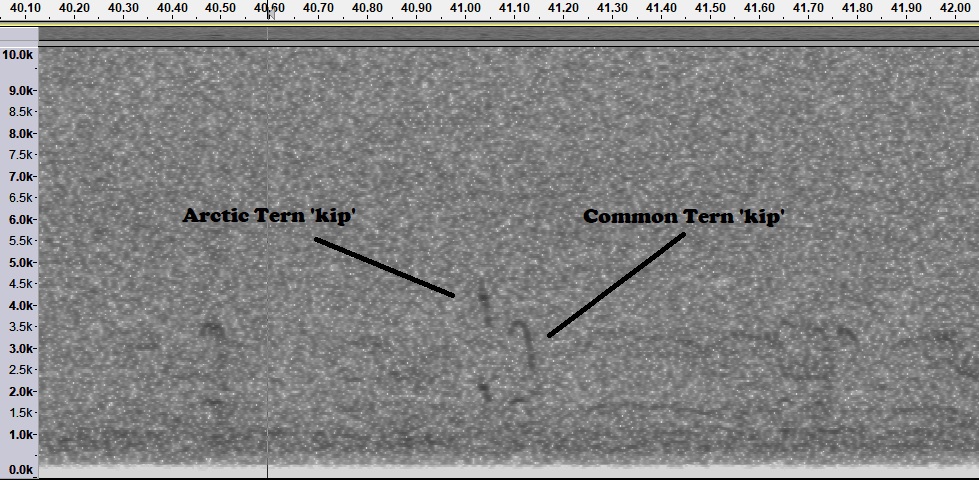
19 May - for several minutes from 00:48hrs calls from a group of Common Terns, apparently moving up and down over golf course, initially to E but receding W - weather at the time WSW1, 12C, a few spots of rain and more coming. Very unexpected, last records here in August 2006! PS - confidently ruling out Arctic not trivial, this is a useful article:
Birding while you sleep: noc-mig ID, part two Having now analysed
the very poor quality recording on my Huawei mobile I seem to have captured only 3 calls but clearly audible despite the background noise - the sonogram is entirely consistent with shape of Common Tern "kip" in the 3-4k range, and not the higher pitched Artic Tern (see
useful comparison sonogram in BirdGuides article) - so that's reassuring!
Tawny calling distantly 23:53hrs 18 May, very scarce this year compared to last.
18 May - rain in early hours but did not deter the Moorhen which was calling as usual as it passed over at 01:36hrs; feeling it is actually on a regular flight path as typically heard from same general area to the north-west, but clearly in motion. A couple of days ago there were a pair of Moorhens on the "Coot's pond" on the golf course, this is the most likely source for these territorial birds and lies about 750m from the house almost due west.
 17 May - Blackbird fledglings are out! One struggling through buddleia then plunging down to neighbour's lawn, some hop flights there, let's hope the local cats are indoors as they will have no chance. Another hazard - fledging sparrows twice bouncing off front room window, despite some stickers, we need to add some more to make it more visible. Plus the Magpie circulating all day, it's a tough old world.
First Swift back on 17 May, a typical date for recent years (18/5/19, 19/5/18, 16/5/16), though in earlier years they were normally early May (7/5/05, 2/5/06, 5/5/07, 6/5/09, 6/5/11, 4/5/13, 7/5/14) and on the coast I recall logging them much earlier, on 24/4/04 (Seton), 22/4/05 (Bents) and 26/4/08 (Yellow Craig).
More for the new Longniddry Bents patch page, but here's an updated #lockdownbirds analysis - 70 BirdTrack lists (58 complete) with 2,555 records, total 28,921 birds counted, of 105 species (+6 more nocturnals from garden) - includes trend and comparison graphs for Gadwall, seaduck, waders departure and warblers arrival - Excel file link.
16 May - #gardenbirdrace day - useful additions in morning were Grey Wag and Siskin but heading for a much lower total than the 40 on 29 April, may species now silent.
One of the most bizarre events I can recall here, and there have been a few (e.g. Robin on the TV in front room!) - back in kitchen after concluding nocturnals at 02:15hrs, and banging noise outside, looked down and saw at base of kitchen window a female House Sparrow fluttering and trying to get in, and right behind it the regular black cat with red collar, this at 02:41hrs! Opened door to chase cat off and heard it crashing through vegetation, then heard fluttering in the buddleia, presumably Mrs Sparrow made it there. Spugs do occasionally roost in that bush but not heard them recently. Nevertheless, most likely the cat has flushed the sparrow from a low roost in garden and it has flown to the light to escape - I doubt it recognises me as a friend, though there is a steady stream of them all day coming to water trays put out under buddleia, where many of them have a small bath.
15 May - following the scoter(s), Moorhen
recorded calling over 00:55hrs, part of a long series of "bap-bap-bap" calls, bird arriving from SW and receding NW, then another Dunlin at 01:21hrs, just a single call. Moorhen back at 01:50hrs, calling to NW, longer series of up to 9 "kip" calls strung together, 3 times. Quite noisy creatures really!
14 May - just before midnight, the surreal experience of hearing a series of mellow calls like a muffled bell, "ne-ne ne-ne ne-ne neh, ne-ne ne-ne ne-ne nuh", with subtle variations of pitch - I presume this is the nocturnal flight call of the Common Scoter! Pitch and tone a perfect match to calls on
Xeno-canto. Possibly moving N-ish. Weather - wind W1 steady, 7C, 2/8 cc, clear and some light from moon; so little breeze and no other sounds tonight (1 car and 2 planes in 3 hrs, and the dull rumble from the cruise ship and tanker engines out in the Forth, no trains!) so near perfect conditions for listening. NB - many Common Scoter seen in flight over sea to north in recent days, 60 yesterday, Velvets generally move around less offshore. This is
species 110 for garden but I suspect previously overlooked - a fellow birder in North Berwick picked them up on his recording on first ever night of nocmig monitoring on 25 April!
11 May - first juvenile House Sparrows being fed in garden, looked a couple of weeks old.
9 May - a Small White in garden:
8 May - insects again, Speckled Wood and Orange-tip, and garden teeming with
St Mark's flies, odd creatures which just seem to buzz around without doing anything, though
apparently they feed on nectar which may explain why they gathered round the rowan - nevertheless welcome prey for many birds!
Evening 7 May - Dunlin call distantly to W 01:02hrs, then 01:28hrs 7+ sets of "kek-kek-kek" calls from a Moorhen which initially approached from SW, went NE then receded NW, best evidence yet of some kind of territorial circuit.
Another Water Rail, 00:58hrs on 6 May, two sets of kip/trill calls, "kip-kip-kip grrrEEEEeeee" repeated (not "squeal" which I put in Tweet, in haste), bird heading NE (second call recorded); this is the 3rd Water Rail for #lockdown, never previously heard here but unmistakable. As far as I'm aware these are also the first "nocmig" records of this species in Lothian, can't find any in our database, and this species is not a common breeder here, largely I suspect due to lack of habitat (there are plenty in Borders) - typically there are breeding records from 1-5 sites (Duddingston now benefitting from camera traps) and only one of those has been in East Lothian - a dead juv recovered from a new site in Aug-19. Hence I think noteworthy - I tried posting to BirdGuides after their offer to feature garden firsts, nocmig etc, but it was deemed non-newsworthy; bizarre really as they will post Velvet Scoter, LTD etc in the Forth and it would be very odd to go to Gosford Bay and not see a Velvet, or several hundred, unless the weather was very bad.
5-6 May - pipistrelle sp. over for the bat survey. Then another Coot calling over, probably heading W, 22:51hrs (16th record, and 5th of #lockdown!), followed by a bout of Moorhen calls at 00:20hrs (~10th of #lockdown) and then a Grey Heron moving NE over 00:22hrs (1st for the year, and just 4th nocturnal record, following 15/7/19, 23/6 & 16/9/16). Then Water Rail 00:58hrs (see above) and first Common Sandpiper of the year too at 01:02hrs (~25th record)! Weather tonight - clear sky, full moon, nearly no wind, 4C - chilly for sitting in the garden but well worth it.
4 May - migrant Whimbrel calling over 00:32hrs. Local Blackbird struck up at 04:33hrs, Robins were much earlier.
3 May - wonderful song flight of Grey Wagtail circling over, went quiet when female Sparrowhawk appeared!
2 May - young Dunnocks being fed in garden, they appear without fail every year!
1 May - Mallard over again in morning and Mistle Thrush song, Grey Wagtail again in afternoon with brief song, and Moorhen nocturnal calls 22:23 and 22:59hrs, followed by regular circuit of hedgehog.
A day late for daylist, Song Thrush singing at dusk on 30 April - at least brought up 51 species for the week and 61 for the month, both are new records for spring and I expect will never be repeated. Regular call from Moorhen, 22:33hrs (8 records in last 3 weeks, surely a regular territorial flight). Sandwich Tern 23:34hrs, rare in spring.
29 April - pr Mallard and a Greylag Goose over at dawn, also Buzzard thermalling over Fernyness Wood, and in the evening the first Grey Wagtails of the year and then regular Moorhen calling over 23:10hrs brought up the daylist to 40 species - but first day with no Mipits or Chiff song!
 Bright again on 28 April, alarm/display call from f Sparrowhawk over was notable. Also first of the year Speckled Wood:
Great, first Barn Owl of 2020, call 22:51hrs 27 April. Updated #lockdownlisting with 100-up: 56 from garden, heard only (Pinkfooted Goose, Mallard, Sparrowhawk, Buzzard, Pheasant, Water Rail, Moorhen, Coot, Oystercatcher, Curlew, Redshank, Black-headed Gull, Common Gull, Herring Gull, Lesser Blackback, Great Blackback, Feral Pigeon, Woodpigeon, Collared Dove, Tawny Owl, Barn Owl, Skylark, Sand Martin, Swallow, House Martin, Meadow Pipit, Tree Pipit, Pied Wagtail, Wren, Dunnock, Robin, Blackbird, Song Thrush, Redwing, Mistle Thrush, Blackcap, Chiffchaff, Willow Warbler, Goldcrest, Long-tailed Tit, Coal Tit, Blue Tit, Great Tit, Nuthatch, Magpie, Jackdaw, Rook, Carrion Crow, Starling, House Sparrow, Tree Sparrow, Chaffinch, Greenfinch, Goldfinch, Siskin, Linnet, Crossbill, Bullfinch); 44 additional species recorded on "patch" in same period (Brent Goose, Red-necked Grebe, Whimbrel (2), Purple Sandpiper, Little Egret, Kestrel, Grasshopper Warbler, Whitethroat, Treecreeper, Teal, Great Crested Grebe, Sanderling, Snipe, Guillemot, Sedge Warbler, Goosander, Rock Pipit, Stock Dove, Mediterranean Gull (4), Fulmar, Greylag Goose, Shag, Grey Partridge, Shelduck, Dunlin, Reed Bunting, Slavonian Grebe, Grey Plover, Knot, Razorbill, Red-throated Diver, Common Scoter, Turnstone, Gannet, Cormorant, Grey Heron, Mute Swan, Long-tailed Duck, Wigeon, Bar-tailed Godwit, Gadwall, Velvet Scoter, Eider, Red-breasted Merganser). Altogether 1684 records from 50 lists (39 complete lists, others for Gosford Sands) totalling 93 species, plus Pinkfoot, Water Rail, Coot, Tawny Owl, Barn Owl, Tree Pipit and Crossbill only from garden. Just Swift expected now, and hopefully some more waders!
Something new - Orange-tip in garden (previous records Apr-17 and May-06!). Starling "FF" so the young have hatched.
27 April - a joy to hear the song of Mistle Thrush dominating the dawn chorus, last heard here in spring Feb-14, though more regular in springs 2009-11, also song in Dec-17 and Dec-06.
Sunday 26 April started well with pr Mallard (picked up on call, quacks!) and Nuthatch and Goldcrest song. The latter is interesting, 5 weeks of daily BirdTrack circuits and song only from Fernyness Wood conifers, then yesterday song in 3 different places - have they just arrived from somewhere?
Skylark song 25 April, seems really to have set up territory, plus Mistle Thrush and Goldcrest song which makes 55 species for the garden lockdown
The Skylark sang again in morning of 24 April (maybe it has just arrived and established a territory), while in evening the hedgehog was in the garden and a/the Moorhen was calling at 23:27hrs.
Yet another bright sunny day with a light north-easterly on 23 April - despite this and long hours outside, visible or audible migrants really thin on the ground - only exception was 24 Swallows briefly at Longniddry shore yesterday evening, circled and fed before continuing; local Swallows in song over garden daily, and finally another House Martin back. Most cheerful this morning was song of Skylark from high over the golf course, bird eventually flew low S, presumably back to its home in farmland south of village. I'm pretty sure Skylark does not breed on the golf course, no hint of another in a month of visits, so maybe just a morning out?! NB - not uncommonly recorded as migrant here, but singing birds now sparse, wks of: 21/5/17, 4/4/10, 28/6/09, 16/4/06, 1/5/05.
Nuthatch calling from gardens in Gosford Road, 22 April, third record (after one distantly on 20 July 2016 and another in Jan 2018); recently have heard two calling in turn in Fernyness Wood, adjacent territories? Juv seen there on 23 July 2018.
Finally, after a couple of probables (i.e. bird not seen) a Tree Pipit low N over garden calling 07:33hrs 20 April, species 109.
Great, another Moorhen calling, or perhaps more likely the nightly excursion of the same Moorhen, 00:15hrs 20 April. Earlier in the day had located one on the tiny pool at top of golf course, this is 710m from our house (nearly due west), but I have not found any literature indicating any size for a flight territory, if such exists (BWP does not mention it, but says "Pair studied by Howard 1940 occupied area of c. 122 m2, but territory size highly variable" and "In winter, defend a reduced part ('core area') of former breeding territory, often feeding beyond boundary. In study population, Avon valley (Hampshire), occupying streams running through agricultural grassland, c. 50% of pairs held winter territories of c. 40 m (33–47) of waterway plus adjacent land up to 1 m from banks". So, not large! Moreover, checking records, had recorded same on 1 April and 21, 22 and 23 April last year, so perhaps actually a long-term resident breeder? Have also heard and seen previous in the c/p 2 bog and burn across golf course which is much closer, only 400m from house. Postscript, one seen at c/p 1 burn 27/4, which is 1.5km due W.
18 April, Swallow really back now, singing in the sun, also a ragged Buzzard thermalling high over in morning; that's 51 garden birds for the #birdinglockdown, 10 nocturnal only, slim pickings compared to many who have been adding Eagles, Cranes, etc to their garden lists, even just over the hill in Haddington; still, I feel I have a much better knowledge of local status of many species even in 4 weeks - locations of each Chiff, Lotti, Bullfinch, Pheasant etc on local patch, daily variation in wader numbers (peak 172 Barwits), frequency of nocturnals (and lack thereof), much more still to learn! Photo of garden "patch" occupied ~10hrs per day (completed reading 3 PhDs, one to go):

Many more hours in the garden with very little evidence of vismig, Mipits passing as singles every now and again during the day, normally less than 1 per hour! About 75% direct low over garden SW, 25% high due N or NE. Nocmig normally has an even poorer strike rate, Tawny has been scarce this year compared to last so nice to hear one from golf course early on 17 April. The only genuine change of status has been hearing regular calls from Pheasant, with pr at Bents bog wood they are probably breeding within 400m of house. Some close encounters too, Wren within touching distance in red currant and working our flower pots, lovely to see it so close, completely unaware of me!
Blackcap in song in the garden was a rare treat, morning 16 April. Blackbird spent all morning building, I was pleased to see her take some of the stuff I'd left out for her; nest just behind bird table in Leylandii hedge, maybe I can carefully monitor for BTO.
Evening 15 April - like buses, another Water Rail, but treated to the "squeal" call this time - 21:54hrs; perhaps I've been missing them in the past, it is often too cold and windy to sit outside in early April, this year have got used to wrapping up warm. More Moorhens latter, 2 of them calling to each other, one circling over house. Been out every day for 4 weeks and not had a sniff of one, then at night they seem to be all over the place! A hat trick with Coot giving single calls at 23:27hrs, the nocmig website mentions these repetitive flights might be territorial behaviour.
Morning 14 April - Tree Pipit heard, also 3 more Crossbill SW over.
Food caddy raided overnight, broccoli stalks ejected, one main suspect - hedgehog!
Change in the wind late on Easter Sunday produced an unusual dusk movement of many hundreds of Herring Gulls moving NE towards colonies/coastal roosts - and with them 8 ad GBB, 3 flying as pairs and two singles, an impressive bird in flight.
2 more Swallows low NE over same day, 12 April.
Robins courtship feeding in garden on Easter Sunday, a very secretive breeder (not found a nest!) but per BWP "♀ starts giving Contact-calls regularly (up to 20 times per min) within 3 days of completing nest (East 1981b) or before lining it (88% of 66 nests: D G C Harper)...Within a few days (exceptionally 15: D G C Harper), ♂ starts to collect food for ♀, while giving infrequent Contact-calls".
Evening of 11 April, Coot and Moorhen heard again flying over; thus ends the best ever spring week for observations from garden, 48 species recorded (though somehow missed Buzzard!) including one tick with Water Rail - an obvious consequence of the noticeably quieter environment and more time spent while working from home.
A new challenge - pr Grey Partridge in flight over golf course just 300m from home! At nearest the course is 250m NNW (map - birds near clumps of trees in centre of course, house is 4th row in) so dusk song should be easily audible - problem at present is the BHGs (on sea) are quite raucous, but most of them will be off soon. Here they are by the bunker on the 14th:

NB - Grey Partridge has declined drastically in South-east Scotland recently with the atlas documenting a numerical drop of up to 80% with accompanying 61% range reduction between atlases (20 yrs); but locally a few cling on; there was one at the c/p 2 bog in Feb 2015 but before that last records on this side of Longniddry (golf course/Bents) were back in 1993, when one resident reported 9 of them in his back garden! [PS - present again by clubhouse on 20 April, and original location 22 April, no song heard which seems odd - I frequently hear song in farmland areas where they are resident, particularly at dusk].
Small Tort rescued from garage - just woken from hibernation? After a minute in the sun flew off before I could give it sugar water.
Water Rail! Had heard a series of distant calls far to north at 23:13hrs, reminiscent of a cross between a House Martin and a Dunlin; delighted when it came back 23:51hrs, three clear Water Rail "trill calls" (like this) heading W - managed to record one. Species 108 for the garden! Also Moorhen calling again, these must be local birds flying around the area. [Logged results to date on trektellen - 30 hrs "observation" now in April, this time is actually spent well wrapped up in garden reading a PhD (4 to examine!)].
First Swallow back 9 April.
Moorhen - several calls, 23:37hrs, 19th record (still well ahead of Coot), of which 9 Apr, 5 May, 2 Jun, 2 Jul, 1 Sep.
Crossbill migrating W over morning 8 April.

Wonderful, Willow Warbler in our flourishing rowan tree for one bout of song early on 8 April, then gone, the essence of spring!
2 House Martins back feeding over late morning 7 April, earliest ever here (after 8 on 9/4/17); also Willow Warbler in the Bents on 6 April, earliest ever here (after one on 10/4/11). [Earliest ever Swallow was 3/4/11, not breaking that record!]
Hard to get excited about it, but nocturnal flight call of Mallard at 00:00hrs on 7 April was a garden year tick! This is second nocturnal record of Mallard after one on same date in 2012.
Several Mipits on 5 April late morning them from 17:00hrs, including group 24. Another Redwing call 22:10hrs, then 03:00hrs.
01:19hrs 5 April - Redwing call, wind again reduced from W4 earlier.
4 April, 2 queen Buff-tailed Bumblebees on red currant flowers.
01:53hrs 3 April - Redwing call; very clear night, wind much reduced from W4 in afternoon
Coot moving NE over 22:46hrs 1 April, 13th record (9 in spring, 4 Jul-Aug). And another 01:05hrs 3 April! Had enough Coots now, would like to swap one for a Water Rail thanks!!!
First queen Tree Bumblebee 29 March.
Blackbirds in song from 04:07hrs, 27 March, that's 1 hr 47 mins before sunrise.
First Chiffchaff song nearby on 22 March.
A chance spot - stuck at home due to COVID, Starlings were up so I looked out and spotted a Sprawk circling, went upstairs for a better look and was surprised to see a Peregrine circling over to the west, toward the golf clubhouse, legs hanging down with a small object, presumably a small bird.
Queen White-tailed Bumble-bee on 8 March (another on 21 March).
Song Thrush doing its thing early March, a bit later than usual but nice to hear it.
 Linnets back in birch on 13 February, commonly heard in flight over and once on road outside front but this is an unprecedented number in the village itself.
590+ Herring Gulls through 07:45-08:30hrs 4 February, led by a large pack of 2-300 birds, en route into Edinburgh area, would have departed roost islands off North Berwick about half an hour before sunrise.
Flighty bunch of 60 finch sp. in birch, majority Linnet, with a few Greenfinch mixed in, 3 February.
Morning gull commute on 28 January, hundreds Herring gracefully gliding through into the wind 07:45-08:30hrs, 50+ BHG high SW over and best came last with 4 lumbering GBB quite high following the Herrings, lazy lunges at each other as they went, 3 ads + 1 imm.
Butterfly flew over garden on 22 January, Small Tort by size and appearance, most have been woken by sun!
A frustrating one - apparent Reed Bunt call from bird in flight at dusk 21 January, with Fieldfares going over S to roost at same time, but could not see it.
A bit OT for a blog on 'garden birds' - but amazed to find this Small Tortoiseshell flying round my head in our front room on 18 January - where had that been hiding?! Released it in garage, was soon back to sleep...
Greenfinch in song 18 January, normally not heard till around mid-February in recent years.
Social gathering of 23 Magpies on 10 January matches previous peak count from 27 January 2005.
Cheery Coal Tit in song on New Year's Day.
2019
[Overview of the year 2019
77 confirmed species is one of the best, and restrospectively includes a single addition to the list (now 107, only 14 additions in last 9 years), this being an apparent Marsh Harrier (photos & video) on 1 September. But a probable Tree Pipit on 26 August eluded me! Scarcer species included Waxwing and Peregrine in Jan, nocturnal Coot in Feb (12th record), male Pheasant calling Mar-Apr (4-5th records), Moorhens consecutive nights in Apr (c. 15 records), another nocturnal migrant Quail in May (4th record, and earliest, 22/5), another Moorhen in Jun, Dunlin in Jul (13th record), Kestrels in Jul (first record of pr together), Ringed Plover in Aug (11th record) plus Common Sand (now ~24 records), Med Gull in Aug (2nd record, first to be filmed!), 20 Canada Geese in Aug (4th record), large numbers of Barnacle Geese in Sep (including 380 over on 28/9), Jay in Oct (4th record), Crossbill in Nov (poor year for them) and Tree Sparrows in Dec. Tawny Owl(s) took up residence within the village, in the spring, for the first time. Greenfinch still resident in breeding season, but a poor year for Grey Wagtails. Latest record of Swift with 3 still on 9 September. Status of Blackcap is changing, with a returning wintering bird in Jan-Feb (though it may have perished/moved on), but m+f in autumn were only 2nd November record here. There was also an invasion of Painted Lady butterflies which reached our garden on 9 June.]
Large group of Pinks NE over late evening 30 December, more at 16:55hrs on New Year's Eve.
3 Tree Sparrows in garden amongst House Sparrow at feeder (grain from Townhead) - a fairly regular fly over but this first in the garden since 14/9/15 (also 31/10 and 3/12/10 when first recorded).
Woodpigeons hiding in the bushes and mating near former nest, 29 November, could we see first ever December nest here (previous juvs in nest Nov and Feb)?
Even better, now pr of Blackcap, in rowan on 19 November, taking the last berries on ends of branches that thrushes and starlings failed to reach. Robin not happy!
Magic, another male Blackcap, in rowan on 10 November (2nd November record, logged every month of the year here).
A poor year for Common Crossbill compared to autumn 2018, 1 on 4 November was first since 4 November 2018!
Geese continue into November, hundreds SW most mornings and going back at night ~2 hrs after sunset. 12,342 Pinks at Aberlady on 28 October was latest autumn peak for 20+ yrs.
Jay low S over 08:45hrs 29 October, 4th record, likely unconnected to current irruption on the Continent but interesting that last here were in 2014, which was the big year for autumn movement.
Red fox behind surgery on 24 October, first record since June 2009, but many must pass unseen.
Barnacles still over in numbers on Saturday 28 September, including a flock of 380 E (from photo) at 14:50hrs.
Yet more Barnacles over early on Friday 27 September.
A small "fall" in our tiny garden on Tuesday 24 September - 2 Chiffchaffs with 9+ Long-tailed Tits, a male and a f/imm Blackcap (the latter bird seen again twice in following days eating Rowan and Elderflower berries). Several House Martins still around.
Great, first flock of nocturnal Barnacle Geese for a while, calls from a decent number over SW in rain at 23:05hrs 23 September, with 90 over SW c.09:00hrs the following morning.
A remarkable 6 Cormorants flying inland on 20 September, previously nearly annual (2004-2013 except 2008), but only 2 in last 5 years, all previous records have been singles apart from 2 in Dec-2004.
Pleasing to have a Bullfinch in the garden feeding on rosehips the same morning (one previous record of pair in garden).
3 Swift still on 9 September!
Pinks moving W over 01:50hrs 4 September, earliest autumn record here.
Noted a huge cloud of c. 1000 Sandwich Tern over coast by Aberlady at dusk on 3 September, then at 00:58hrs 3+ calling as moving S over our house.
Swift still, 2 September (getting close to latest, which was last year 3-5 September).
A presumed f/imm Marsh Harrier - a large apparently dark raptor distantly approaching from NE down Wemyss Road, two streets south of us, Buzzards are a routine occurrence around the village but something grabbed me about this bird so I got out phone and grabbed a distant still at 11:55:50 hrs, then some video from 11:56:16 hrs, bird then encountered mobbing from two Herring Gulls high over and veered NW, grabbed 4 stills, the first below taken at 11:56:53 hrs - bird on left is a Herring Gull which can also be seen in distance rising at bottom of second below which was previous image at 11:56:51 hrs (top right image in Tweet was first view over tree 11:56:48 hrs). Admittedly the first image below looks "different" but it is 100% certainly the same bird, confirmed as taken 2 seconds after previous image, view is direct into sun but I think difference in profile is because flight is now inclined, perhaps in response to mobbing? Overall views and analysis suggest compared to Buzzard the glide with V "arm" and flat "hand", the longer tail (marginally longer than base of wing), the narrower wing and narrowing hand are all indicative of Marsh Harrier; later more careful analysis of processed video was sufficient to confirm the initial ID, also showing clearly the narrowing hand and less squat appearance in flight (processed video linked, compare Marsh Harrier flight action).

 Species 107
Several more parties of Sandwich Tern over in early hours on 28 August, some close and some to north nearer coast, all accompanied by Tawny hooting from Fernyness Wood.
Sandwich Terns again 01:15-01:30hrs 26 August, calm and warm.
One that got away - an unusual call of a bird flying over 16:05hrs 26 August, very like this: Tree Pipit. I wonder if any move later in the day?
Sandwich Terns over late evening 25 August, very close to house.
Med Gull hawking for flying ants amongst BHGs directly over garden on 25 August, sufficient views to check legs and confirm unringed, just second record, short video clip in Tweet. Also 2 Swift over and in evening long duets of Tawny Owl, more Sandwich Tern and a Lapwing call, not frequently heard at night.
Nocturnal Sandwich Terns over 24 August, a few heard so far but down on last year.
Bizarre occurrence 23:44hrs on 17 August - two clear Ringed Plover calls over to N apparently prompted a response from Tawny Owl, with kewicks from direction of golf clubhouse NW! This is 11th record of Ringo, of which 8 have been in August, but first since 24/8/16.
Swift still on 17 August.
c. 20 Canada Geese low SW over evening 11 August, only 4th confirmed record, or which only 3 flocks seen.
First nocturnal Sandwich Terns on 6 August.
Common Sand 00:25hrs 26 July; early a good candidate for Turnstone call a low soft "churee-chuh churee-chuh chuh chuh" (no recording; probably the teu call is easier for this species).
Dunlin calling 03:30hrs 22 July. Golden Plovers twice in last few days.
Grey Heron calls over 01:00hrs 15 July, third nocturnal record (after 23/6 & 16/9/16).
Great sight of a pair of Kestrels circling over on 7 July, first record of more than a single, this is less than annual over garden; male has been hunting golf course recently, perhaps they are failed breeders?
Another Moorhen calling 4 times flying S over village 02:35hrs on 22 June, already bright towards the east so would have been visible if I could have got onto it!
Never really gets fully dark at mid-summer and dawn chorus starts very early - logged Blackbird at 03:01hrs on 17 June, joining Robins already in song (cf. 02:59hrs for Blackbird on 18 June 2017).
More bumblebees on 16 June, now in excess of 100 though Tree greatly diminished, just c. 5 left, along with 3 Early, 3 Garden, a queen Buff-tailed and this single worker Red-tailed (plus 2 honey bee, 1 wasp, 1 hoverfly).
Garden teeming with life on 9 June - 2 Painted Lady (seen nearby in 2006 but tick for the garden) with 3 Red Admiral and a small white and probably over 100 bumble bees, white-tailed in majority but also many Tree and 3 Early (
Bombus pratorum). In addition families of Blackbird, Dunnock and Blue Tit, and a large crop of Great Tits on Saturday.
Nocturnal migrant Quail calling over near house 00:50hrs 22 May, first two calls near house, by time I had got recorder switched on next two calls were from far to NE; very calm evening, earlier rain had ceased and sky fairly clear; 4th record from house and earliest (previous 1 June 2007, 12 July 2012, 9 June 2017).
Roaming male Tawny noisy on evening 20 May.
More terns on 19 May, sounds of large group over late evening - earlier there were 77 on Gosford Sands about a mile north of our house.
Very late return of Swift on 18 May, very high over so not even sure they are "ours" (they have been present every year since 2004, seen going to neighbour's eaves in 2011-14 but never *proved* to breed).
2+ Sandwich Terns calling high over village 21:40hrs 13 May.
Female Mallard low in through houses towards the Braid Burn evening 2 May. Kids reported pr Mallard loitering on path when they went to school, not seen that yet in our village!
Tawny hooting again in village near house, to NW, on 1 May.
pr Tawny in noisy hoot and kewick calls, to NE, 28 April.
Moorhen calls over late evening two consecutive nights 22 and 23 April.
pr Tawny again on 21 April.
Cock Pheasant calls 24 March and 7 April, not very exciting but only 4-5th records here.
Tawny hooting continuing on 22 March, Gosford Road area.
pr Mallard low over 22 March, a regular sight in spring, duck seen a week later in burn by community centre.
Tawny hoot and "bubbling-call" (call 2 in BWP, apparently common but audible only over 30-40m, hence perhaps why I've very rarely heard - described there as a mate "summons" and given by either sex) very close to house on 21 March, beginning to wonder if nesting in village.
Tree Bumblebee daily in early March, on redcurrant flowers.
Small Tortoiseshell found below freezer in garage around 3 March, flapped so placed securely high up to continue hibernation - but later gone - flown off or moved?
Tawny vocal again 01:15hrs 27 February.
Collared Dove visiting probable nest site still 26 February.
Calls from another nocturnal migrant Coot low W 01:18hrs 26 February, 12th record and by far the earliest spring record.
25 February - first bumblebee, queen Tree (also rescued one from pavement at work last week); also nice to hear the Greenfinch in song again - regular spring song (=local breeder) here most years since 2005 (only missing in 2008-10, 2013-14).
Tawny hooting and roaming through village 24 February.
Tawny calling continuously for over an hour 18 February.
Bizarre - 01:40hrs on 13 February, daughter screams having seen a large spider by her bed, while looking for it I hear a Magpie calling outside, followed immediately by Tawny Owl kewicks - one seems to be lingering in Community Centre/burn trees!
Starling and Blue Tit alarms late afternoon Sunday 3 February, expected Sprawk failed to materialise but about a minute later a wonderful lanky Peregrine appeared only about 50m over veering NW, probably a female on size (10th record, previous in 04/05/06/07/08/2x09/13/18).
Blackcap still daily into Feb, often in control of bird table; seems to confirm it definitely first arrived around 19 Jan, no way would have missed it earlier.
c. 50 redpolls low over on Sunday 27 January, record count - unfortunately did not perch for further scrutiny.
Blackcap the first on the BGBW - initially seeing off sparrows coming to bird table but eventually sitting with 8 of them eating bread crumbs, ignoring fat ball!
Blackcap still on bird table in sub-zero conditions 23 January, fighting for scraps with House Sparrows, Robin and Starlings.
Blackcap again on 20 January, on same apple.
She's back, female Blackcap present 27/1-7/4/18 seen eating rotting apple on ground in garden on 19 January! Presumably same bird as hopping around on a similar circuit.
Daughter reports male Pheasant at Community Centre on 16 January, I've only seen one previously in the village, same location on 19/12/14, but heard distant birds twice.
Waxwing heard again 11:00hrs 2 January. On 6 January Collared Dove flying to and from conifer where nested in March 2018, likely either nest building or sitting - song continues for long periods.
 Signs of spring on New Year's Day with Collared Dove (above) and the three tit species in song. Woodpigeon (below) is the most regular species in the garden, up to 4 at once on the tiny bird table.

2018
[Overview of the year 2018
72 confirmed species is similar to recent, with two further additions to the list (now 106), Snipe in early March "beast from the east" snow and a very distant singing Sedge Warbler in early May; unfortunately it was a year where potentially the three best birds went unconfirmed – calls matching Wood Sandpiper on 15/7, a falcon sp. chasing hirundines on 3/9 (and again over Fernyness Wood on 4/9) which was surely a Hobby (and actually 3rd seen from garden, but none confirmed), and 2 chunky pipits giving a non-Mipit “ppzzz” call on 4/11 which seem likely to have been Water Pipits. Confirmed scarce this year included Peregrine on 3/3; more nocturnal gallinules and waders - 4 Moorhens 21/4, 5/5, 14/5, 27/7 (now at least 12 recorded), 1 Coot 9/5 (total 11), Whimbrel 5/5, 3 Common Sandpipers (1 in May, 2 Aug), 1 Green Sandpiper recorded low over house on 3/8 (second record), Dunlins on 9/8 & 4/9; then 15 Barnacle Geese on 22/9 and Waxwings 28/10, 9&18/12; nocturnal Sandwich Terns were prominent from 9/8 to 23/9, often daily; a wintering female Blackcap from 27 January was last seen on 7 April. On downside another year passed with still no record of Reed Bunting or Hawfinch.]
Pinks heard after dark on Boxing Day.
Two Waxwing flying down to pink flowers tree at #20 on 9 December (roughly 17th record here in 14 years, peak 18 birds); again on 18 December.
c. 630 Golden Plover high NE in loose flock early afternoon on 25 November, later a similar number were seen on the mud at Aberlady. Second highest count, after 800 on 31/10/10.
Dusk on 4 November - 2 pipit sp. low S over at dusk 16:30hrs, single "ppzzz" call, not typical of Meadow, they also looked too big for Meadow - Rock is a candidate, have once seen one flying inland from Seton Burn. No recording and immediately out of sight, another which got away! Also an interesting flock of c. 50 finch sp W over at dusk, most likely a pre-roost flock of Greenfinch. Earlier, 7 Crossbill SW over.
Waxwing SW over 08:50hrs on 28 October, same or another back again mid-afternoon, just overhead. Also 2 Buzzard over, one very high, and a hedgehog feeding under bird table, climbed into a plant pot and carried on munching, no-one will see me here:

Very little time to look recently but in passing 9 Crossbills over SW on 18 October; last three hirundines (distant, probably Swallows) on 14 October.
Bunch of Sandwich Terns heading S over 21:30hrs 23 September, several ads and at least one juv, still lots on the coast. Goose flocks heard every few minutes most of the evening, Pinks going SW/NE, 3 flocks high N, also 40 Greylag NE, perhaps to roost.
Geese in all directions 22 September - Greylags 32+24+36 W/60 E, yapping Barnacles 15 NE directly over house, many Pinks calling.
Sandwich Tern(s) calling 23:20hrs 5 September. ad+juv 01:20hrs.
Swift feeding over on evening 5 September, decent numbers of hirundine still - 20+ each of Swallow and House Martin.
Redshank over 23:42hrs 4 September, what a lovely call they have. Sandwich Terns, ad+ juv, 23:45hrs.
Several clear calls from a Dunlin heading SW over 00:25hrs 4 September.
Group of Sandwich Terns, ads + juv, SW over 23:15hrs 3 September, approached from NE and followed a steady course over next 2-3 minutes until barely audible to SW, probably over centre of the village. Whether these birds continue inland or return to follow Forth coast I have no way of knowing, likely a mixture of the two.
Falcon sp. on rapid flat beats distantly to N over golf course spreading alarm through the hirundines (mainly Swallows, some high House Martin) feeding over, c. 15:30hrs 3 September - did a circuit but no further sign - quite a gathering of Swallows over Fernyness Wood, rain just easing off. Seen again distantly 19:05hrs, in a long flight SW just over tree tops of Ferny Ness wood where many hirundines feeding (over 200 hirundines altogether over the woods along the coast, mainly Swallows, also Swift, with perhaps same Swift low SW over house c. 19:45hrs). [Incidental, as cannot be submitted due to lack of plumage details, but this would have been my 3rd Hobby from garden in 14+ years, and 5th in Lothian, however species not yet on my Scottish list - as one was dead, one rejected by LBRC (was very confident of that one, plunging to garden opposite on Douglas Road on 4/8/10, but naked eye view only, so understandable) and two others not submitted, including one on 13/9/08 "Upstairs at home, heard alarm calls (Jackdaw, Starling); looked out, shortly afterwards bird appeared from E, following a trajectory about 50m SE of house. Approached with the rapid flapping of a Sprawk, and nearly dismissed as that species which is very common over the garden; however, as came into profile, saw narrow pointed wings and realised not a Sprawk, but was also clearly not a Kestrel, due to very distinct rapid flight action and tail not long enough; suspected must be a male Peregrine but did not seem right so grabbed binoculars and ran through upper floor of house ready for its reappearance at the rear; got good profile view of bird, then increasingly a direct rear view as it was moving away, continuing on a fairly straight path; all dark upperparts, and dark moustashial stripe seen on cheek; underparts indistinct as on a level with bird; winnowing flight action; on glide, could see distinct secondary "bulge"; watched for longest from behind as continued on its journey; wings flexible in flight action, bending up and down with each beat, upstroke taking tips well above horizontal (unlike Peregrine); each set of flapping 8-13 rapid beats." - did not submit this due to lack of plumage details but pretty sure it was also one!]
Sandwich Terns calling in early hours of 1 September, then twice in evening, 21:50hrs, ad+juv over 22:50hrs.
Sandwich Terns again 02:00hrs 21 August, group of 3 (2+ ads, juv) over SW (recorded - image below is the spectrogram generated in Audacity, I'm still a novice with this software)
Lone Sandwich Tern calling over in light rain 00:35hrs 20 August; sometime the shrill call of the older juveniles can be difficult to separate from Dunlin.
A bunch of 12 odd looking geese NE over 18:44hrs 19 August heading for Gosford Estate (where recent Snow Goose), most looked smaller than usual Greylags but a couple of rather larger birds, may well have been Canadas.
Willow Warbler hooet-ing in back gardens 19 August, part of a national-scale movement.
Yet another Common Sand calling 23:15hrs 16 August. Earlier 5 Arctic Terns were towering at Port Seton, rising very high over the shore as if checking the route ahead, a potential garden addition but tough ID on call alone.
Sandwich Terns again inland on 15 August.
Tawny hoots 01:33hrs 13 August. Golden Plover heard 3 times to 02:35hrs.
Sandwich Terns again in early hours of 11 August, also Redshanks twice - though this is one of the five "common" waders which regularly goes inland to feed here (with Oyc, Golden Plover, Curlew and Lapwing).
Sandwich Terns - usual combo of ad + juv, calling over house moving inland 01:05hrs 10 August; also Tawny Owl, scarce recently and no young found in Fernyness Wood this year.
Roost flight of 9 Greylags W c. 22:00hrs 9 August.
Dunlin calling over loud and clear 01:35hrs 9 August (12th record, annual now since 2015). Sandwich Terns audible from coast, but not moving inland.
Another Common Sand calling persistently 00:44hrs 7 August, same following day at 22:30hrs, that's also a hat-trick of sandpipers in a month! First Sandwich Terns over.
Green Sand over 01:28hrs on 3 August - heard a peep-peep-peep call to NE and turned on recorder, about 20s later it called again, a loud clear call "tlooit-vit-vit" now to SW of house, audio is in tweet. [A previous record of this species on 19/9/15 retrospectively accepted as species 100, and prior to that one on 27/5/14 was deemed unconfirmed, many more must pass undetected].
A great cloud of birds over on evening of 2 August, 500+ gulls coming N to coast and 150+ Swifts with other hirundines feeding over Fernyness Wood (cf. 420+ there on 23/7/17)
Moorhen low over house calling several times c. 01:40hrs 27 July.
Clear Sandpiper call 01:44hrs 15 July, k-SEE-soo...kw-see-see-see-soo - not high pitched like Common, nor any hint of disyllabic k-yuk in Green, so I think it was a Wood Sand, no recording though so one that got away.
Bumble bee total falling last week of June as buddleia flowers dried up, totals much lower than last year but Tree now ~40% of total.
Another Crossbill calling over Saturday 16 June, just before heavy downpour.
Hedgehog in garden early June. Bumblebees ramping up on buddleia globosa, Trees already in double figures, become the dominant species!
Kestrel hovering over golf course to N, Sunday 10 June.
Sedge Warbler in song, barely audible, just the piercing high notes, c. 440m WNW at Longniddry c/p 2 bog early hours of 14 May (species 106); Moorhen call 00:30hrs, near but could not see; single high pitched 'peeee' from Common Sandpiper 01:30hrs.
Yet another Coot, probably E, 22:50hrs 9 May, in rain, actually 11th record.
Yet another Moorhen, E, 02:50hrs 5 May, Whimbrel calling 04:03hrs.
2 prs Buzzard very high over in sun on 28 April, some display, mewing calls only faintly audible.
Willow Warbler, Chiff and Blackcap singing 24 April.
Old hat these days with nocmiggers reporting huge flows of nocturnal migrants, but a Moorhen low over our house at c. 21:40hrs on 21 April was recorded the old fashioned way.
Blackcap apparently absent 2-6 April but showed again on 7 April!
Fatball vacated and no sign of wintering Blackcap on 31 March, but back again on 1 April in its usual spot, dodging the Robin:
Amazing to think it could soon be out over the sea - after months lurking in a hedge.
Blackcap still 28, 29 and 30 March, lurking in same gap in hedge where present since 27 January.
First bumble-bee of spring 25 March.
Blackcap right at kitchen window 21 March, wonder when it will be off?
Another batch of snow 17-19 March - ad f Blackcap still present on bird table; also during 18 March first 2 LBB NE over, and flock 20 Greenfinch.
Weather beginning to ease 3 March but still lots of snow - Blackcap regular all day and mid-morning a Peregrine passing over to the SW, at c. 30m altitude, a loop with a bit of flapping, such an awesome bird to witness. Joanne also saw it from her room, her second for the garden after one he spotted herself 13 years ago when aged one (confirmed by dad)! As per many others, thrushes suffering - had a Song Thrush literally at the front door eating a snail it had recovered from leaf litter against wall of house, gave it a good bashing first.
Snipe - great view, had bins ready, flying low NE along line of Forthview Road during severe snowy weather on 1 March, species 105 for the list. Blackcap still present on bird table, though subordinate to the Robin. Also Fieldfare in garden. Later while standing in kitchen amazed to see a snipe sp. approaching from SW, flew low over garden hedge before veering S, as if looking to land; naked eye view so if had not seen it earlier may have thought it more likely a Jack Snipe by behaviour (seen on occasion 400m NNE where tiny Braid burn which runs c. 50m W of our house enters the sea).

f/imm Blackcap took up residence late Jan, eating bread on bird table and going to feeders in neighbour's garden, poor cropped shot right; this species fairly commonly reported from Edinburgh gardens these days, but this is only our second here after mid-October, 3 on 25 November 2016 was first "winter" record. Also recorded on 1 February by Christina Welch as "an unusual bird" (forgot to tell me till the following day when I saw it again), will be her first bird record in the Lothian database!
Pinks again moving at night on 2 February.
Pinks moving late evening 6 January - spring migration is underway! Tawny hooting from Longniddry Community Centre trees 01:05hrs, first there since 20/2/13 and 28/11/07 (also passing our house itself on 27/7/08 (family) and 3/9/14).
2017
Overview of the year 2017 75 species recorded is second only to 77 in 2010, with a single addition to the list, being Red-throated Diver (total now 104), also notable second records of Little Egret and Nuthatch, and third of Quail. 1294 weekly peak counts were logged totalling c. 15k individuals with an average weekly list of 24 species. A new weekly list record of 45 species seen in/from the garden in week of 5th November. Also, a new high of 27 species were recorded *in* the garden during the course of the year, out of 41 in total for all years*, quite a surprising total given the tiny extent of the plot, the back lawn is about 5x5m, but for example hosted 40+ Starlings one day in May, and Rooks in late April - and Herring Gull has regularly plundered that bird table; Barn Owl may be hard to believe, but I could have caught it flying low over our garage a few years ago.
Some highlights of 2017: the year started well with a few Waxwings and a Nuthatch calling nearby. A Small Tortoiseshell butterfly overwintered in garage and came out on 9 April. Further records of nocturnal migrant Moorhen and Coot in spring, also Sandwich Tern in late May. The calling Quail was heard at 02:19hrs on 9 June, but aside from often daily Sandwich Terns, nocturnals were fairly poor in late summer, one more Coot on 8 July and Dunlins on 24 July and 10 August. Down in the garden, bumblebees peaked at 85 mid-June including a new record of 13 Tree Bumblebees. An interesting sounding Crossbill flew over on 8 October. Geese were prominent in autumn with over 10k Pinkfeet logged and several flocks of Barnacles and Whoopers, but it seems like I made a bad error in ID of the first flock of swans on 29 October as possible Bewick's - was not aware then of a Fife record two days previously but it now seems impossible that mine could have been, must have been deceived by the distance! No doubts on the Little Egret flying down Douglas Road the same morning, and vismig efforts during the same spell also revealed a strong Siskin passage (up to 70/hr), and just the second migrant Brambling, but not the hoped for Hawfinch.
Quick analysis of two species pairs, shows Grey Wagtail increase (often daily in autumn/winter, may even roost near Braid Burn bridge), and Greenfinch bearing up after trichomonosis, though clearly it is suffering at a national level. Clearly these graphs can be significantly impacted by even a single resident breeder, at it seems this year we had Greenfinch and Goldfinch breeding somewhere nearby, while Grey Wag was absent from early March to mid-July, so clearly bred elsewhere, but often heard daily after that. Nearly all Pied Wags are recorded in roost movements, concentrated in autumn.


* All species seen in garden (or low airspace): Sparrowhawk, Black-headed Gull, Herring Gull, Woodpigeon, Collared Dove, Tawny Owl, Barn Owl, Common Swift, Swallow, House Martin, Wren, Dunnock, Robin, Blackbird, Fieldfare, Song Thrush, Redwing, Mistle Thrush, Blackcap, Common Whitethroat, Chiffchaff, Willow Warbler, Goldcrest, Long-tailed Tit, Coal Tit, Blue Tit, Great Tit, Treecreeper, Magpie, Jackdaw, Rook, Carrion Crow, Starling, House Sparrow, Tree Sparrow, Chaffinch, Greenfinch, Goldfinch, Siskin, Lesser Redpoll, Bullfinch
Pinks have remained all autumn commuting over most days - 3480 NE to Aberlady at dusk on 9 December, 1080 at 16:05hrs and c. 2400 at 16:30hrs.
Extensive Blackbird sub-song heard most calm days since mid-Oct, but full song briefly at dusk on 3 December; also a treat earlier with the only songster in the "dawn chorus" being a Mistle Thrush; Robin, Great Tit and Collared Dove also during day, last Woodpigeon song was a couple of weeks ago.
1400 Pinks SW over dawn on 20 November.
Bright cold morning on 11 November, thought I'd started too late but Siskins ramped up after 9 with c.70 in an hour, now ranking third after Spurn and Durlston for this species in Nov ;P Finished week with a new high of 45 species recorded, up on 43 last week, missed 3 easy ones: Buzzard, Fieldfare and Feral Pigeon.
Another shot for Hawfinch on 5 November, less passage with just one Crossbill of note (counts), but just before packing up at dusk an alert on phone of one W over Kings Court which is 800m SW and on same flightline - how did I miss it?!
Beautiful morning on 4 November, constant passage of small groups of Siskin and two groups normal sounding Crossbills; also 34 Lapwing N (counts). 43 species seen/heard from garden this week, dedicated vismig watching would certainly add more.
With news of first irrupting Hawfinch seen on vismig in Scotland thought I'd start ironing early Sunday 29 October - expecting not to see one but wondering if may see something else. A good start at 07:30hrs with a diver sp. heading due NW some distance to north, Shag sized bird but distinctive flight on stiff wings, view of pale belly and dark vent - RTD is the only realistic option (species 104). Later at 08:18hrs excellent view of a Little Egret heading low SW down Gosford Road, good view of dark legs and yellow feet, dark bill - second record for garden. Potentially better was yet to come, standing at kitchen sink at 09:13hrs looked up to NW to see a line of all white adult swans proceeding SW at a modest height - but quite unlike all previous swan sightings here these looked more like giant geese, short necked and compact, with blunt bill. Flung open door and watched them for a few seconds through bins before lost to sight behind rowan, bills seemed all dark but no calls heard, unfortunately - should probably have stayed listening but instead dashed upstairs for further view from kids room as came into sight over Old Douglas Road further west, counted 10 and attempted to video on phone, but nothing visible on footage. Kicking myself for lack of proof, but feel sure these must have been Bewick's, WWT sat tracked birds are currently in Latvia. Kept watching and at 09:27hrs a bunch of Whoopers flew NE, these clearly totally different, big lanky birds with long bills, honking regularly - 6 in total, ads at front and back flanking 4 juvs. Later towards dusk a further 9 ad Whoopers ESE over some distance south - roughly Longniddry school - again unmistakable, unlike this morning's batch. Got video and photos of these latter but even at 10 times zoom they are mere specks and proof of nothing, so perhaps was futile from the start - no time to set up digiscoping gear for transient migrants! Anyway, clearly a day for swans in transit. PS - 15 Whoopers (4 juv) reported on sea off Muss 12:33hrs and understandable that people will doubt above record!
Also during 29 October, 8 Mistle Thrush over, which is equal second high count with 8 on 30/10/11, peak 11 on 6/10/15. Final day list 34 species.
Warblers in our rowan mid-Oct - Chiff on 15th, Blackcap on 14th, ses dad "wow, a Blackcap in the rowan!", daughter comes running, dad impressed, she's finally showing an interest in birds, "can't see it", "there it is, hopping about behind that branch"...after a minute of peering into tree turns out she thought I said a "black cat"!
Crummy pics but first proof of Barnacles over garden, several among c. 3k Pinks over on 13 October, including flock of 11 in lower image:
Barnacle Geese heard over, perhaps E, 20:55hrs on 9 October. First Redwing detected, very late, in the morning.
Crossbill sp. SW over 09:07hrs on 8 October, also upturn in finch passage, Siskins. Many Pinks over, flock 800 NE at dusk.
Sandwich Terns can be heard daily in late summer, logged in 10 weeks out of last 12, but biggest apparent movement was late, on 25-26 September, 3 groups heading S over at one point. Still 40 on coast earlier.
Evening 16 September a rare coincidence of geese, Canadas low E (Muss-Gosford to roost?), Greylags low SW (Gosford to stubble?) and Pinks high S, and at same time Sandwich Terns audible to N while House Martins and Swallows calling over in the gloom.
At last, I can hear them, Pinks over on evening of 14 September, many more to follow no doubt!
Swift suddenly disappeared on 8 August, but one low SW over on 28 August. Previous last Swift dates here 14/8/16, 22/8/15, 10/8/13, 14/8/14, 27/8/12, 18/8/11, 23/8/10, 29/8/09, 20/8/08, 20/8/07, 20/8/06, 13/8/05, 14/8/04.
Dawn chorus on 27 August - rich crooning calls of Woodpigeons from all over, topped off with Robin and Swallow song, and the odd bit of Collared Dove, very pleasant on the ears. Also 29 noisy House Martin very high over, barely visible, perhaps getting ready to move, though at least one active nest still in Glassel Park Road.
Probable Snipe heard over 22:40hrs 10 August - spot on for call but just one and with possibility of some extraneous source matching this call will not add to the garden list!
August started with Sandwich Tern low over house at 00:45hrs on 1 August, often audible from coast but heads inland normally from mid-August. Redshank and Dunlin calls into early hours of 10 August.
Hedgehog chomping through stuff in garden in early hours of 31 July, seen here most years even though access via neighbour's not easy for a hog.
Thrushes on berries may generally be a winter thing, but our local Blackbirds normally make a quick start on our garden rowan and clear the bulk in August - the tree seemed to be early ripening up this year, turning proper orange red towards end of July, and sure enough first Blackbird scoffing them on 29 July, let's see how long they last.
Several nocturnal calls from a single Dunlin S over 23:25hrs 24 July, 9th record.
More showers wknd 22-23 July produced further congregations and movements of Swifts and hirundines, these also spread all along coast and over Fernyness Wood where minimum 400 Swifts swirling on Sunday evening (tip off from Willie). Poss highest Lothian count since 2004; coastal concentrations not unusual historically, peak 8000W in 1 hr at Aberlady 29 July 1982.
Dunnock second brood calling from nest 21 July.
40 Swift SW in small groups in the hour before rain arrived from NW at 12:30hrs 9 July, a typical July move. Checked a few rumps.
Another Coot, 10th record, low over calling 00:48hrs on 8 July (now 3 Apr, 3 May, 2 Jul, 2 Aug).
Pipistrelle bats are a frequent sighting on any nocturnal trip around local area but never seen more than singles over the garden - then on evening of 5 July a party of 5 rotating round and round up to neighbour's eaves, presumably a local colony. On evening of 6 July 3 in line heading in from SW at 22:11hrs, joining Swifts and singing Swallows slightly higher up in the sky.
18 June - local Blackbird kicking off for dawn chorus at 02:59hrs.
20 Greylags W 11 June, perhaps start of post-breeding to and fro seen last couple of years.
Dawn chorus from 03:01hrs on 11 June, several Blackbird underway by 03:05hrs.
More bumbler pics, 85 present on 10 June.
Dusk on 9 June - first post-breeding Starling flocks hurrying west, heading for the western hills?
9 June - probably "peak bumble", 75 of them on our buddleia bush but some flowers now finished, and new record of 13 Tree Bumblebees.
Pleasing to hear a clear set of 3 quic-ic-ic calls from a migrant Quail over house, probably not far off to east, at 02:19hrs on 9 June, 3rd record after 1/6/07 and 10/7/12; an overcast night but a bit of brightness in the east and a strong moon behind clouds.
Dusk on 8 June as I dashed to polling station 21:55hrs a distant buzzard was heading over west, pursued by corvids, flap-flap-glide, deep beats (though it was dusk), did make me pause considering the time of year, but no bins!
At dawn on 7 June after 30 hours solid of rain I was surprised to note dawn chorus on as usual - Song Thrush and Blackbird undeterred, not sure if Robin was still involved due to the noise of the downpour.
Buddleia globosa out earlier than usual with 70% in flower by 29 May, Tree Bumblebee present again (first seen in 2016 when peaked at 7). New record of 8 Tree Bumbles, amongst 60 total, on 4 June, then 12 in 40 on 5 June! First Red-tailed (lapidarius), a queen, on 3 June, also a queen Buff-tailed (terrestris). Here's a Tree, Buff-tailed and Early (pratorum):
Young Starlings out in force, 41 on a tiny patch of our tiny back lawn on 30 May!
2+ noisy Sandwich Terns over SW 23:35hrs 27 May, unusual in spring.
Coot calling over to north 00:22hrs 26 May, matching late May records in 2015 and 2013, only 9th record but must miss loads. Moorhen more frequent. Much Barn Owl noise 02:40hrs, encouraging sound just after getting back with latest dead one off A1.
Late May, dawn chorus now starting just after 03:00hrs, with night Robins joined by Swallow at 03:10hrs, the Blackbird, Song Thrush and dawn Robins at 03:20hrs, often accompanied by main arrival of large gulls from colonies by 03:30hrs. Also Greylags audible departing their roost at 03:15hrs. On 26 May also Skylark song audible around 03:15hrs, song detected here previously only in 2005/6 and 2009/10, what a privilege to hear.
Swift at last, Sunday 7 May.
Moorhen low over house, very close just north-east, 03:52hrs 29 April (annual since 2011, mainly late spring).
Easter Saturday - Orange tip butterfly out in garden, Swallow low over, 2 Herons passing NE perhaps to Gosford nests?
Again 27 species during ironing 9 April, including first House Martins (8W in one group), other westbound migrants included 18 Siskin and 16 Goldfinch; very impressive lightening quick male Sparrowhawk having a shot at our local Blue Tit (which has been collecting down from a phragmites head I had left out for it, presumably nest lining) proving that even small garden birding can be exciting - Blue Tit escaped and sang repeatedly. Also a Small Tortoiseshell out in the sun, first seen near open back door of garage, and likely the one which overwintered there clinging to the wooden ceiling.
27 species during an hour of ironing, 11 in song including Buzzard, with first LBB, Mipit and Skylark of the spring, 5 March. Also recently Magpie song.
Crossbills SW over early on 26 February - early post breeders? Hint of an early spring movement some years.
Large gulls commuting SW over at dawn on 22 February totalled at least 1180 from 07:00hrs, including 4 ad GBB; probably more than usual due to WSW4 wind, but many will have been missed. Also one possible LBB, first seen locally at Seton on 4 February.
Rolling Nuthatch call nearby in last week January, second record and much closer than first.
Another 10+ Waxwings in berry tree at entrance to our small cul-de-sac, 15 January. Regular flocks of Fieldfare over from Longniddry Bents.
Started well on New Year's day with 5 Waxwings and the first Kestrel in over a year, hunting golf course to north. 13 Waxwing on 5 January.
2016
[Overview of the year 2016
73 species recorded is above average, boosted by three additions to the list, long-expected Nuthatch and Yellowhammer, along with a surprise Wheatear, overall total now 103. 57 species are now recorded every year (listed below for reference*), so just the 16 "scarce" logged of the 45 not recorded annually - these included nocturnal migrants: Moorhen (gave two replies to its call on xeno-canto!), Ringed Plover (3), Whimbrel, Common Sand (2), Dunlin, Sandwich Tern (recorded in 9 wks), and also third records of Pheasant and pr Stock Dove, Waxwings in late autumn and several Sand Martin in spring. Tree Bumblebee was new. The number of targets for additions is diminishing but still expected are: Snipe, Yellow Wag, Tree Pipit, Raven and Reed Bunting, with a few other long shots still possible (falcons, other pipits/buntings).
* Pink-footed Goose, Greylag Goose, Sparrowhawk, Buzzard, Oystercatcher, Lapwing, Curlew, Redshank, Black-headed Gull, Common Gull, Herring Gull, Lesser Blackback, Great Blackback, Sandwich Tern, Feral Pigeon, Wood Pigeon, Collared Dove, Tawny Owl, Barn Owl, Common Swift, Great Spotted Woodpecker, Skylark, Swallow, House Martin, Meadow Pipit, Pied Wagtail, Grey Wagtail, Wren, Dunnock, Robin, Blackbird, Fieldfare, Song Thrush, Redwing, Mistle Thrush, Blackcap, Chiffchaff, Willow Warbler, Goldcrest, Long-tailed Tit, Coal Tit, Blue Tit, Great Tit, Magpie, Jackdaw, Rook, Carrion Crow, Starling, House Sparrow, Tree Sparrow, Chaffinch, Greenfinch, Goldfinch, Siskin, Linnet, Lesser Redpoll, Bullfinch]
At dawn on 12 December a Yellowhammer calling high SW over, first record. Can't match Banchory garden where we had one perched in our birch tree, still a welcome addition to the list, species 103.
A Small Tortoiseshell is overwintering in garage, perked up and flew around when I had light on one day in early December.
Remarkable event on 25 November with first a single f/imm Blackcap in rowan, which flew off NE (first winter record, regular in song in spring, and 7 autumn records all Sep-Oct); less than a minute later two male Blackcaps appeared in same rowan and remained for 10 mins, sunbathing and taking last berries from extremities of branches (<1% left after thrushes cleared in early autumn); during last 2 minutes followed round tree and briefly pursued by a ticking Robin.
Waxwings three dates early Nov, decent flocks reported by others locally.
Golden Plover flying inland on afternoon of Sunday 16 October, no great surprise with 450 along the shore the previous day! Also Red Admiral, all sightings in last two years from late Sept onwards, similar with Peacock seen as late as 30 November. All the usual suspects of late, abundant geese, Goldcrests, Redwings and a Song Thrush (less than annual in garden) spent a day in the rowan (berries normally all eaten by Blackbirds in August!).
First wink-wink calls on evening of 15 September. Followed by "grak grak", fairly rare log of nocturnal Heron.
Single clear "plü-ip" Ringo call 23:14hrs 21 August. 3 more of same call low over 23:24hrs on 24 August.

Last home working day in school hols paid off, when glanced out and amazed to see a pale bird perched on ridge of roof over the road, clearly a Wheatear. Over next 5 mins this ad f was very obliging, chasing the odd insect and crouching low when a distant Buzzard mew was audible (quite unlikely to have been caught on a roof, but presumably an innate response), then moving down the roof to stretch out for a sunbathe, one wing after the other. Species 102 for the garden and first year with two new birds since 2011!
Still 19 Swift drifting over on evening of 14 August, typical mid-August appearance here in bigger group, lazy flight with occasional high "chit" calls. Willow Warbler in the garden, another typical appearance, though Chiffs far more common these days.
25 Greylag low NE dusk 12 August.
Swift gatherings now more obvious, 22 over house on 6 August hopefully including some young, a week or so from now most will be on their way.
Dunlin 02:11hrs 6 August.
More rain 27 July - Barn Owl shriek 00:30hrs then Whimbrel 01:30hrs.
Calm and drizzle on 24 July - Common Sand calls over to N 23:15hrs.
Party Lotti through on 24 July, Blackbird still in regular dusk song.
Over-night work on a European project report 20 July gave chance to log calls: Barn Owl screech 00:44hrs, Common Sand 03:02hrs, Dunlin 03:14hrs, first 'long calls' from Herring Gull commuters 03:56hrs, Robin ticks from 03:58hrs, Blackbird song from 04:05hrs, Wren song from 04:20hrs, Swallow song from 04:24hrs, House Martin calls from 04:39hrs, three corvid species active from 04:40-45hrs, first Swift screams 04:48hrs, [sunrise 04:56hrs], Woodpigeon/Collared Dove songs from ~05:00hrs, Chiffchaff 05:09hrs, Greenfinch twitter 05:12hrs, Curlew 05:13hrs, GSW 05:15hrs, Bullfinch call 05:30hrs, Crossbill W 05:31hrs, Linnet song 05:33hrs, Tree Sparrow calls 05:44hrs, Coal Tit song 05:54hrs, Skylark low over 05:55hrs, House Sparrows song ~6:00hrs, Grey Wagtail over 06:16hrs, Goldcrest song 06:30hrs, Starling song 06:45hrs, Goldfinch tinkle 07:30hrs; but best of all, just after dawn at 05:05hrs, extended bout of Nuthatch calls - at last, first "for the garden" and species 101! Back to work...possibly the last of these for a very long time, due to Brexit :(
Grey Heron call low over at 00:04hrs on 23 June, still light enough for this large creature to be flying around.
First Tree Bumblebees on 19 June, 3 on buddleia globosa, rising to 7 amongst 70+ bumblebees feeding on 22 June.
House Martin calls over just after 23:00hrs on 21 June, nocturnal roosting?
Greylags NE over 23:25hrs 6 June.
Moorhen calling over house 23:35hrs 3 June, I quickly toggled to xeno-canto and played a nocturnal flight call which matched it very closely - remarkably got two replies, one distant and one closer - bird must still have been circling. Cloudy, but no fog but drizzle later, and just light wind. This species annual since 2011 (3 in April, 2 May, now 2 in June, 1 July, 1 Sept).
Sparrowhawk in slow flapping and swooping display flight on 3 June, latest such noted here (latest previous was on 10 May, back in 2008); per BWP display (normally just high circling) mainly Feb-early May.
House Martins are ever present nesting in our part of the village for 12 years we've been here but Swallows though abundant locally are normally all concentrated outside the village, nice this year to have some presumed breeders at the end of the road opposite the club house. Swifts have been erratic so far, 2-4 on odd dates from 16 May.
Ringed Plover over 01:05hrs 9 May - was hoping for this having totally failed to find one on the shore so far this year, including Gosford Sands at dusk today. Attempting to sneak namesake Sedge Warbler onto the garden list via the bird back on territory at Longniddry c/p 2 bog, 460m NNW, but despite snatches of possible churring not quite sure I can hear it - unlike Gropper which could be heard from house at same location in previous years. My hearing may have deteriorated though. Pheasant also at same bog - and at dawn on 9 May a distant territory call heard, just my third record here!
2 Stock Dove over on 1 May.
Sunday 17 April: Siskins very visible including male in song in garden and flock 25 low W, Smartie W, Tree Sparrow over, Robins courtship feeding on bird table.
Two Swallows briefly over burn trees late morning on 3 April, equal earliest back here (3/4/11, 5/4/09).
Golden Plover low NE over c. 02:30hrs 3 April.
Chiff flitting around garden calling on 1 April, just about annual in the garden now, previously only song.
4 Smarties low W over on 31 March, first March hirundines here (4 previous records, all spring migrants, earliest 3/4/11)
50 Redwings low over on 23 March.
Drake Mallard making characteristic spring appearance dropping down to tiny Braid Burn past Community Centre on 3 March; further south some have laid, but not enough vegetation here for that yet.
Decent flocks of Fieldfare milling over last week February into March, max 85, with the odd Redwing.
Mistle Thrush has been defending a bush on Douglas Road and was perched on neighbour's aerial on 2 January, closest ever seen to house, normally a scarce fly-over.
2015
[Overview of the year 2015
A better year for species recorded with 75 being second only to the 77 in 2010, and two additions to the list with Mediterranean Gull in regular flights over the neighbourhood in early August and Green Sandpiper heard in late September (now just 7 additions in last 5 years, after 9 in 2010*). Nothing exceptional recorded but a decent collection of scarcer species including Cormorant, Whooper Swan (flock of 22), Canada Goose, Mallard, Kestrel (2), Pheasant, Moorhen (5/9), Coot (21/5), Ringed Plover (11/8), Whimbrel (15/8), Common Sand(s) and Dunlin(s). After a good year in 2014, Sandwich Tern seemed to be even more prominent, with several nocturnal migrants heard some nights and daily records persisting until 19/9. Stock Doves are not uncommon locally but rare in the village, and two on 3/7 was just the second record over. Barn Owl was less frequent than last year, just three dates, but Tawny regular as usual. Crossbills passed over in five weeks May-Sept and Tree Sparrows continued to increase with records in 12 weeks, up from 9 in 2014 and ~5 from 2010-12, and renewed appearance in the garden. Nocturnal song was heard for both Woodpigeon and Collared Dove. Herring Gull made it to the "in the bird table" list, while Robin became the first species on the "in the house" list!]
An adult Great Blackback over at dawn on 19 November.
On 1 November at 16:13hrs, 20 minutes to sunset, a Blue Tit flew over the ironing board and went to roost in a crack under tiles accessed from the side of the upstairs bathroom window - a roost flight path which I last noticed on 10 September 2007 (and previous to that date)! Seems unlikely that this particular gap has been rediscovered, so this is perhaps a "traditional" roost, knowledge passed on down the Blue Tit generations, and there they are asleep inches from our bathroom sink.
On 25 October, out at the back door with the ironing board as is my regular practice on Sunday afternoons and normal expectation of getting the first ~20 species for the weekly list, heard a single Whooper note and running into back garden the glorious sight of a V of 22 returning Whoopers at about 30m NE over the Community Centre area. Alerted kids who both saw them, but did not manage to check for juvs/rings as they progressed over Fernyness Wood trees onto Gosford Estate; 10 minutes later, a V of 9 S/SW even lower, presumably some of same, included 3+ juvs and no rings apparent.
First for the "in the house" list, Robin becoming a little too cheeky, flew in kitchen window at breakfast time, daughter Joanne heard fluttering and saw it sitting on top of the TV in the front room, 12 October!
Male Blackcap in rowan (last berries remaining from Blackbird feasting) 4 October, chased off by sparrows, fourth record (f 16/9/07, m 29/8/11, m 19/10/13) - never in winter, suspect all are local birds roaming after breeding, pre-departure; also regularly heard in song in spring but never in garden.
Golden Plover calls 22:30-50hrs 3 October - 244 had been at Ferny Ness towards dusk and following morning a large flock in flight over Hoprig a mile south, probably all the same birds.
A first for the garden - late evening on 29 September, sat in the middle of the front doorstep, a full size adult ... frog!
House Martins suddenly dropping in last week September but still 60+ Swallows over our part of the village in 28th, mainly juveniles.
First Pinkfoot 2 minutes to midnight on 19 September! Then Barn Owl shriek 00:18hrs 20 September. That's goose, wader, tern and owl species so far tonight, some of my favourites...
Another of those calls you wait for - a wader type clear repeated "cooee hwee-wee" rather distantly east and receding 23:15hrs 19 September, surely a Green Sandpiper! One day one will come right over the house [retrospectively added as species 100 after one did exactly this on 3/8/18 tweet]
Sandwich Terns going strong daily until 19 September, me benefiting from some late season still nights for listening - some nights occurring every hour or so and sounds of larger groups, calls often very close overhead, i.e. 500m inland from Longniddry Bents and 1km south of Gosford Sands; suspect some/all are Aberlady roost birds thinking about/setting off on overland flights south.
A Moorhen moving SW over at 00:10hrs on 5 September (reedy kwup-kwup-kwup, repeated), latest date for this species here, more common in spring.
Yet more geese over, 31 presumed Greylags NE 17:11hrs 4 September, repeat of last year's regular Muss-Gosford roost flights?
Lapwings calling over just before midnight on 3 September, an unusual nocturnal call, the first I can remember hearing. Sandwich Terns being heard most nights. Tawny vocal from Fernyness Wood just after midnight.
Golden Plover calling over 23:00hrs 31 August.
2 Common Crossbills with rather redpoll-like calls SW over 27 August, then standard "glip" type on 28 August; meanwhile a dry chatter Redpoll itself on 31 August. Siskins prominent again daily from mid-August, possibly a good autumn ahead?!
High calling Curlew and 8 Greylag W over evening of 30 August, Redshank in early hours.
Nights drawing in and winter song of Robin has started up, 24 August.
Common Sand SW over 22:20hrs 23 August
Dunlin call 00:35hrs 19 August, becoming a habit!
Dunlin W over 02:35hrs 18 August, 6th record.
20+ Swift over on evening of 16 August.
2 Whimbrel W over 23:15hrs 15 August, strictly not from home, rather a tent on the beach from where Michael later heard a "goose" (aka Heron, which we saw at dawn).
Swift still over on 14 August, with 3 over Fernyness Wood.
Ringed Plover calling low over 23:10hrs 11 August, 7th record; Dunlin call heard 00:15hrs 12 August, 5th record. Sandwich Terns frequent at present. Probable Turnstone calls 02:55hrs.
A sandpiper call very close at 00:13hrs on 9 August - for the first time I have doubt between Common and Wood, all previous records here have been quite obviously the former; call was loud and qweee-we-we-we; it's all about the pitch and I can't be sure. Anyway, would like to see it!
ad Med flew NNW over the bowling green within 100m of the house at 20:30hrs on 7 August, species 99. Swift still present, typical departure here is 12-14 August, late dates 20/8/08 and 27/8/12.
So close - ad Med Gull flew over Longniddry school playing field c. 21:00hrs on 1 August and later I found possibly same down on the beach 1km NNW - and our house on an exact line in between - missed it! On Monday presumably same was in stubble at Longniddry farm just behind the railway station early evening - must have been flying over house on a daily basis.
41 minutes before sunrise on 24 July, while writing atlas species accounts in the early hours, the sky blackened with corvids, mainly Jackdaws, presumably disturbed early from their roost; suddenly they whiffled and c. 300 literally whooshed onto roof of three neighbours' houses opposite, where they sat resting for 28 minutes before all departing again as suddenly as they arrived. The unsuspecting occupants would no doubt have been amazed to see them all sitting there!
Another Crossbill, again sadly alone, SW over - 19 July.
Wader return stepping up - Curlew over on 14 July, Golden Plover nocturnal call in evening, then 2 Lapwings flapping N over to coast on 15 July. When I lived much further inland in Banchory I recall seeing flocks of Curlew at great height moving S over, from late June, I reckoned then they were moving off from high ground.
Collared Dove in song 01:40hrs on 14 July, 3 sets of even toned coo-KOO-coo from nearby perhaps at the Braid Burn bridge, where presumably conditioned by the street lighting, only a faint glimmer of blue sky at this time of the night, though perhaps also triggered by the noise I made opening the back door (unusual response?); dawn chorus has drifted back to c. 03:30hrs at this time of the year (03:31hrs distant Song Thrush 16 July, as early as 03:05hrs in mid-June, 03:37hrs local Blackbird), around the time when the first large gulls are heard passing over. Not aware of any other records of nocturnal song of this species and can't immediately find anything in literature (first person I asked, Jim, tells me he's heard it in Gullane - any others?). Have also noted Collared Dove triggering Woodpigeon song.
Siskins prominent in late June/early July, calls heard every few minutes at times but few seen, those that were all heading over SW. More effort to see them produced sight of flocks of 5+10, also another Crossbill on 13 July, sadly chipping along all on its own :(
Some excited Sandwich Terns over the golf course early evening of 8 July giving a rare sight record of this normally heard only species.
1 then 2 Stock Doves over N of village on 3 July, second record of this species after 12/08/06.
Amazing - Herring Gull entering our tiny roofed bird table from the side to snatch scraps of chicken skin, first for the bird table! Local crow got very cross with it and tried to pull its tail.
6 Greylags W evening of 21 June.
Two more fluff balls out in garden week of 15 June - Dunnock second brood!
c. 5 June - drowsy sounding Woodpigeon in song c. 02:00hrs, first record of nocturnal song for me. Not previously come across this as far as I can recall but checking BWP I note this historic reference: "♂ may occasionally give Advertising-call at night (Klinz 1955)"
First 7 post-breeding Crossbills SW over 08:40hrs 25 May, followed by Siskins from 7 June.
Coot NE over 23:50hrs 21 May (too late for a migrant, so perhaps moving between ponds? Still ON at Blindwells 2 miles WSW, also resident at Gosford 1.5 miles NE)
Common Sand heard 20:50hrs 12 May.
Steady stream of hirundines W over on 10 May, plus first two Swift (later than usual). Wow, 20:35hrs as we got to door of the house, suddenly the sky blackened and 180+ hirundines flew over low calling, mainly Swallow but a few House Martin. An unprecedented flock (previous max 22W 19:00hrs 21/9/06, spring peak 13W dusk 6/5/13), I can only presume a pre-roost somewhere east which had just been dispersed.
New bird for the hanging feeder - Herring Gull - technically our neighbours' one, and stocked with bread crusts, gull alighted on ground then flew up and managed to extract bread before flying off! Repeated another day end of April so an acquired habit.
Another warbler spent 5 minutes in our rowan on 26 April, a female Blackcap (4th seen in the garden, previous all autumn: 16/9/07, 29/8/11, 13/10/13; normally heard in song from burn area).
2 House Martin back 22 April, 3 over on 24 April.
Willow Warbler in our rowan, just coming into leaf (photo at top), on 18 April (also third record in the garden after 21/8/11 and 11/9/04); still a common species in Scotland but one of those magical moments just watching it moving from twig to twig gleaning from the new leaves for several minutes, pondering how a tiny thing weighing less than 10g has found its way to sub-Saharan Africa and back again.
First Blackbird chick spotted out in village 20 April.
2 Sand Martin high over, song, on 18 April (fourth record after 3W 3/4/11, 4W 15/4/06, 1W 15/5/12)
3 Buzzard thermalling over in heat of 8 April.
40 Pinkfeet heading N on morning of 7 April.
A Kestrel drifting over on 6 April, 9th record, of which 6 were spring/summer but dropping off (2 '05, 1 '06, 2 '07, 2 '10, 1 '13).
Barn and Tawny Owls calling within the village on evening of 5 April.
Peacock in garden with sun beating down 5 April, Pipistrelle nearby in Amisfield Place in evening.
Blackbird eggshell on lawn 29 March.
Chiffchaff back, in song along Braid Burn, 22 March (one near Seton House 18 March).
Blackbird and Great Tit in full song during eclipse c. 09:30hrs on 20 March; may have been coincidence, however daytime song by Blackbird in late March is fairly rare here, almost all song is concentrated at dawn/dusk at this time of year, suspect becomes more common once first brood fledged and in longer summer days.
2 Redwing low NW over in drizzle in 13 March, fairly rare to catch them on return migration.
8 February - first Siskin of the year, also the mellifluous tones of Blackbirds around the village after dusk; ours roosted in our leylandii along with our ever present Robin, entering 17:40hrs with last flapping/readjustments of position 18:00hrs. Early song generally this year, with Dunnock from 2nd week Jan and both Collared Dove and Woodpigeon daily from mid-Dec.
320 Pinks SW over 5 February.
c. 45 Greenfinch to roost west end of Douglas Road was a heartening sight, a declining species; no Siskin in January is pretty unusual but hopefully doing fine elsewhere benefiting from cone crop?
37 Fieldfare SW over 30 January.
Song Thrush in garden on 28 January, I think only second record in garden after one in 2012!
2 ad GBB low over SW on their morning commute 27 January, always nice to see away from coast.
A flock of Canada Geese SW over the house calling at 21:20hrs on 3 January.
2014
[Overview of the year 2014
Another relatively low total of 67 species recorded, but again managed a single addition to the list with the Little Egret on 9 August, species 98 (just 5 additions in last 4 years after 9 in 2010*). This year, a good series of Sandwich Tern records, nocturnal migrants totalling 29+ heard most weeks 2/8 to 11/9, coinciding with big influx on coast. Also at night, two Common Sandpipers and another Moorhen in spring, but most notable nearly daily Barn Owl calls with locally breeding birds regularly venturing into and through the village, once flying past house nearly within touching distance (strong hints of local residence in 2013, occasional records since 2009), with Tawny's equally prominent and the first record of one actually on the house. A regular roost flight of Canada (+Greylag) Geese was a less exciting new development, yapping Barnacles again heard on nocturnal migration. Also the second record of Pheasant (call), but the second and third records of Jay, over in late October, were much more welcome. Finally the Chiffchaff on 1 March was interesting, likely a wintering bird. * Several ideas for what might be expected for species 100, some vismig may bring a Tree Pipit, Yellow Wag, Reed Bunting (or better bunting!), and I expect Raven will eventually materialise, as they have been increasing elsewhere in the region; amongst the waders, Snipe is long overdue...]
Into December and Grey Wagtail still around daily (best year here so far), Pinks flying out from Aberlady many mornings and Barn Owl still being heard. On 23 December I discovered a female House Sparrow roosting in our now very sparse Orange ball bush (Buddleja globosa); this is a regular roost on balmy summer days but with an overnight low of 1C I expected they would be in warmer roosts mid-winter, indeed per BWP adults roost in nests and young normally roost in secure sites (evergreen/buildings) from autumn, then potential nest sites in spring.
30 November in continuing mild weather (10C!) had a Peacock butterfly in neighbour's garden then sunbathing on eaves; this follows what I thought was a late Red Admiral on 20 October.
c. 50 Lapwing NE over on 15 November/N over on 29 November. Redpolls heard and up to 12 Siskin.
Mid-afternoon on 31 October the spugs and Starlings plunged for cover with urgent alarm calls giving me ~5 seconds warning of a large falcon low SW directly over the garden, dash for bins upstairs and picked it up again gaining height but then entering a shallow stoop; possibly a Peregrine but they are usually higher over in transit, once one chasing Woodpigeons over gardens, but also bird seemed unusually dark - similar to this one last October from St Abbs. Per Kris also informed of a possible Gyr-Peregrine hybrid seen eating a gull in Gilmerton on 30 October - coincidence?
Thrush arrival at dawn on 30 October, Redwing calls every few seconds and a great flock of 51 Fieldfare high SW over 07:25hrs, sadly could not watch for longer.
Like buses, Jay again on 29 October, NE over with acorns.
Jay! One over, ambling NE, 23 October, this is the second record after one on 2 October 2010. Also saw one recently over A1/A720 junction at Musselburgh. When resident in Herts this species was common around gardens in autumn but our Scottish birds are typically much more wary, shy and often only betrayed by calls deep in cover.
Barn Owl shriek yet again on 00:13hrs 20 October; I wonder what calls immature Barn Owls make, not much clue in BWP and shriek should only be territorial ad m, so perhaps young silent post-fledging until first breeding?
17 October - good timing for once - arrived in kitchen clutching camera to take pics of a Tawny Owl recovered from A1 (per Murray) to see not one but two raptors on the patio - this juv male Sprawk very much alive and had just that instant taken a female House Sparrow, still struggling; stayed for 20 seconds, as soon as I twitched, to call my daughter to see it, it was off with its prey. Have been feeding up those sparrows for a couple of weeks now, another good breeding season for them here, also a new record of 7 Tree Sparrows seen buzz-calling over last weekend.
Both owls calling 15 October.
Barn Owl shriek 8 October.
Migrant thrushes over 7 October and Song Thrushes around gardens.
Starling doing fine Mistle Thrush song mimicry, as well as the usual Tawny Owl, Redshank, Lapwing, Curlew, etc. I think these birds know me now as have noted them doing the high descending whistle (that we often exchange) when they spot me, i.e. before I have done it now, but maybe just a coincidence?
Both owls calling 29-30 September.
Yapping calls of Barnacle Geese migrating on towards the Solway, 23:55hrs on 22 September. First Redwing call 00:20hrs 23 September.
Both owls calling 21 September.
Influx of Swallows in the haar on 17 September, 40+ over burn trees and later feeding low over playing fields, still c. 10 House Martin around. Haar continuing in the evening and frequent Golden Plover calls heard in evening into early hours.
2 Song Thrush 10 September, immigrants.
Tawny Owl roaming our part of the village and briefly kewick-ing from roof of our house, a welcome guest, 00:50hrs 3 September.
Still 1 Swift with 45+ House Martin evening 24 August.
Barn Owl call 21 August.
Stewart saw the Canada Geese again at 19:32hrs on 19 August and then c. 76 flew low west over our house at 20:04hrs on 20 August, whiffling/dropping over Fernyness Wood - clearly now a commute and perhaps feeding/roosting in Gosford Estate?
2 Swift 19 August.
Back up to 4 Swift 18 August, Sandwich Terns calling over village early evening.
98 Canada Geese low NE over 19:10hrs on 18 August - the Muss flock relocating to Gosford? [Third record for garden, second seen after 33 on 24/8/12]
First definite Sandwich Tern movement with bird calling over to south late on 17 August.
Did big butterfly count which included this Small Tort in front garden, a Hummingbird hawkmoth nearby at burn does not count! Swifts most days but just 2 on 12 August.
A Little Egret SW over Wemyss Road on 9 August, first for garden and
species 98; two had been at Aberlady the previous day, but I only spotted one (inset) there on Saturday evening.
Rescued a baby hedgehog down the road, set it in motion again beside mum who had walked off in opposite direction:
Only 6 Swift on 7 August but back up to 23+ during rain on evening of 8 August.
A magical evening on 6 August with 27+ Swifts high over giving their occasional brief scream calls, as previously at this time of the year becoming more erratic but also more concentrated presumably coasting after dispersing breeding areas - at the same time the distant calls of massed Sandwich Terns wafting over from the coast, 600+m north.
House Martin summary - arrived 4 May, commenced nest 16 May, most complete by 19 May, 3 large juvs (pictured) 13 July, fledged probably 15 July; on 5 August 36 birds feeding over playing fields/Fernyness Wood, no other nests known in our road though so mainly immigrants.
Buzzard family (3) mewing while thermalling over Fernyness Wood on 5 August, juv hunger calling later, also both owls vocal on evening of 5 August with Barn Owl very near the house.
Sandwich Terns again in early hours on 2 August, seemed to retreat to coast.
Tree Sparrow again on 29 July, with a single Greylag towards Gosford at dusk on 30 July.
A Sandwich Tern heard 15:00hrs on 20 July. Second brood of Blackbirds out, whilst one of first brood was sunbathing in the garden:
A huge tit flock of c. 90 passed along the Braid Burn including a record (for me) 45+ Long-tailed Tits on 19 July.
Cock Pheasant heard calling mid-July was second record, not very exciting though!
June - and insects coming to the fore - not many butterflies, a few Red Admirals excepting, but our Orange ball bush (Buddleja globosa) covered in bumblebees now (above): White-tailed (Bombus lucorum) dominant with 50+ at one time, also a queen Buff-tailed (B. terrestris) and Small garden (B. hortorum), Early (B. pratorum), Common Carder (B. pascuorum) and Red-tailed (B. lapidarius); looking out now for Tree (B. hypnorum), spread to Scotland by last year. Also a remarkable sight of an adult male House Sparrow tackling a grounded Cockchafer on our patio, despite its fearless pecking, the insect may have escaped to cover.
Besides the owls again, an intriguing wader call, a high "sweeep" at 23:00hrs 27 May, resemblance to Green Sandpiper but seems highly unlikely in late May, another option would be Little Ringed Plover, with a previous good candidate (10 May 2011). Hopefully some day I'll have the time to get into recording, the sonogram would have clinched it.
Wow, seen it, heard the Barn Owl again close, looked out to see it flying past between our house and neighbours, not 10 feet away! 00:49hrs 22 May.
Ocarina hoot of local Tawny 00:47hrs 20 May.
House Martins - 19 May, day three on the nest, fresh mud by 09:00hrs clearly visible, but seemed nearly completely finished by evening and both birds roosted in it, heard calling 23:30hrs. Day one was little more than a splodge of mud so most of it was done in two days, much faster than those cited in BWP - minimum 8 days for a new nest: "9 pairs building new nests took mean 10·4 days (8–18), while 25 pairs repairing old nests took mean 3·5 days (1–9) (Lind 1960)". However the final layers to the roof took a few more days, so probably comparable overall. Also individual pellet fixing took in excess of a minute here, BWP 30-60 seconds.
Common Sand again 23:10hrs 10 May, lots of calling again from Barn Owl.
Whimbrel calling while passing W in rain 00:24hrs on 7 May, interspersed with a Common Sandpiper.
2 Swift back over nests 7 May, 3 days later than last year.
Both owl sp. vocal at present with Barn screech from nearby in the village on 6 May, remarkable!
Redpolls in song over on 1 and 4 May, not an unusual date for here, I suspect these are tail end migrants from somewhere well north.
3 House Martins back descending to inspect nest on 27 April.
Barn Owl screech 23:55hrs 26 April, also Tawny very vocal for over an hour. Another screech 00:50hrs, triggering fresh Tawny calls. Earlier Buzzard thermalling over Fernyness Wood.
Tree Sparrow over house on 20 April was second breeding season record here, one on similar date in 2012; winter records since late October 2010 normally depart by mid-March.
Redwing call low over 01:15hrs 20 April, also Redshanks heard twice and Tawny Owl.
2 more Swallows on 16 April, then present 18 April, when finally joined by singing Willow Warbler. First baby Blackbirds out by the burn on latter date, also two other locations in village, one predated by Magpie.
Rather behind first reports, a Swallow W over into strong wind on Saturday 12 April was my first of the year.
Another nocturnal migrant Moorhen, calling loudly low over "krek-krek-krek-kwep", every 5-10 seconds, receding SW, 23:35hrs on 10 April (first heard here on 12 and 16 April 2007, annual in summer months since 2001).
pr Mallard flew in to stream (the tiny Braid Burn) from west 31 March, these appeared each spring 2009 to 2012 but not always easy to spot; limited breeding habitat for them here but suggests at near full capacity locally. Also Chiffchaff singing.
Sparrowhawk pair in full display flight over on 22 March.
Silent rather grey-brown Chiffchaff again on burn 15-16 March, perhaps still same bird as 1 March but equally likely an arrival.
Chiffchaff, silent, in the garden 13 March, considering ours is c. 10m square how many are covering the whole of the UK?! Also more Siskins, male in next door's garden which is a rare sight.
Heard very little Blackbird song yet this year but dusk song on 9 March suggests we've lost the territorial male of the previous 4 years - time to learn a new song!
A Jackdaw nearby at the end of Wemyss Road on 22 February had a pale neck mark a la "Nordic", my first in the village - though previously had not checked so thoroughly.
Approaching 10 years at this address now - and one species that's always around but never numerous is Carrion Crow - from weekly records peak count 5 seen in Aug 06, Jan/Sep 07 and May 11, 4 on 3 other dates - mainly families. Imagine my surprise when opening back curtains on Monday morning to see a gathering of 44 in the trees north of the Community Centre. Lots of typical corvid interaction and posturing, some dispersal and regathering and many birds apparently paired, all reminiscent of the Magpie "Ceremonial gathering" which per BWP is initiated by "high-ranking birds ... flying into centre of established territories to provoke territorial response from owners. Noise and activity attracts all nearby breeders and non-breeders as spectators." But there is no exact equivalent described for Carrion Crow, the closest is "Social gatherings" which can be pre-roost in April (up to 10 territorial birds) but "common late winter/early spring" (Goodwin), and any time of day in summer. However same gathering though slightly less was present again at dawn on Tue/Wed, none came to roost there at dusk on Wed evening and apparently none present Thu morning, so I suspect more likely this observation relates to a temporary roost. Up to 255 birds seen at pre-roost dusk by Gosford Bothy a couple of winters back so they must roost in some numbers not that far away. NB - a local brood of 3 last summer were distinct in their significant white wing markings, a single individual regular in the neighborhood since and one like it was present in this gathering.
RSPB Big Garden Birdwatch - kids submissions - 4 House Sparrow, 4 Dunnock, 3 Woodpigeon, 2 Blackbird, 2 Goldfinch, 1 Robin, 1 Starling, 1 Magpie, 1 Herring Gull (Michael, Saturday); 17 House Sparrow, 2 Blackbird, 2 Dunnock, 2 Woodpigeon, 1 Magpie, 1 Starling, 1 Robin (Joanne, Sunday). First Goldfinches since April 2012, took one look at our seed feeder and cleared off. Herring Gull on roof. Odd just to have the one Starling, 20-30 are on neighbours aerial daily, I whistle to them and they usually return my call. Also during wet windy weather Saturday morning a Redshank low over the house, can't count it though! Up to 15 Redshank, 20 Oycs and even a Curlew regular on school playing field in recent weeks, mainly after dark.
My BTO Early Bird results: Robin 07:58, Blackbird 08:02, Dunnock 08:04, House Sparrow 08:05, Starling 08:49, Woodpigeon 09:30hrs, light c. 08:00hrs; good to see 56 returns from Lothian are included in the national results (5 East, 7 Mid, 10 West, 34 Edinburgh); in fact rarely see the Dunnock on the feeder itself during the day, sparrows rule the roost unless the pigeons are clinging on - up to 4 now present and one or two loafing in the garden all day; courtship feeding seen last week, a Herring Gull targeted them and ended up with a beakful of pigeon feathers!
New Year's Day brought a Heron, first since 2012.
2013
[Overview of the year 2013
A low total of 65 species recorded, only garden list addition was the Fulmar on 15 May species 97. The most fascinating records of the year were the Barn Owl screeches on five dates in the summer, though I failed to track these down to a local breeding site - renewed presence here particularly welcome given latest estimates of a catastrophic reduction from c. 4k to perhaps less than 1k pairs surviving in the UK, after several years of poor weather. All available evidence points to a similarly dramatic reduction locally. Yet another nocturnal migrant Coot was detected, late May, but not many waders logged in summer and for first time since we arrived in 2004 no nocturnal migrant terns recorded. The first Redpoll in the garden was nice.]
Another on cue, redpolls appeared on 14 December, flight only so far.
For the fourth successive year Tree Sparrows have reappeared late autumn, two over on 12 November. A Peregrine was circling nearby over Fernyness wood on 15 November, striking fear into the resident corvids. Pinks continued to pass over SW every morning.
A few Pinkfeet SW at dawn now, 300+ on 6 November and 200 on 7 November also including 2 Barnacle Geese; 500+ on 9 November, with a nice group of 16 Barnacles in one flock, 430 on 12 November with 14 Barnacles in one flock. Can't match the 7000 which went over at dawn on 8 November 2004!
Still 2 House Martins feeding over on 17 October.
28 House Martins over trees along burn on 27 September, perhaps boosted by latest to fledge or some migrants? My son Michael (aged 6 yrs) reported two white "Whooper Geese" with long necks flying east over house calling on afternoon of 26 September, along with another flock of geese further south, he counted carefully 24 - an intriguing report! [Postscript - have been informed 2 Whoopers seen Aberlady same day, also 42 back at Strathbeg during the week]
Common Sandpiper calling over 00:05hrs 20 May; two screech calls from Barn Owl well off to east 01:15hrs, 4th record but all previous in July/August. Coot SW over 02:05hrs.
A Fulmar low E over at 08:00hrs on 15 May, directly over the house, flapping a fair bit in no wind, was a first for the garden, species 97. Weather overcast but decent visibility and no precipitation - perhaps just going for a wander inland but interestingly when very calm.
First Swift back was a migrant bombing over W on 4 May, also 13 migrant Swallows towards dusk on 6 May; House Martin numbers slowing increasing. Willow Warblers still lurking nearby at the burn, only a single snatch on song in two weeks though. Tawny Owl in good form with continuous hoots 23:57-00:13hrs, 00:25-00:35hrs into 7 May.
2 Lesser Redpolls in our back garden rowan was a surprise on 17 April, second record in the garden after the February visit.
Nuthatches (2) reported to be still visiting feeders at east end of Douglas Road so local breeding looks a possibility.
Tawny Owl hooting from Fernyness Wood again on 9 April.
I'm always curious to hear our Blackbird in spring to see if last year's male has survived; thought I'd heard the familiar phrases but then another evening careful listening for some time suggested a different bird - was puzzled - but then those unmistakable phrases came again but from 50m further west in trees over the burn. So it looks like our previous resident has shifted his territory slightly, not sure how common this is. This is his 4th season with us, recognised as same as previous in 2011, prior to that had a new bird in 2008. Nest building also underway late March.
First Meadow Pipits over on 17 March, also Siskins prominent at present and a Great Spotted Woodpecker.
95 coasting Redwing SW over dusk 12 March, return migration.
Snow lying to a few inches dawn on 11 March again produced Skylarks low over, many more flying over fields further inland searching for somewhere to feed.
23 Greylag E at dusk on 10 March, presumably to roost at Gosford. Around same time a pair of adult Great Blackbacks soaring over the village to N, a great display from this large gull which is quite rare over the garden except as an early morning commuter. On same date 2 Robins sharing garden the first such since last breeding season.
Grey Wagtail around in first week March, scarce recently.
A first - 6 Lesser Redpoll appeared at our seed feeder briefly on morning of 20 February, none previously in the garden in 9 years!
Snow lying Saturday 19 January, 20 Skylark low over house early on - later 3 Fieldfare and a Cormorant over, female Sparrowhawk hunting in the snow.
2012
[Overview of the year 2012
Just one more than last year with 73 species recorded (down 4 on peak in 2010), only garden list addition was an Osprey SW over on 1 July species 96. A nocturnal migrant Quail calling loudly whilst circling over at 01:15hrs on 10 July was a second record but an amazing experience. 4 records of nocturnal migrant Sandwich Terns, mainly ad+juv, from 4 August to 11 September, but not many records of scarcer waders with records of nocturnal migrants: a Ringed Plover in March and 3 Common Sand, 2 Dunlins, 2 Redshank and 1 Whimbrel in late summer. The Barn Owl in July was the second record after July 2008. A good total of 150 migrant Barnacle Geese in first week October when nocturnal migrants also heard, also 10 Whoopers in first week November, these being first since 2007. Up to 16 Waxwings were present in 4 weeks towards the end of the year.]
At Christmas counted 595 Woodpigeons over garden one evening, presumably heading to roost at Gosford, many more would have been missed. Into the New Year and numbers of they clustered around our feeder doubled from 3 to 6, a new peak! This was not the desired effect of the new batch of seed from Mike McD.
In colder weather birds emptying the garden feeder about once per day; stock it with a grain/sunflower seed mix mainly intended for the sparrows, which do appreciate it, but have also had up to 4 Coal Tits regularly; these waste a lot of seed, tossing out up to 10 grains before finding one they like (sunflower), then flying off to bury it and returning, all on a 20 second turnaround. The pigeons are worse, a few years ago they would only gather spilt seed from below feeder, now they cling on to gobble seed directly and exclude the smaller species :(
On 16 December a social gathering ("council"?) of 15+Magpies in the tall fir on Gosford Road, biggest group from the house since 23 on 5 February 2005; local numbers strongly depressed in recent years by trapping and removal.
Waxwings turned up in the neighbourhood on Friday 7 December and up to 18 were seen or heard most days in the following week (14 still present Saturday 15 December), often flying up/down Douglas Road; flight direction early morning was SW, perhaps they had roosted in Gosford estate woods?
Regular Pinkfoot roost flights over garden in December, a minimum of 1395 went SW at dawn on 14 December; have seen some of these continuing SW at least as far as Inveresk, not sure where they are going to feed in that direction.
Single Cormorant over on 9 December, also a Great Blackback.
Spectacular display by Rooks on 8 December, 2 pairs in high display/chasing flight for 20 minutes. Flock occupying Fernyness Wood colony on two occasions last week.
Yapping Barnacle Geese SW over just before midnight on 1 October.
6 Lapwing high SE over on 29 September.
House Martins still visiting apparently occupied nest until at least 20 September, 8 birds still around at end of month.
Nocturnal migrant Sandwich Terns (ad+juv) SW over after rain 00:25hrs 11 September.
House Martins still feeding young in nest on next door neighbour's house 9 September; 60 geese over 17:55hrs were mainly Canadas, these apparently now roosting at Gosford.
45 each of Greylag and House Martin over on 30 August, latter is a record count for me in the village, perhaps boosted by latest fledglings?
Greylags in the area late August, 60+ in stubble by Longniddry, some also over the house, going to roost 20:45-20:50hrs on 29 August. Still 35 House Martins feeding over on 29 August, this time without Swifts.
Still 3 Swift feeding over house amongst House Martins on a muggy still evening on 27 August. 36 House Martins over the house a couple of weeks ago must have included birds from elsewhere in the village, seem to have done well this year and still entering nest on house opposite.
The scruffiest of scruffy young crows loitering in our area recently!
33 Canada Geese low NE over the house 19:55hrs on 24 August, the first seen from the house; presumed same as were seen over a neighbours on 16 August, and also reported from Aberlady - so "locals" or moult migrants?
Sandwich Terns (ad+juv) again calling over house late evening 23 August - more records than usual this year, but also the Forth seems to have a bumper gathering.
Swifts still high over on 23 August.
Blackbirds stripped 99% of berries off our rowan within a week; they do this every year in August and it seems unwise - don't they need those berries for mid-winter!?
Sandwich Terns (ad+juv) calling over either side of midnight on 20 August.
45 Swift SW over in rain on 19 August.
4 Crossbill SW on 18 August.
Common Sand and owls again in early hours of 17 August.
Common Sand over (twice) on evening of 15 August, also lots of Tawny Owl activity most days at present, plus Greylag heard.
Hedgehog in garden on 13 August, feeding after dark, very noisy eater!
Another nocturnal migrant Coot was heard over in early hours of 12 August.
Common Sand right over the house 23:22hrs 7 August, also Redshank.
Terns again at 00:40hrs 6 August.
Early August and mist/drizzle usually generates birds over the house at night - Dunlin, Common Sand and 2 Sandwich Terns over around midnight on 4 August, latter calling continuously until far to S, clearly migrants heading off overland.
Sparrowhawk NE with prey on 20 July.
Tawny and Dunlin calling over in early hours of 20 July, latter is third record.
Crossbills W over on 18 & 20 July, 8 on latter date including obvious juvs.
Coot - single "moo" call c. 00:05hrs on 13 July.
Beautiful rippling call of a Whimbrel 00:09hrs Tuesday 10 July; again 00:25hrs. Bar-tailed Godwit before and after, went over low SW, and Moorhen. Then at 01:15hrs calls of a nocturnal migrant Quail, "quic-ic-ic" repeated in pairs many times over duration of more than a minute, must have been circling over, eventually receding NE; so loud at one point I peeped out almost expecting I would be able to see it! 01:56hrs - Redshank and noisy Tawny Owl. Manic night, Barn Owl screech at 01:57hrs!!! Nothing further after 02:00hrs as light of dawn appeared.
Wow, Osprey at last!!! Just coming into our road on foot, a Herring Gull approaching from NE in drizzly wet conditions, another not far behind it ... hmmm ... odd looking Herring Gull, is it injured, or no, has fingers on the wings it's a Heron is it?, odd shaped rounded tail, what the heck?! - suddenly there it is very obvious, for once a large bird in the sky is not a gull but my very belated first Osprey in Lothian (species 96 for garden)! Continued on a fairly hesitant path at perhaps 30m up, passing just S of the house and visible for another minute flying SW over Community Centre, got both children onto it ;) Not moving very fast in still conditions, indeed had posted to LBN when it was still just in sight!
Changing topic slightly, have never seen so many Bumblebees in garden, counted 30 on orange ball flowers of our Buddleja globosa (orange-ball-tree), of which I think majority are Bombus terrestris workers but also individuals of Bombus pratorum (orange tail) and Bombus lapidarius (red tail). Noticed that some roost on the flowers, moving very slowly at dusk. Inside the same bush a cheerful chorus of sparrows (in winter they roost in the house).
Indeed House Sparrows seem to have done really well despite the very wet spring with massed juvs boosting flock in our back gardens to 38+; annual peak counts since 2004 have been: 18, 18, 20, 27, 18, 22, 24, 34. Clearly winter hardship has had no impact, no wonder with so many young produced. One new threat is Swifts with both Swifts and House Sparrows entering crack at top of wall on neighbours house, Swifts usually win. Swifts were also seen investigating House Martin nests, repeatedly passing active nest on other neighbours houses then flying up to eaves at two of these but not entering nests. Can't find much comment on this behaviour in literature but evidence of it on another blog, also comment that there is a video record of one entering a House Martin nest and staying inside though I have not traced this.
Second batch of young Blackbird fledged 14 June, though last two did not make it beyond rim of nest then retreated:

Second batch of young sparrows out in garden.

Noisy Tawnys in Fernyness Wood 18-20 May, calling for up to and hour and a half in early hours. 8 Swifts briefly.
With brighter weather (10C!) hirundine passage cranked up on 15 May, 24 Swallow, 2 House Martin and a Sand Martin down Douglas Road in an hour in the morning.
Great to see our first local Swift back on Thursday 10 May, a bit late - appeared in a heavy downpour and was seen visiting eaves of neighbour's house where nested last year.
pr noisy Tawnys calling in early hours of 4 May.
Rare visit of hedgehog in garden on 2 May (submit local hedgehog records here).
pr Long-tailed Tits in garden on 29 April, Blackcap in song from burn; Siskins daily at present.
First House Martin back over house 28 April.
Have suspected breeding of Dunnock in area previously but this year no mistaking a brood in leylandii hedge at end of garden, first noticed 22 April; by 27 April very noisy, recorded parents feeding at 4 minute intervals on average. Sunday morning and a Magpie was being seen off from same hedge by Collared Dove, thereafter saw the Dunnocks doing a fantastic wing-flicking display and extended chase round garden but no sight or sound of young.
First Swallow back on 21 April, feeding not a migrant.
Unusual record of 4 ad GBB passing over early evening of 18 April.
6 Crossbills SW over 08:15hrs on 16 April with Willow Warbler in song nearby (latter nearly annual in spring, records 05,07,08,09,11, none breeding nearby).
A Coot flew over W calling at 21:50hrs on 9 April, dead calm; third record (all nocturnal migrants, previous being 21/4/11 & 7/8/10).
2 prs Sparrowhawk displaying over on Easter Sunday (8 April); this implies male recently found dead nearby has already been replaced - there is a regular pair breeding in village and I suspect another in Fernyness Wood. Also a rare sight of Blue Tits mating in garden - elsewhere some have apparently already laid eggs (per nrsforum). The previous day a Mallard was heard in flight over during the night, also a Wren in full song at 02:45hrs!
Not actually in the garden, but certainly within a stone's throw, we have the tiny Wemyss Burn nearby which has a source up near Elvingston and runs down through Redcoll and Longniddry Farm eventually crossing the golf course and entering bog at Longniddry c/p 2. Rubbish accumulates rapidly on the stretch past the community centre and I removed 2 black bags full a fortnight back. How pleasing to see today for the first time a Moorhen in the burn by the surgery on Forthview Road, joining the resident pair of Mallard first seen flying in on 13 March. If the former lingers till 1 April, or the latter breeds, we will have two new atlas records.
2 Curlew high S over calling on 25 March, too fanciful to imagine they were en route to breeding grounds up in the Lammermuirs?
Greenfinch in display flight many days recently, a welcome sight after not seeing many in winter. Also Tree Sparrows remain, first time we've had them into breeding.
2 Tree Sparrow over on 3 March. pr Robins mating in rowan tree, not sure if this implies a very early nest or just practice, others have discussed.
Nice to hear "our" Blackbird in song again, no doubt it's the same individual as last year with its rather monotonous turn of phrase, at least it has survived the winter. Also interesting to note Woodpigeon in nocturnal song, 04:20hrs on 2 March.
Ringed Plover south over at c. 22:00hrs on 28 February was unusual. No Nuthatch heard yet but they are now resident at peanut feeders just down the end of our road!
4 Buzzard in territorial encounter over Fernyness Wood on 24 February.
2011
[Overview of the year 2011
Could not match last year with only 72 species recorded (down 5) but some real highlights with two Woodcock making a roding flight excursion well over the village and a Short-eared Owl over in the late October influx, obliging going straight overhead allowing species confirmation. These were the only species additions (total now 96). Other highlights were further nocturnal migrant Coot and Moorhen in spring, probably many more of these would be detected with better coverage, or even automated monitoring as per the Old Bird system. The latter may also have permitted confirmation of the most intriguing record of the year with the clear descending "tseeooo" call matching LRP on 10 May.]
Dark and windy on Christmas day, the only birds of note were 70 Fieldfare SW over early afternoon. Merry Christmas to all readers!!!
The morning gull commuters on 21 December contained a nice ad GBB, always a highlight for "the garden" though I guess could be found regularly and in some numbers if I scrutinised these birds on a daily basis.
Waxwing flew low NE calling in drizzle 09:20hrs on 8 November - seems there's been a small arrival the last couple of days, mainly north Norfolk coast but also a couple of singles on Scottish east coast. [Postscript - apparently nothing new, one reported from Fairmilehead in Edinburgh on Monday, thought there might be others around!]
Short-eared Owl high NE trailing corvids 09:42hrs on 26 October, first for the garden, (species 95). Was watching thrushes passing SW when picked it up distantly west, fortunately it flew directly over, though quite high, and in perfect autumn light - allowing clear view of wing tips to confirm ID. [PS - presumed same was apparently seen by a visiting birder from Longniddry Bents!] Full counts.
A first - House Martin heard over c. 22:00hrs on 29 August, nearly 2 hrs after sunset; BWP has lots of interest on this, "aerial roosting not proven, but thought to occur during breeding season (Buxton 1975), and 2 reports provide circumstantial evidence" - also mentions late roosting in breeding season, which would seem more likely as any aerial roost should be a great height; later, 22:50hrs, first Sandwich Terns of the season, noisy ad and juv over the village, seemed to retreat back towards coast so perhaps an abortive expedition inland? Nothing more till a Ringed Plover 03:18hrs!
Male Blackcap visited our rowan (which has already been stripped bare by Blackbird family) on 29 August, 2nd autumn record after one mid-Oct 2006; we've also had several spring records, but unlike many others none in winter.
Migrant Bar-tailed Godwit calling over 01:02hrs 28 August (3rd record).
Migrant Ringed Plover calling over 01:12hrs 22 August (4th record); 34+ House Sparrow sunbathing in Leylandii in our tiny garden, another good season for them - indeed this is a new record high.
A juv Willow Warbler passed throo garden, lingering in rowan for just 5 seconds, on 21 August.
10 Redshank came over from inland falling rapidly towards shore on evening of 18 August, an unusual sight by day (commonly heard over at night); last (?) Swift over the same evening.
25 June - Woodpigeon building again in our Leylandii hedge; soon after saw it being pursued from the garden by a pr extremely agitated Blackbirds, who have recently been feeding second brood - not sure what it had done to annoy them. On small grassy area on Forthview Road remarkable 5 ad male Blackbirds gathering food and one singing above - can only think they have all survived the winter by garden feeding.
Crossbill "passage" commenced with 12 low SW past on 17 June, another heard nearby on 23 June. Also a few Siskins moving, and others still around gardens, with juvs reported elsewhere in village and presumed local breeding.
As is typical House Martin only starting to build on house opposite mid-June - witnessed a major conflict with House Sparrows this week with a 5 minute continuous exchange of occupation at their nest, and associated bickering. House Sparrows feeding fresh second broods and seem to have done well.
Better news on Swifts into June with birds entering crack at top of wall under eaves of neighbour's house, the first such observation in 7 yrs here (further comments in blog post).
A first for me on Thursday - with Swifts back down around eaves of houses a Starling returning with food took exception to one and pursued it in "mobbing" flight until it was seen off.
Moorhen calling NE over after rain 00:37hrs on 10 May. Later, and more remarkable, a clear descending "tseeooo" call twice 01:27hrs, then once 01:48hrs! Could not immediately place it though felt it was a wader call; later realised it fits very well to Little Ringed Plover, however will have to go down as unconfirmed (dubius?) as this is a local description species; also considered Snow Bunting, which does call on nocturnal migration but on reflection call had more substance to it than the sweet "deeuu" of that species which is so much more passerine-like.
2 drake Mallard over SW on 7 May, unremarkable elsewhere but a real rarity here, 5th record for garden in 7 yrs. Also first two Swifts here over SW.
Better to follow later, with 2 roding Woodcock over the house 21:30hrs, a first for the garden (species 94)! Heard the call, thought "hang on!" and peeped throo blinds to see the two of them nearly directly overhead, heading south but veering back round east towards Fernyness Wood (which is c. 350m at closest); however many previous excursions have never produced roding birds over this wood either (this is a tetrad tick too) so they may have been on a longer transit from somewhere closer to Gosford House.
 This little chap appeared in garden on Saturday 6 May.
Whimbrel calling over 23:32hrs 29 April. pr Tawnies distantly in Fernyness wood 23:40hrs, hooting and kewick. Golden Plover NE 23:49hrs.
A distinctive white-headed Blackbird seen previously at gardens 50m west sneaked into the garden on 23 April; looked anxious when it heard the resident in song nearby but did not flee for 10 minutes - a bit cheeky!
A nocturnal migrant Coot was calling going over W at 23:44hrs on 21 April, 2nd record! Same conditions, calm and misty, as first record on 7 August last year. Seems these are the only two migrant Coots so far logged in the UK, though some sites in Netherlands have observed diurnal movements of several hundred. Other nocturnal migrant Coots have been noted in The Netherlands (Coot v LEO debate) and London (londonbirders discussion).
3rd week April treated to a trio of warblers in song, Blackcap (1 previous singing male, 2/5/05), Willow Warbler (singing birds 2/5/05, 27/4/07, 12/4/09) and Chiffchaff (regular in previous years). Also Redshank and Curlew over.
Listening to "our" Blackbird, noted how it gets lazy with song in the afternoon - gap btwn phrases lengthens to up to 10s and repeats same basic song component several times in succession "woot'to-root-toot wee-gah ****", where **** is the final flourish - only the flourish differing from one to the next! In active dawn/dusk song is much more imaginative.
15 Greylags high N over on morning of 9 April was a first, being possible wild birds - though local feral birds are not infrequently seen/heard.
Garden deserted and small heap of sparrow feathers on 25 Feb suggests a Sprawk had been visiting. Earlier in week Mistle Thrush in song; also a good dawn chorus now and our Blackbird is apparently the same individual as last year, distinctive and familiar song phrase certainly suggests so.
Slow start to the year - 2 Cormorants over early on, then a good flock of 30+ Greenfinch in last week Jan; Song Thrush in song from 17 Jan and a very rare visit of one actually into the garden; even rarer, second record, a Treecreeper doing its stuff on the garden shed on 11 February; previous record was 11/9/06.
2010[
Overview of the year 2010 Total 77 species is best yet, and pleased to get 8 additions in 7th year of recording here: Whitethroat, Canada Goose, Blackwit, Coot, Jay, Brambling, Tree Sparrow, Teal and Wigeon (and Hobby pending acceptance). Of these, the calls of nocturnal migrant Coot and Blackwit have to be the highlights, the vismig Jay was also a great surprise, and Tree Sparrows are now well and truly rooted in the area, peak count 4. Duck were hard weather movers. Also during year, Barnacle Goose record smashed with 310 on 3/10, same with Golden Plover, 800+ 31/10. 2 prs Buzzard together was a new peak too. A few Waxwings no great surprise. The only previously annual species not seen was Peregrine and probably for first time no nocturnal migrant Sandwich Terns logged.]
GSW bounding over in Christmas week; also small flock redpolls from house, same location as last year's Mealy but flew off before grilling.
4 Tree Sparrows in neighbourhood 23 December, the highest count so far; snow on ground now for nearly a month and several days now with temperature not really getting above freezing, and down to c. -10C at night, so feeding plenty; Wren seen twice this week, also crow in the garden, very rare they are bold enough to descend; Robin extremely tame, coming within touching distance and perched on threshold of back door; adult abundance was reduced by 27% after last year's hard weather (CES results), those without access to food in gardens may already be perishing.
350 Woodpigeons SW over on 20 December, with 1600 the previous day feeding in snow a mile south.
20+25 Skylarks low south on 19 December.
Less signs of movement on 3 December but a fine Tree Sparrow in the garden again; gone are the days when I could count the House Sparrows by brown silhouettes in the rosehip bush! A Buzzard went over SW pursued by crows (unusual) and a male Sprawk dashed throo NE, dispersing 50+ Starlings in the area.
Unprecedented flocks of dabbling ducks totalling 81 birds NE over house c. 10:30hrs on 2 December, many were Mallard but 3 small ones must have been Teal (species 92) and Wigeon heard (species 93). Immediately before 4 Skylark flew SW and another Tree Sparrow was passing. Later, a male Brambling perched in our rowan, the first we've ever had in this garden!
Long-tailed Tits (4) again in garden on 30 November, now deep snow.
Long-tailed Tits on 26 November, first for a while, plus a Heron trying to descend towards gardens in Forthview Road - goldfish?
13 Mallard (+ 6 duck sp.) over NE on 25 November, new record count.
A juv GBB over with food, being chased, on 20 November.
c. 1100 Pinks WSW over on 4 November, routine at this time of year but followed driving in to work; most disappeared in Cousland direction behind Falside Hill but one bunch persisted over Whitecraig, Millerhill, Danderhall and Drum, last seen 10 miles from start in time of 28 mins (minimum 21.4 mph, no significant head/tail-wind); I found no direct data on Pinkfoot flight speed in quick web search, Brent reported as 26 mph.
Redshank calling over late evening on 1 November.
Lots seen late October, with several vismig counts posted to trektellen and a peak of 6470 Pinkfeet NE at dusk on 24 October and close to a thousand Golden Plover over on the last day of the month. 30 October saw good counts of 175 Siskin, 35 Crossbill SW past (including some counted at Ferny Ness), also a calling Brambling (species 90) and a Tree Sparrow seen in flight, then doubling back and dropping (species 91) (full counts); following day (31 October) Tree Sparrows heard, a couple calling in flight, but was still cautious about adding to garden list before actually seeing properly, House Sparrow can do a good imitation at times; then suddenly one alighted in the rose hip within 10 ft of kitchen window, and sat amongst its sibling species as if it were always there, but what a pleasant sight after watching only House Sparrows day-in day-out for getting on for seven years! Waxwing also heard from house and many other finches and thrushes over.

At 14:25hrs on 3 October and extended flock of 310 grey geese flew S other, nothing unusual there with hundreds of Pinks over many days at present, but these seemed to be Barnacles, far and away the highest total from the garden (134 on 8/10/07 from near home).
Saturday 2 October produced a great finch passage early morning, including 15 Crossbills, also a f/imm sawbill, apparently Goosander (2nd record) and a Jay SW over, species 89! Full count on trek.
First Pinks heard back over towards midnight on 16 September, and a group of 80 very high SW over on 18th.
A racing pigeon dropped in on afternoon of 3 September, remarkably was still sitting at the very same spot mid-morning on Saturday! Did not try to read the ring as SHU do not accept reports unless bird is in your possession. In fact it's only about a month since the last lost individual hunched on road outside.
Evening 3 September heard a flock of Greylags, presumed feeding in fields east of Fernyness Wood, in early hours. Also Sandwich Terns but none passing over house. Tawnys also very vocal into 1st wk September, often calling hours on end from Fernyness Wood (juv + ad).
Bar-tailed Godwit flew over SW calling at 23:05hrs on 22 August.
Interesting "tittering" calls heard over in early hours of 8 August, slightly reminiscent of Sparrowhawk, considered Whimbrel but did not fit - in retrospect think very likely a Little Grebe!
Coot! Amazing, yet another garden tick - unmistakable call of a Coot over at 01:13hrs, then immediately E of house at 01:15hrs, on 7 August. Dead calm, humid and misty. Species 88 and a good one! Check this link for the fascinating debate over Coot v Long-eared Owl nocturnal calls in The Netherlands, thanks to Rombout de Wijs for this useful resource; the calls just heard here were very similar to those on this site, particularly those interspersed in call 5, a sort of wavering or bleating drawn-out "mow, mowow", with distinctive tone of Coot. Perhaps also relevant is the increase and successful breeding of Coot at nearby Blindwells (3km SW), and even nearer at Elvingston pond just 2km SSE (map). Calls of night flight Coots have also been noted in the London area (londonbirders link). Another Whimbrel 01:57hrs.
13+ Crossbill low SW over house 13:10hrs on 6 August.
 A Hobby went over SW, plunging into a back garden opposite, then rising into the tall fir trees on Gosford Road, 11:13hrs on 4 August; this is 2nd record after one SW over on 13 September 2008, but I don't include latter on garden list as I did not submit it, views too brief for any detailed description; will probably submit this one based on good view of upper parts. [Photo at dusk, Hobby tree second from left].
More Crossbills with 6 SW over at 09:18hrs on 3 August, following 3 on 1 August.
Dead calm and drizzle on evening 1 August looked good for wader passage - delivered with a Whimbrel SW over 23:12hrs and then a Black-tailed Godwit - 6 single "kvik" calls heard from bird moving SW over, a distinctive fairly soft/mellow call but almost with a ringing quality and vaguely reminiscent of sound from gentle push on a child's squeaky toy - species 87 (14th wader species).
Common Sand calling over 22:47hrs on 30 July, nocturnal wader migration getting underway in earnest now.
In rain on evening of 20 July terns were heard calling to north, probably Common Tern, but too early for any significant movement.
 Blackbirds bringing food to a second brood from 19 June, this one right outside kitchen window in the 6-inch gap below a plastic roof over a heap of logs. As found by various studies, nests in proximity to humans can benefit this species by deterring mammalian predators. Curiously we had a visit from a hedgehog the night of 20 June, sure it would have had the eggs if it could have found them! Young fledged while we were on Islay, also second broods of House Sparrows out.
In rain on evening of 5 June, at 23:38hrs, a flock of Canada Geese passed over in a generally northward direction, another garden tick species 86 (and 2nd on my original targets list)! These will have been moult migrants en route to the Beauly Firth, and part of a much wider passage reported throo Lothian and Borders reported in last few days.
Mistle Thrush has always been scarce with just a few records annually but this year one singing regularly from late April, daily in early June (presumably having fledged a first brood, indeed young seen at various places in west of village/Longniddry Bents); another sings at Fernyness Wood so species seems to be doing well locally, latest map.
A female Whitethroat in our rowan for 1 second on 8 May was the first garden tick since summer 2008, species 85, recalling my only previous garden Whitethroat, in Banchory in August 1986. Also another Cormorant over. Caught the Wood Mouse in a trap baited with cheese and translocated it to the bottom of Longniddry Dean, for an owl to catch; overnight it found celery to its liking!
pr Mallard west over on 29 April.
Chiffchaff in rowan on 22 April first record of this species actually in the garden! Same day managed to digiscope the mouse which regularly visits our bird feeding area, this little chap with beady eyes, right, is clearly a Wood Mouse.

Drake Mallard over house on 20 April is third record, following pairs this time last year and late Feb 07. Also first Swallow back here today.
Mute Swan N right over house on 18 April, in perfect timing for spring swan census!
Four Buzzard thermalling over NE of village and Fernyness Wood on 11 April was a new peak count, presumably there are two pairs resident in this area.
Impressive roller-coaster display of Buzzards over Fernyness Wood on 2 April then a kettle of 3 over house; 2 Cormorants flying over inland the previous day was first multiple record of this species (1-2 records per year since 2004).
With fine conditions again on 5 March noticed several finch flocks over SW and heard a Crossbill going the same way first thing in the morning; a Song Thrush singing from wood by Community Centre is quite a scarcity here, with no local breeders and the nearest singing birds usually pretty distant!
3 Greylags over on 4 January, would be Gosford birds. 3 with Pinks at Redcoll later in month.
After the first year with no records (below) a Kestrel over on New Year's Day (and beyond the garden, the same with Short-eared Owl!).
2009
[Overview of the year 2009
An unremarkable year, with no new species added and equal lowest total with 2008 of 62 species (max was 2006 with 69). Highlights were second record of Barn Owl and up to 10 Barnacle Geese over on several occasions mid-November. Obvious omissions included Goldcrest and Kestrel, both previously annual or better since 2004.]
A flock of Greylags flew over NE at c. 22:00hrs on New Year's Eve, heading for Gosford - perhaps frozen out from elsewhere, disturbed by revellers or just feeding late? Also recently many winter thrushes, Fieldfares frequently dropping out of sky upon spying local berry bushes - plenty food still to be had, but Mistle Thrushes have also moved into area - unprecedented in our 5 years here as all previous records have been distant/flying; resident nearby in Gosford Road/golf course area, but this species is often incredibly sedentary.
A rare visit of an adult Great Blackback right over house on morning of 9 December, followed by 6 Bullfinches going over SW - first vismig record of this species here and also highest count.
Imm m Peregrine NE over on morning of 22 November, and 7+3 Barnacle Geese SW.
3 Barnacle Geese SW on 21 November.
Single flock of 10 Barnacle Geese SW, +1 more with Pinks, plus 280 Golden Plover SW and 70 Lapwings E, on morning of 20 November.
2 Barnacle Geese amongst 1200 Pinks over SW at dawn on 11 November.
Large flock of Pinks over at dawn and dusk on 9 November with c. 3700 found inland in stubble btwn Hoprig and Greendykes, including at least 9 Barnacles. Also at dawn, 4 duck sp. over inland, most likely Mallard.
A party of Crossbills over SW at dawn on 28 October.
Tawny Owl(s) vocal evening of 26 October.
Redshank calling over during night of 23 October.
Blackbird again in song 07:15-07:25hrs on 19 October (no wind, drizzle, 8C); not subsong, but rather subdued compared to full summer song, and many phrases rather short.
Our Blackbird in full autumn song 19:10hrs this evening, with Redwing seeping overhead.
Various brief Redwings heard from 1st wk Oct but flood gates opening on 13th with minimum 190 in 10 minutes (trek entry), quickly seen off by local Mistle Thrush and continuing SW. Also 20 Golden Plover over.
Tawny Owl hooting in early hours and 4 Swallows over on 9 October.
Second wave Crossbills now appearing with 8 SW over on 8 October.
On 5 October, a visit from old "white wing", our male House Sparrow with single all-white tertial present since autumn 2006, photo.
Swallow over SW on 4 October, some lingering locally.
Geese on the move SW over on evening of 30 September, a full moon and fairly clear, including at least two groups of Barnacles in the 3 hrs either side of midnight (turns out these were part of a massive movement which came down from Spitzbergen and over the North Sea the previous day, many of which are now back at Caerlaverock).
Curlew high SW over at lunchtime.
In calm conditions on 13 September Sandwich Terns (ad + juv) calling loudly over the house heading SW inland, 21:30hrs.
6 Golden Plover very high S, veering SE, over at 18:30hrs on 10 September.
A juv male Peregrine whizzed S over the Community Centre at 09:20hrs on 9 September, from over the house but not seen from garden.
A Greenshank calling over 23:18hrs on 1 September.
Surprised by a Barn Owl screech on 31 August; also, several waders including more Golden Plover.
Meadow Pipits over on 30 August first of the autumn (though moving at Elie Ness for a while and 366 in 90 mins today).
A Ringed Plover calling over 00:20hrs 26 August (3rd record).
First Sandwich Terns heard on evening of 18 August, but could not confirm they were going inland.
Two high thrush calls over in early hours of 12 August a surprise, not unlike Redwing but short and far more likely just Song Thrushes.
Waders moving again early hours of 11 August, including Curlew.
Crossbills again 2 August.
Curlew over on 25 July.
Good Swift movement on 24 July with 110 past in 15 mins from 18:30hrs, just as a band of rain was moving N. Common Crossbill SW over in the morning.
First Swift back late on 9 May.
At 11:49hrs on 2 May a lanky large falcon sp. flew over SW, banking to reveal brown upperparts; possibly just a large f juv Peregrine; no local reports of Saker (national records Yorks mid-Apr and Wigton D&G 10 May).
pr Mallard rose from nearby (but tiny) Wemyss burn at dusk on 13 April, 2nd record.
Willow Warbler in song from Wemyss burn area 11 April.
2 House Martins back on 9 April.
First Swallow SW over on 5 April.
Grey Heron dodging pursuing gulls and crows, weaving between houses on 7 February.
Long-tailed Tits briefly at feeder 3rd wk Jan.
Great Blackback over with morning gull passage 2nd wk Jan.
2008
7 Waxwings low SW over on 19 November, with many on the move at present.
A Swallow feeding over on 2 November followed a local report of 3 on 31 October. Seen later nearby over Longniddry Bents - ad f + 2 juv on 14 November, but not subsequently.
Peregrine S over early on 30 October.
Several missed opportunities early Oct - white goose/swan very high S over on 3rd, flock c. 40 duck sp. (Mallard/Wigeon?) over to N on 9th and a wader sp. with erratic flight over SW on 11th, perhaps Snipe - all naked eye views.
A Common Crossbill SW over on 4 October, with noisy Tawny Owl on 9 October.
2 Sandwich Tern over at 21:25hrs on 14 September.
[A probable Hobby cruised over SW at 15:45hrs on 13 September - chose not to submit this as view too brief, so not included on official list].
A Common Crossbill went SW over on 27 August.
First signs of Sandwich Tern movement at 22:25hrs on 13 August; also a movement of 40+ Swifts SW at 18:42hrs same evening, before a shower, with some returning NE later.
Ragged Buzzard over on 8 August.
Redshank over 02:44hrs on 28 July.
Early morning on 27 July, a Helmetted Guineafowl was heard calling from the area of Forthview Road; one (pied variety) had been seen the previous day in Kitchener Crescent, a presumed escape from Longniddry Farm on the other side of the railway line. Another party of Common Crossbills went over very high SW at midday.
In early hours of 27 July - waders moving during the night, including Common Sandpiper; a noisy family of Tawny Owls moved through the neighbourhood; best of all, the screeching call of a Barn Owl was heard nearby at 02:08hrs, species 84. At 200m from the edge of the village (golf course to N) this was a little surprising, but have suspected this species previously.
Great Spotted Woodpecker on 22 and 26 July.
4 Greylag Geese low NE at 19:00hrs on 16 July.
First Golden Plover back on 12 July, just after midnight.
Redpoll in song over on 3 July.
A dark long-tailed falcon sp. cruised over NE on evening of 15 May, one that got away! 8 Swifts feeding over the same evening was the biggest gathering this spring.
Pr Linnet fed on weeds at end of drive, 14 May.
Noisy Tawny Owl nearby on 10 May.
A Dunlin was heard moving NE over at 23:15hrs on damp evening of 7 May.
First juv Blackbird just fledged on 7 May, a couple of weeks latter than usual.
A pair of Wood Warblers were found 400m west on 4 May, just out of ear shot for the garden list; they'd gone the following day, to be replaced by a Garden Warbler.
House Martins back late on 28 April, visiting last year's nest the next day.
Jan-Mar highlight was again wonderful morning display flights from male Sparrowhawk. Our male Blackbird is new this year, with an unusual song.
2007
A small duck was seen over E on 22 December, and a Cormorant W the next day.
A single Common Crossbill flew over low SW on 28 November, with a Tawny Owl hooting nearby in the evening.
2 Redshank over c. 23:00hrs on 20 November.
Pair Sparrowhawk over 18 November.
4 Whooper Swans flew over ENE on 10 October (species 83); later, 16 adults were found at East Fenton, about 5 miles E.
In drizzle on evening of 9 October, a good passage of Redwings was heard between 21:30 and 01:30hrs, 19 singles/groups, peaking after midnight when call frequency was less than 10 minutes. Also, Golden Plovers.
Redwing over on evening of 27 September, 2 weeks earlier than last year (but 1000's on the move in northern England).
Male Sparrowhawk in full display flight overhead on mild morning of 24 September.
Female Blackcap in hedge 16 September, some rowan berries remaining, first "autumn" record.
Geese heard over in early hours of 13 September may have been returning Pinkfeet but sounded more like Canada Goose.
Golden Plovers over 00:00hrs, 00:25hrs on 12 September.
On 10 September a Blue Tit flew, alone, to roost into a crack behind vertically-hanging slates adjacent to our bathroom window at 19:15hrs - 30 mins to sunset on a warm evening. Have noticed this roost in use previously, but it is a winter roost type - summer roosts are in foliage.
Viewing with scope throo a small gap which had opened in the trees to N (heavy apples), had brief view of passing Gannet on 1 September (not added to list, as a bit of a cheat).
First Mipit S on 26 August.
Rare sighting of a Kestrel on 25 August, 8th record.
Up to 3 Tawny Owls very vocal week of 19 August, including juv hunger calling.
Common Sandpiper over at 21:50hrs on 19 August. Have now uploaded a summary spreadsheet on nocturnal migrant records over the garden (2004 to date).
A probable Canada Goose heard at midnight on 18 August. Also various other calls, including distant Sandwich Tern and Tawny hooting.
A good day on 14 August, with 51 Swifts high over in the morning, House Martins attending nest in Douglas Crescent after colony apparently deserted earlier, and 1500 mainly small gulls N over to coast before heavy rain late afternoon - an ad-win Mediterranean Gull with them would have been a garden tick; however, that came later with a Whimbrel calling over in continuing rain at 23:32hrs, followed by a Common Sandpiper at 23:44hrs! (species 80 & 81). By midnight, two more noisy Whimbrel, including one low over the house, and Ringed Plover, amongst other waders. Bar-tailed Godwit followed at 00:20hrs (species 82). Another Common Sandpiper followed at 01:13hrs, circling.
At dawn on 11 August Sandwich Tern and Curlew calling over.
First proper autumn wader was a (probable!) Redshank over 02:00hrs on 10 August. Swifts still lingering and a pair of Bullfinch present daily for over a month now (only 3 records in previous 3 years!)
A Common Crossbill SW over on 14 July.
Tawny hooting extensively on evening of 13 July.
2 Curlew high SW early evening 4 July.
On 3 July female Sparrowhawk took a young Blackbird in the garden hedge and a male of the latter species included clear Tawny "kewick kewick" mimicry in full song, 08:45hrs.
On 2 July Collared Dove feeding two young juvs in eucalyptus.
Dispersal movement of 315 Starlings over SW in 4 flocks 20:30-21:00hrs on 20 June.
At 00:47hrs on 1 June a rather liquid and rapid "quic-ic-ic-ic-ic", repeated at 2-3s intervals, with quality of a Quail; much later got confirmation this is the flight call of migrant Quail, hence finally accepted this as species 79.
Collared Doves mating on garden fence, 24 May.
One or more Ringed Plover clearly heard calling over to the north at 23:55hrs on 14 May species 78.
Sandwich Tern heard 11 May.
Very intriguing harsh call low over just after midnight on 5 May - a "dag-a-da dak, kak-kak, kak-kak"; reminiscent of a young Grey Heron in tone but not really matching in structure.
Tawnys hooting daily into first wk May, from two directions.
House Martins back over colony 26 April, 3 days later than last year (though two "probables" very high over last wknd).
Willow Warbler in song 26-27 April.
First hirundines back on 21 April, with at least 5 over, all seen well being Swallow SW. Small parties of finches SW included Siskin and Goldfinch, also 3 Mipits. Curlew high N in the evening probably local.
A similar pattern on 16 April, Redshank 21:20hrs, Golden Plover at 22:20hrs; later, at 00:40hrs, two reedy calls "kip-a-kip, kip-a-kip", low over but from a bird clearly moving N, surely another Moorhen! Final Redshank 01:40hrs.
Redshank calling over, 21:30hrs, and Golden Plover at 23:30hrs on 15 April; a high-pitched thin "seeee" call, not Redwing, at 00:12hrs might have been a Common Sandpiper. An individual of the latter was seen the next day at Blindwells a couple of miles west, not present on 15 April.
A good migrant night on evening of 12 April with 4 common waders calling again, and two different calls, a metallic "dzzip" and a reedy "kwep-kwep, kip-a-kip-a-kip-a, kip-a-kip-a-kip-a" at 01:50hrs, latter a presumed Moorhen, species 77! Tawny Owl hooting earlier.
Redshank calling over 21:30hrs and later on 11 April.
2 Greylags NE and Skylark low SW on 7 April.
3 Buzzard (pair and single) and both breeding Sparrowhawks up thermalling a lot on 3 April.
Curlew low over on evening of 2 April, with nocturnal call of Redshank 22:50hrs.
Mipits moving at last on 1 April.
Some movement on 10 March, including 5 Siskin SW.
Golden Plover over NE at 23:00hrs on 7 March.
180+ Herring Gull SW and 120+ Wood Pigeon and one Buzzard over SW on morning commute on 6 March - in the half hour before sunrise. Dead juv male Sparrowhawk found on the lawn at dawn - presumed window strike.
Extended display by Sparrowhawk pair again on 5 March.
First Lesser Blackback back over on 4 March. Magpie active at nest just feet from the Wood Pigeon nest (still sitting).
4 adult Mute Swans over W at 09:45hrs 3 March. Still need Whooper Swan for the garden! Magpie nest-building and Kestrel over (7th record). Steady stream of Herring Gull W all day - presumed returning migrants.
pr Mallard over NE at dusk on 25 February, species 76.
2 Buzzard over were a fine sight, mobbed by crows, and the pigeon was seen going back onto its nest, 4 February. 6 grey geese NE presumably returning Pinkfeet.
Wood Pigeon back on nest high in eucalyptus on 3 February, and 15 Lapwing over S.
A male Sparrowhawk in display flight again on 27 January and 2 February - high in the sky in buoyant flight like a dove, then plunging and slow-flapping.
On 22 January observed an interesting Sparrowhawk social interaction, a pair "patrolling" in level steady flapping, one behind the other, with a further female bird in "slow-flapping" flight nearby and a bit higher. Latter is a distinctive flight action reminiscent of a Lapwing.
Winter peak of 27 House Sparrows at mixed seed 13 January - targeted by female Sparrowhawk which plunged into hedge, clambered up inside hedge, then darted out lightening fast when they flushed; did not see if it got one, but hope it did - have been fattening them up all winter! Same morning 500+ Herring Gull over SW on their commute from coastal roost to urban Edinburgh, accompanied by at least 2 ad Great Blackback.
A fine female Peregrine drifted NE over on 6 January (5th record, and 3rd this winter!)
Redpolls back on New Year's day, 5 of each sort - a joy to watch from the kitchen window!
2006
[Overview of the year 2006:
A total of 71 species were logged*, including 8 wader species, with peak weekly count 38 species from 15/10; a good series of Common Tern and Sandwich Tern records, with both detected commencing southward overland migration early autumn; reeling Grasshopper Warbler audible in spring; significant decline in local breeding House Martins (peaks 35, 19 and 10 over last 3 years), though they prospected our house; House Sparrow stable with autumn peak again around 20; Wood Pigeon successfully reared young in garden and nesting into October. Hummingbird Hawkmoth the non-avian highlight, closely followed by Roe Deer, Hedgehog and dragonflies. * missed only Pheasant, Grey Plover, Waxwing, Willow Warbler and Crossbill]
Redpoll sp. again on last day of the year.
35 Golden Plover high S at dusk on 30 December.
Another good day on 29 December with a sawbill duck high S in the morning (probably a Goosander, species 75) and a male Peregrine scuttling past SW in the afternoon.
On 28 December big flappy birds in the morning - Grey Heron, pr ad Great Blackback NW over and 6 Lapwings NE over. Later spotted a flock of 20+ redpolls in nearby birch, mainly Mealies (species 74), but also 4+ Lessers.
Blackbird in full song early hours of 24 December.
A desperate Grey Heron attempting to land nearby chased off by a Herring Gull.
Blackbird in full song 01:45hrs on 19 December.
Robin in song from 01:52hrs (5C) on 16 December.
The Mistle Thrush which appeared mid-Oct has taken a liking to the area and was in song on 6 December (formerly scarce visitor, single record in 2005).
First Fieldfares of autumn were 25 SW on 1 November, rather late.
At 06:05hrs on 30 October some Redshanks went over calling - before dawn and 2 hrs to high tide - presumably a feeding movement.
Great Spotted Woodpecker again on 29 October but very little moving in a couple of hours vis mig in clear weather; a paltry 680 Pinkfeet over NE at dusk again included Barnacle Goose.
c. 4k Pinkfeet SW over on morning of 28 October included at least 2 Barnacle Geese. Also picked up a group of 320 Golden Plover high above the geese flying NE.
Finch and Wood Pigeon movement finally under way on 27 October.
Magnificent sight of 2 Mute Swans (ad + juv) over W at 17:00hrs on 22 October - a year to the day after first record! 2hrs vis mig (11-13:00hrs) produced virtually no movement in bright calm conditions.
Two hours vis mig on 21 October (9-11:00hrs) failed to produce incoming Whoopers, or any buntings, just 50 Redwing, 10 Song Thrush, 9 Sky Larks and a sprinkling of finches all SW, plus Great Spotted Woodpecker and Mistle Thrush down in the gardens. A single ensemble of c. 3800 Pinkfeet went over NE to roost in the evening.
At 00:10hrs on 21 October, in steady rain, a Dunlin was heard calling over to the north - a long expected addition and species 73.
Redwing passage continued on 19-20 October and single Bullfinch and Siskin were logged.
Another hour vis mig on 17 October produced more of the same. More unusual, a f/imm Blackcap appeared momentarily in the garden, snatching a rowan berry.
On 15 October an hour's vis mig watching produced the usual suspects: Redwing, Song Thrush, Sky Larks (5N!) plus a single Lesser Redpoll SW.
Finally! Song Thrush and Redwing back at 23:30hrs on 11 October.
Further small groups of Barnacle Geese flew over 22:35-22:45hrs on 10 October - moonlit at the time but generally damp and overcast.
Redshank calling yet again over at 01:35hrs on 10 October.
On 8 October Sky Larks were moving SW over, as was a Great Spotted Woodpecker. At 14:20hrs watched a Great Northern Diver flying high along the coast to the north of our house! Unfortunately we were out, in neighbouring Port Seton, but it would surely have been visible from home. In the evening another Redshank called flying over.
Golden Plover over at 05:15hrs on 2 October.
Both Pinkfeet and Barnacle Geese were heard over in early hours of 1 October, latter a small group NE at 01:00hrs followed by a bigger group SW at 02:35hrs. Tawny Owl very vocal now with "kewick" calls.
A fantastic Peregrine today, 30 September, spotted approaching well west at 13:50hrs and just cruised past directly overhead - 4th record. More mundanely, a Wood Pigeon was sitting on a nest in eucalyptus outside kitchen window!
A couple of Sandwich Tern (ad + juv) went over SW at 00:50hrs on 30 September.
Early on 29 September 150 Pinkfeet flew over SW and a group of Redshank were calling over at 21:25hrs (high tide 18:39hrs).
A Grey Squirrel in garden on 28 September was our first record.
A couple of Sandwich Tern (ad + juv) went over NE in the early hours of 25 September. A pair of Tawny Owls were calling.
The Hummingbird Hawkmoth was back on 24-25 September.
The twittering calls of Lesser Redpoll were heard twice on morning of 23 September, the first not seen but the second a bird high SW.
2 presumed Common Sympetrum over on 22 September were first dragonfly record.
In extremely mild conditions on 21 September migrant Golden Plover (12) and Barn Swallow (22) were seen SW over by day, and more of the former heard again at night.
Late evening of 16 September Sandwich Tern and Common Tern were heard again distantly, perhaps moving along the coast.
Whilst talking to our neighbour a Treecreeper flitted over my head and landed on the ornamental tree in our tiny front garden on 11 September - species 72.
A Chiffchaff was calling in back gardens on 10 September.
Nocturnal calls of Redshank, Curlew and Tawny Owl (hooting) were all heard again in week of 3 September.
An honorary bird, a Hummingbird Hawkmoth, appeared in the garden from the south, alighted on our honeysuckle, and within a couple of seconds whizzed off again north, at about 17:00hrs on 2 September - 1st record!
Common Terns were heard again on 3 occasions 22:30-00:00hrs on the calm and relatively clear evening of 1 September; the last of these was of two or more birds clearly moving south (not heard returning!).
A couple of Golden Plovers were heard again at 05:05hrs on the morning of 29 August (high tide at 05:27hrs). Another Curlew flew over a few minutes later. A distant call earlier in the night was probably another Common Tern.
Two Common Terns were heard again at 22:00hrs on the clear evening of 26 August, probably S.
Tawny Owl hooting 22:00hrs on 25 August and a single "tuhuhuhu" was heard over from a presumed migrant Curlew later at 01:30hrs.
Several Common Terns were heard over on calm overcast evening of 23 August (species 71); this included 2+ birds which could be tracked moving due S at 22:30hrs, one with a call descending deeper than the other (individual variation, or an adult and juv?). But 25 minutes later a couple of birds went north, perhaps they had lost their nerve in darkness inland, or it was just an exploratory flight?
Curlews were amongst waders heard moving at dusk on 22 August.
Several Golden Plover over again at 22:00hrs on evening of 21 August.
At 00:39hrs on 21 August (10 minutes before high tide) a possible Sanderling was heard flying over south-west; given the challenge of identification with short calls, and the retrospective recognition of the significant potential for confusion with House Martin, which I have heard nocturnally (perhaps disturbed from nests, or even roosting on wing) I no longer include this on species list.
A couple of Sandwich Terns went over on afternoon of 20 August, unusually not at night, though weather pretty grey.
4 Redshank over SW around high tide (23:43hrs) on 19 August, with adult Tawny Owl hooting again.
Another Greenshank over SW at 23:20hrs on 18 August, 3rd record of this species.
On 17 August the mournful call of a Golden Plover was heard again after dark.
A Stock Dove over SW on 12 August (species 70).
More waders and juv Tawny Owl calling early hours of 12 August.
Redshank again just after midnight on 5 August, as the Hedgehog snuffled in the garden. 4 Silver Y moths on honeysuckle today.
More waders over on evening of 3 August included Redshank, Golden Plover and a higher-pitched call, probably a sandpiper. A Tawny Owl was hooting.
A Roe Deer running down the road at 09:15hrs on 3 August, a good few hundred metres from nearest suitable habitat on the golf course, was a mammal tick. A hedgehog is also resident in our garden.
A Greenshank was calling as it flew over SW at 22:35hrs on 2 August.
Silver Y moth in the garden/house 30-31 July.
The Grasshopper Warbler singing continuously whenever listened for up to 11 June.
In still conditions on evening of 3 June the Grasshopper Warbler could be heard reeling from scrub next to the coast road east of Longniddry c/p 2 (450m NW from our house, first heard there on 19 May, species 69) and Tawny Owl was heard hooting from the Clubhouse (c. 700m W). Regarding the former, it is interesting to note that BWP describes the carrying power of the reeling as "variable: up to 250 or 550 m (Witherby et al. 1938b; Hulten 1959), even c. 1 km in still conditions (Naumann 1897)".
Breeding developments in May included a pair of Wood Pigeon which laid two eggs and fledged at least one young from cypress hedge at bottom of garden (within 10m of house) and House Martins making a half-hearted attempt at building a nest under our eaves. A Grey Wagtail flew over uttering a rich chattering song on 21 May.
House Martins arrived back at their colony on 23 April. Pairs of both Sparrowhawk and Common Buzzard were seen displaying overhead during the weekend.
A good series of records over Easter weekend, with first Swallow on 14 April, followed by 4 Sand Martins (species 67) through the next day; also Cormorant over, first Chiffchaff back in song and a Lesser Redpoll in song flight (species 68).
An adult Lesser Blackback with panel of pure white feathers on both upper-wings (all the greater primary coverts), also a single white secondary, overhead on 27 March. Quite a distinctive bird - thought at first it was wing-tagged!
On 5 March, a Long-tailed Tit on a fat ball in our garden was a first, as was a Grey Heron coming down to the small stream just east of our house. Unusually, a Song Thrush was also resident in the (tiny) garden over the weekend, taking seeds and pecking at a banana!
Flock of Pinkfeet over at 01:30hrs on 2 March - unusual on dark moonless nights.
A Curlew over on 11 February.
2005
3 Mute Swans directly over W at dawn on 13 December were the second record.
A Cormorant over inland at dawn on 3 December was the second record following a couple heading to the coast at dusk one day last December.
Confined to the house with flu logged 100+ Wood Pigeons over NE on the traditional evening roost flight on 26 November. Bird number 66 was followed by an odd-looking individual which suddenly accelerated and made a lunge at it - a hungry Peregrine!
Pinkfeet over at 22:30hrs on 25 November - perhaps fleeing the cold weather?
Hundreds of birds moving over on morning of 29 October, including many Siskin, Chaffinch, Redwing and Wood Pigeon, some Skylark and Meadow Pipit. 4 Barnacle Geese tagged on the end of a line of Pinkfoot were new for the garden, species 66. Amongst nearly 1000 of the latter was a single leucistic bird, which had my heart beating faster briefly as a juv Snow Goose had been reported in East Lothian last week. 7 Sparrowhawk sightings during the day - perhaps a few recirculating but nearly all were E so possibly some migrants?
5 Mute Swans (1 juv) high over E at 11:15hrs on 22 October were species 65. An adult Great Blackback heading off inland was only the second record.
Tawny Owls vocal on evening of 16 October.
Sky full of Redwings in drizzly dawn of 13 October - 215+ over in less than 5 minutes.
5 Common Crossbill low SW at on 9 October were species 64.
Passerine passage continued on weekend of 1-2 October with Meadow Pipits and Skylarks both days, including 24 of the latter on the Sunday morning.
A few Pinkfoot over E in the moonlight early hours of 17 September were the first logged here, though they returned early this year to nearby Aberlady (8/9).
At 03:42hrs on 5 September the clear wolf-whistle call of a Grey Plover was heard over, apparently moving S, in fog. This is species 63, now equalling total for Kincardineshire garden - and reminiscent of the Golden Plover record from the latter on 3/10/88, also in fog.
3 September saw first Meadow Pipits over (8E) and a couple of Curlew. A Chiffchaff calling persistently nearby and later flying to trees over stream was species 62.
A Willow Warbler on 29 August was the first sign of passerine movement.
More Sandwich Terns were heard overhead in rain at 22:50hrs on 13 August, heading off S inland.
On the evening high tide on 30 July the unmistakable sounds of a feeding flock of Sandwich Terns were carrying over from the shore, along with Curlew. 30 of the former were found feeding at Ferny Ness (nearly 1km due N) a few minutes later - species 61.
4 Curlew low over on 29 July in rain/fog.
A Kestrel and a Grey Heron flew over on 17 July, the latter being species 60.
In the dawn chorus on 2 May heard a singing Willow Warbler, a singing Blackcap and a cock Pheasant calling distantly (latter pair being species 58 and 59).
A Skylark in song high over on 24 April was species 57. A couple of Swallows were back the same day and House Martins arrived back at their colony in the last week of the month with 9 on 27 April.
First young Blackbirds at large in the garden on 20 April.
25 Greylags N on 11 April were species 56 for the garden.
A Woodcock was spotted flying out of Gosford Estate and along Gosford Road on 26 March. Had we been at home we might have added this to our garden list!
On 24 March a hirundine over rapidly W was probably a Sand Martin.
Plenty of activity over 19-20 March with several Meadow Pipits over and first Bullfinches and Great Spotted Woodpecker for the garden - taking total number of species recorded to 55.
Bright sunny day on 6 March saw 8 Curlew, species 53, and 14 Lapwings going high N.
First Siskin on the nut feeder on 27 February, species 52.
Blue Tit numbers peaked in mid February with up to 14 together around our feeder.
A Tawny Owl on 19 February was new for the list, species 51.
Another, or the same, Peregrine over on 11 January.
2004
A Peregrine was spotted by my daughter, aged 15 months, on Christmas Day - directly overhead as we came in through the front door for Christmas dinner. This took the new garden list to 50 species.
Waxwings were heard overhead on 15 November and 3 individuals glimpsed as they disappeared from view.
On 9 October a female Sparrowhawk caught and ate a Blackbird in our tiny back-garden.
During first few weeks in new House Martins have logged over 40 species with regular Grey Wagtail, Linnet, Sparrowhawk and Common Buzzard. A family of Willow Warblers passed through with a tit flock on 11 September.
Total numbers of birds can also be high at times, with a total of 7000 Pinkfoot over at dawn on 7 November and gull and corvid numbers often well into 3 figures.
Full records: Excel s/s (updated 1/1/23).


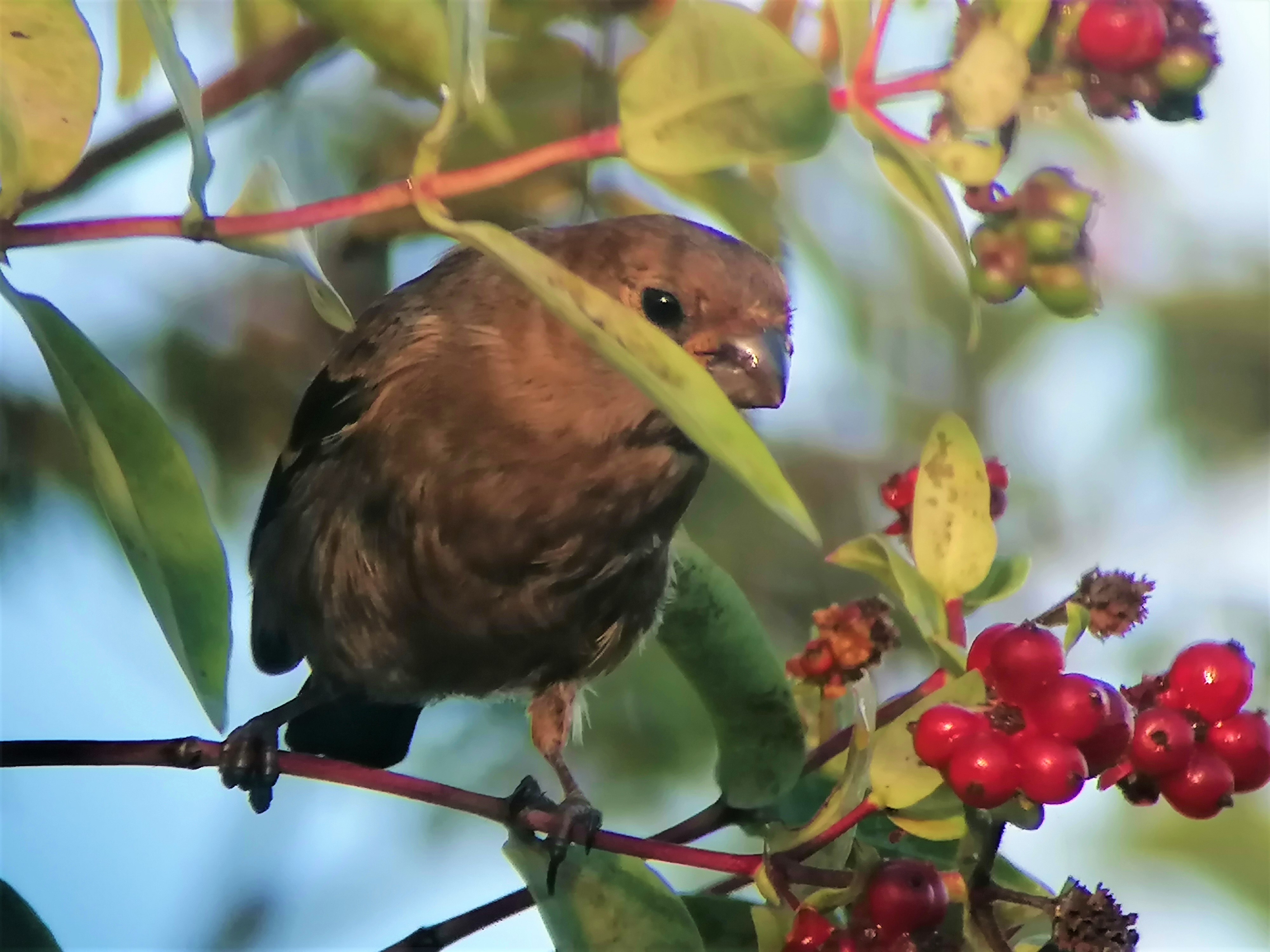


.JPG)
.JPG)