Saturday, 28 April 2012

Wknd 28-29 April

Lacking any bird photos from the day here's some digiscoped flowers at Ferny Ness, bluebell and white deadnettle (this may seem perverse but I find, as for insects, digiscoping gives that nice blurry background by default). A couple of Brents in the pools amongst the Long Craigs rocks off Seton did not wait for me to return with camera! Hastily initially called pale-bellied, later had some doubts but fortunately Geoff got a photo confirming dark-bellied, much rarer in Lothian (10 spring records 1998-2011)! Also a decent spring count of 72 Sandwich Terns there, and by the end of the pipe an odd gathering of "large birds" with Mute Swan, Grey Heron and GBB standing together.

Other bits and bobs - the rookery by the viewpoint at Prestonpans had 30 active nests (counted only 3 there last year) plus 7 at Bankton, also 24 at Macmerry industrial estate. A quarry site held a remarkable Little Grebe nest, a floating structure against a sheer rock face tethered to a protruding willow twig. Back down at Gosford there was a great gathering of Sandwich Terns fishing in the Bay, mainly off Craigielaw, with a steady progression of birds coming in to rocks by pipe at Gosford Sands, some with fish for courtship feeding (one robbed by a Herring Gull which stooped on it). By the time there were 77 on the shore there were still at least 205 fishing offshore, probably more missed along at Seton. Previous spring counts in excess of 100 (1991 to date) have been 126 on 15/5/07, 132 on 10/5/95 and 110 on 13/5/91, all recorded by wardens at Aberlady (Harrison, Thomson and Gordon respectively). So why the current influx, presumed mainly Isle of May birds?

Back home the first House Martin was back, previous return dates being 30/4/11, 24/4/10, 9/4/09, 28/4/08, 26/4/07, 23/4/06, 27/4/05.

Sunday terns had diminished, just a small bunch on shore (below) - along with 107 Barwits, 85 Knot, 54 Oyc, 48 Dunlin, 29 Grey Plover, 24 Curlew and a Sanderling.

Sunset on Sunday over Longniddry Bents c/p2 bog, no sound from the Grasshopper Warbler though!
Back at the Ness on Monday morning a single Whimbrel in the mist.

Monday, 23 April 2012

Wknd 21-22 April

A Moorhen picked up freshly dead on road at Skid Hill, Garleton Hills, gave opportunity to examine the subtle beauty of its plumage, particularly the underparts - a species we may assume is rather dull and take for granted! Note the jet black of central undertail contrasting with white outer panel provides the rear end signal - used both in alarm (Tail fan) and pair greeting (Tail flash), per BWP. The broad white tips on the rear underbelly are shown by both sexes in fresh plumage, but their extent here may suggest this individual is an adult female: "Like adult ♂, but feathers of central lower belly and vent more broadly tipped white, appearing mainly white or mottled grey and white, rarely uniform dark grey; in fresh plumage, white fringes to tips of feathers of lower breast and belly broader on average, sometimes not completely disappearing by wear as in ♂" (per BWP).

Also at the pond there, Mallard ducklings out (b7) and BHG colony in full swing (4th year of occupation, normally fails).

Saturday did some atlas roving around Vogrie & Crichton (first visit), breeding evidence included juv Mistle Thrush on verge at Ford, Chiffchaff bringing feathers one-by-one to line its nest deep in a clump of grass at Vogrie, several active rookeries (10 Ford, 9 Dewartown, 19 Crichton, 16 Blackcastle); also good views of Nuthatch at Vogrie. Single Swallows in several places (including first over our house), Willow Warblers widespread. Grasshopper Warbler in song on Blindwells northern perimeter on Sunday afternoon.

Nevertheless at Ferny Ness later on Sunday no hirundines, nor any other migrants, were seen passing offshore, seems a generally slow arrival this year. 18 Sandwich Terns were fishing Gosford Bay/on Greencraigs, pr Shelduck were again prospecting eastern c/p area, 50 Grey Plover on Greencraigs island; 42 RBM, 16 LTD (mainly breeding plumage), 3 Slav Grebe on sea; single RTD east.

Back to Friday and a Purple Sandpiper and very pale grey (leucistic?) female Eider were at Wrecked Craigs, Port Seton; chatted to Archie Mathieson and his wife there (ex-Aberlady warden). Seton roost numbered 650 BHG, 10 Common Gull (just 3 ads) and 26 graellsii LBB (though BHG were also heard over the house heading to the coast several times btwn 22-23:00hrs, perhaps coming from colonies inland?).

Sunday, 15 April 2012

Wknd 14-15 April

Finally got first Swallows passing offshore in Gosford Bay, Sandwich Terns now more regular (counts); sea duck seemed diminished from last week but harder to count, just 4 Slavs detected and one distant RNG. Gosford Sands above with approaching shower late afternoon.

Seton roost gets hard to monitor into April with birds less tied to the burn and BHG in particular spread widely over the sea, hard to check. At dusk on Friday there were still 1380 BHG but not checked properly for Meds; Saturday had a feeding concentration of 800 BHG in Gosford Bay, something in the water attracting them. At dusk on Sunday (pic below) had a good look throo 1160 BHG mainly concentrated off Longniddry Bents (just one on Seton Burn), 125 Common Gull (all but two on Seton Burn itself) down to just 16 adults, also 140 Herrings and 5 LBB. Looks like the white-wing invasion has truly passed us by now with another blank winter here :(

Photos documenting latest Dolphingstone Barn Owl casualty (22nd such here on this 3 mile stretch of A1 Tranent to Whitecraig since 2004), presumed male (no spots at all):


Also the greyer Tawny from Huntington, a juvenile/1st-win:


Yet another Barn Owl casualty reported Tuesday on the bypass east of Fairmilehead junction, per Tony; I choose to look at the positives here which is that 6 casualties in a month is indicative that there are still a lot about despite two very hard winters; last year's breeding success was not great locally (3.5 young fledged per successful pair), total breeding pairs well down (approx halved) but perhaps more young have survived this last winter with better weather?

[Post mortems on last two Barn Owls confirm the pale unspotted bird as an ad male in good physical condition, containing two field mice; and darker spotted bird is a young ad female (mature inactive ovary, uterus pregravida) also in good condition but containing no prey; ad m Sparrowhawk was a presumed collision injury, it had been in less good condition with some muscle atrophy.]

Sunday, 8 April 2012

Easter 2012

On Wednesday a single Sandwich Tern on Seton shore with small gulls (1220 BHG, 490 Common Gull, 16 ad LBB), first I've seen back. Snow still visible on Pentlands viewed from Longniddry Bents the following morning (above).

Saturday on WeBS, Mute Swans on nests at traditional sites at Drem pools and East Fortune (stick nest). A curiosity was 6 new crow nests around Drem pools but none apparently occupied - two with orange twine woven in. Also a Razorbill just off Sea Green at Aberlady was unusual.

Sunday's highlight was two prs Sparrowhawks displaying over Longniddry - the full display of the male Sprawk is really a spectacle; most interesting with male picked up dead just a fortnight ago, I guess these pairs related to those breeding in west of village and in Fernyness Wood. Seton roost was further depleted though quite scenic at dusk, view here and a sunset from a couple of weeks back.

Update on rookery counts, these now counted, many egg shells below nests:

199+ Huntington, western Garleton Hills
117+ Longniddry station wood (increase from 92 on 24/3)
106+ Craig Wood, East Linton
22 Amisfield, Haddington
c. 20 Macmerry Industrial Estate
19 Drem village
18 Seton Sands caravan park
5 Prestonpans station

The previous highest nest counts I can find in the Lothian database 1991 to date are 125 at Gosford on 5/4/91 and 114 at Berwick Law on 12/4/09. Prior to that high counts all in 1990: 139 Milkhall Crossing, 252+17 Castlelaw (Penicuik), 153 Mortonhill/Frogston, and highest 288 Castlelaw in 1988.

Finally, a grey morph Tawny was found freshly dead at the biggest rookery here, not apparently a road casualty so another mystery - will send off for post mortem (along with another spotless Barn Owl specimen from A1 at Dolphingstone).

Postscript - post mortem came back with chilling findings - puncture wounds to thighs and deep bruising with lacerations on back cranial to tail again with deep bruising - "appearance of bullying or aggression injuries" - thus a suggestion that the Rooks had taken offence at its presence in their colony; vet's view that in that case it must already have been weakened and thus unable to escape.

Saturday, 31 March 2012

Wknd 31 March-1 April


4 Smarties following the plough (!) at Prestonmill just outside East Linton on Saturday. Blackcap in song at Belhaven Bay, no other migrants seen though.

Interesting to see a drake Pintail on pond at Scoughall but it came out onto bank to reveal a blue closed ring 10...AYF.

Also quiet at Aberlady, Peregrine in favourite spot on salt marsh, probable imm f.

Nests built all over the place, can't really log "used nest" (UN) any more so poised to add various as "occupied nest" (ON) shortly, though leaves will soon obscure many. Breeding atlas starts again tomorrow!

Sunday - back at Ferny Ness, finally got a Sand Martin heading W past, also a hybrid crow (one of the normally-plumaged shore residents depicted above); less easy to view sea with some wind and duck numbers down: 160 Velvets, 57 LTD, 47 RBM, 15 Common Scoter, 6 Wigeon, 6 Slav; on Gosford Sands, 190 Oyc, 143 Barwit, 46 Curlew and a Shelduck. On land Small Tort(s) and Peacock at large.

Finally, last weekend's Barn Owl from Tranent bore BTO ring GC42727, ringed locally as one of 5 pulli at a site near Haddington (c. 10 miles east) on 7 July 2007, so had presumably survived the two tough winters preceding this one, only to perish in this sad way in its 5th winter. This is third ring found in 62 recovered, amongst 115 casualties total; the two previous ones from further afield at Drumnadrochit (Highland) and Largo (Fife).

Tuesday, 27 March 2012

Wknd 24-25 March

A thick sea haar descended on the coastal strip from dawn Friday. Figuring this would make Fife hard for migrants to see I spent some hours on the local coast hoping for early returners, but apart from a surge of Mipits on Saturday (unusually going mainly NE in the fog), and an abundance of bumbles bees (+ Red Admiral) little was seen, counts on trek.

Rooks in Fernyness Wood seem to be in great numbers this year, now 94 nests (86 in wood, 4 station c/p, 4 Kitchener Cres (photo), 3 of latter in a tall Highclere holly, which seems an unusual choice but 63 tree species have been used per BWP); this compares 54 nests on 12 March, 18 on 7 March, 10 on 16 Feb, with nest building in full swing throughout (a couple still incomplete). Comparing historical counts here these are unfortunately patchy but 86 nests in 1992, 65 in 1994 then my own counts of c. 30 in 2005, 35 in 2006, c. 30 in 2007, 33 in 2009 (3 Kitchener Cres), 40 in 2010 and 57 last year (when c. 39 in sycamores, 6 elm, 4 beech, 3 dead sycamore; 3 in birch in Kitchener Cres). So why the great expansion?

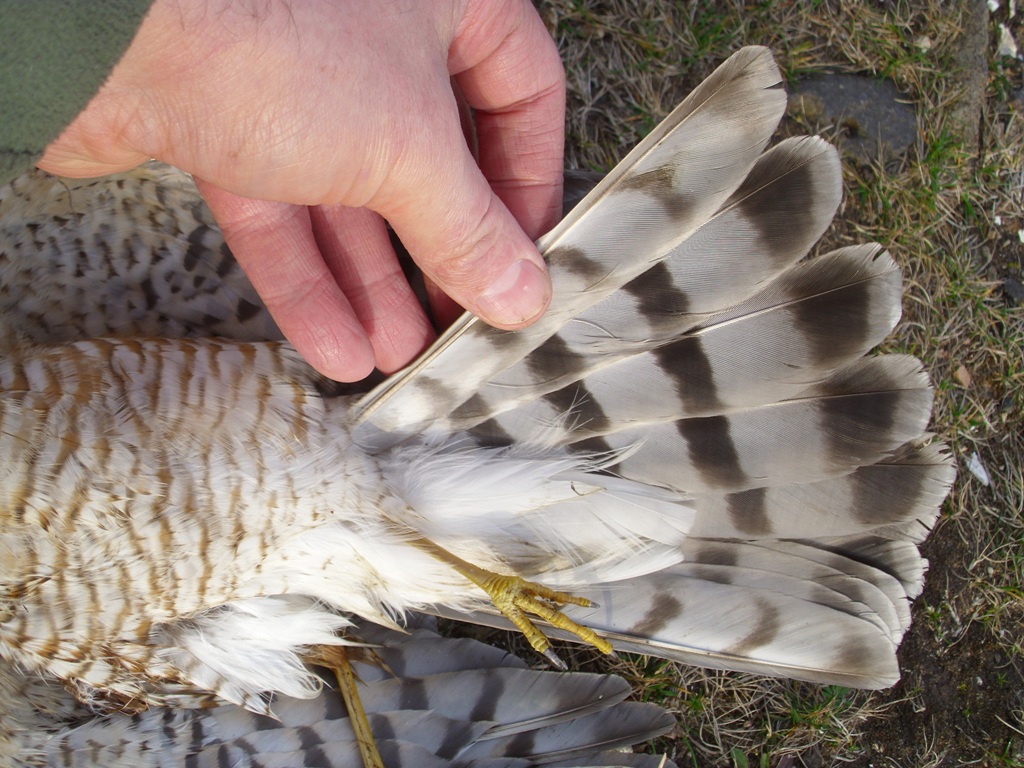
Around the area other local stuff included: Mute Swan on nest at Blindwells (first breeding there as far as I know, after years of residence), Shag darvic blue-ZPL at Seton, Stock Dove in song in great sycamore in front of Longniddry primary (occasional over, but this is first seen in the village in eight years), pr Mallard on burn by community centre again, and a dead male Sparrowhawk (above) at same location, lying in the burn, with House Sparrow feathers on adjacent bank; this was freshly dead overnight so I was curious of cause of death, there is nothing apparent so will send off to vet [Postscript - diagnosis was collision injury, skin inside right thigh torn with bleeding and bruising, ventral abdominal wall bruised with some internal bleeding; small passerine prey in gizzard consistent with House Sparrow, so injuries perhaps sustained in chasing it? Whatever, a sad end to a fine bird, though quickly replaced by others]

Also on Friday minimum 36 Slav Grebes off Longniddry beach, many in breeding plumage, and pr Goosander fishing in shallows at Gosford Sands on Saturday.

Back at Ferny Ness Sunday, nothing new, only 31 Slav Grebes off Longniddry beach by 18:00hrs, 83+ LTD, 173+ Velvet Scoter. 2 RTD flew NE towards roost late afternoon.

Finally, c/o tip off by Tom a new Barn Owl casualty on A1 near Overhailes, a beautiful and pristine specimen, presumed juv male (below); careful examination of last week's from A720 at Newton suggests it's a 2nd-win male, completely white below and only p7 is apparently replaced in primaries, excluding a juvenile. It had been crushed with a mouse, i.e. mouse fur and teeth outside owl, could it have been struck on prey?

Yet another fresh casualty on A1 by Macmerry Ind Estate on Monday, heavily spotted, presumed juv female, photos below. Still another reported from A199 in Tranent, on Tuesday, apparently crushed in centre of road. Interesting that there were no casualties in spring last year and now 4 within a fortnight - we've already exceeded last year's record low total for casualties.

Comparison of the Overhailes and Macmerry individuals shows how distinctly different they can be, these mainly male/female differences though also age related [postscript, post mortems confirm upper bird as an ad male in good physical condition, containing two field mice; lower one is a young ad female (mature inactive ovary, uterus pregravida) also in good condition but containing no prey.]

Saturday, 17 March 2012

Wknd 17-18 March

Started Saturday with vismig at Gullane hill top, a few Mipits moving, of which two went direct over the Forth, but not much else.

Then looked for Whoopers and found only an empty space; thus the decline has been:

255 on 25/2
174 on 3/3
c. 170 on 10/3
117 on 11/3
None 17/3

Who knows were they are now - perhaps staging in the Hebrides or some already en route over the sea or even in Iceland? Coincidentally the same morning Chris Smout has already logged 51 migrants at Carnbee, and later at least 70 more migrants were logged in Fife. Despite these being due N expect likely mainly Welney birds coming up the east coast. We once had a wintering bird (yellow-CX9) reported from Kinnordy on its way north, 3 March 2010.

How magnificent it would have been to have witness the main departure, perhaps one evening during the week? This is described briefly on the Martin Mere blog. Presumably the old timers and experienced birds lead off, not sure this has ever been documented?


Sat pm an opportunistic first visit to the Bavelaw, Threipmuir & Harlaw resrs; not surprising that no sign of 7 Whoopers reported the previous day, just 182 Pinks in grass by Bavelaw. Also 190 Curlew feeding in grass. On resrs 32 Tufties, 28 Teal, 21 Wigeon, 10 Goosander, 9 Goldeneye, 6 Cormorant (which headed off to roost 17:30hrs) plus 25 ad graellsii LBB, presumed resting migrants. Wonderful scenery, rather a lot of people there with some very productive dogs (Rangers logged 1191 poos in the short track from c/p to visitor centre since last August, hmmm...).

Sunday - got to Seton too late after dusk but one 2nd-win Med (very little progress towards a hood) amongst 1900 mainly Common Gulls at burn mouth. The BHG's were segregated as is typical particularly once into breeding plumage, a huge raft of 1700 of them on sea off Longniddry c/p1, including a single full hood ad Med Gull not far offshore, likely more if I had been able to grill them properly. Apart from the change of roost make-up and breeding plumage even with eyes closed you could easily tell we are into those distinctive spring passage roosts with the high-pitched squealing of the excited BHG, much more subdued in winter!

Finally to complete usual species set - a fresh Barn Owl casualty on A720 Edinburgh bypass at Newton by the A68 entrance slip, c/o tip off from Abbie; an interesting looking live owl was seen crossing Millerhill Road at exit to Sheriffhall roundabout - flew N throo trees and not seen again, species not determined but seemed a bit dark above for Barn Owl.