Sunday, 15 September 2013

Yet more atlassing

Heading out early afternoon on Sunday for an atlassing circuit had a small grain of doubt in my mind as to whether it was going to be worth it with torrential rain and strong wind making even seeing to drive the car a challenge whilst passing Drem! But trusted the weatherman and it soon brightened - first stop at Athelstaneford Mains was thick with young Swallows (2 above) and the very first hawthorn checked for Woodpigeon had an obvious nest - not an unusual occurrence. Mopped up a few other Woodpigeon wherever looked for and missing Swallow confirmations in NT67; last weekend was the first time that I found a farm with hirundines over but none entering, today got to Pressmennan farm and depressingly not a one was in sight, however after a couple of minutes a juv fluttered out of a barn; three years ago we had them in the nest into October so I'm not giving up yet!

Best came last on the bank below Kippielaw Farm near Traprain - a covey of 23 Grey Partridges there was a fine sight feeding in stubble near the road - closer scrutiny revealed it was an ad m & ad f plus 21 young, a minimum of 18 young looked identical so must be a single brood, there were 3 that looked perhaps slightly older which are more tricky - per BWP normally single brooded except in case of egg loss, 20 eggs or more in a single clutch found in 15% of cases in one study, but clutches of 21-29 eggs are often (but not always) product of 2 females. Anyway, whether one source or two a good batch of new partridges there! Noticeable that it was always just the parents alert with heads high, all young kept down most of the time - camera gave out at that point but the proud parent can be seen below.

Saturday at dusk - arrived Seton Burn to see a great gathering of gulls on shore but before even crossing the road they started a progressive flush, always a clue to a raptor, sure enough a female Peregrine with heavily distended crop passing over W; on the sea, 38 Wigeon back and a single pale-bellied Brent remained, not for long as a spaniel plunged into the water and flushed it off the sea, did not see where it went in failing light.

Monday, 2 September 2013

Atlassing overtime

This blog rather neglected recently but have been mainly preoccupied with the conclusion of the local atlas, which is all interesting stuff but not very newsworthy! It's not over yet, but with work commitments about to become dominant again perhaps time for a few reflections.

This is our 6th breeding season, and most required fieldwork was down in Borders with the completion of the TTVs; in Lothian we already had broadly reasonable coverage, particularly in central East Lothian, but looking more closely there were actually patches with poor breeding confirmations, which then show up as declines on "change" maps, which are potentially misleading if simply due to less survey effort. The main ones were highlighted on our traffic lights map. Once most of these were done and efforts were also focussed on any remaining "lowland" (approx the Blackbird breeding zone) tetrads with less than 10 confirmed we were approaching a more even coverage across Lothian with all but one 10km square finally having an average of 15-30 confirmed species per tetrad and only 4 tetrads with fewer than 10 confirmed. Nevertheless many hectads west of Edinburgh still have 10-15 species per tetrad fewer confirmed, which predominantly affects moderately common species and will be revealed as declines. It is now apparent that the main reason for these is phenomenal coverage in some of them in the last (1988-94) atlas, e.g. NT17 with confirmations A-U being 46,36,50,47,34,46,35,40,40,31,34,21,44,40,40,20,30,37,38,37. Even with lower numbers in the final 5 tetrads (V-Z) in Edinburgh no hectad in Lothian has matched these in the current atlas.

Personally I made 5 trips to the west (photos above arriving NT17E at dawn on 20/8, House Martin confirmed at large factory complex, Headrig) and collectively I think we reduced the deficit by c. 20%; to have made up the full shortfall would clearly have been a huge effort. I also continued, indeed increased, effort through August, which I always found an excellent period for atlassing but in previous years have been more distracted by returning gulls, colour rings etc. Despite the fact that it is too late for some species, the abundance of young and peak breeding activity for certain species means it can be a very productive time, indeed far better than April; I think we have missed a trick in not deeming it a part of the main survey period, though clearly necessary for TTVs for consistency with other atlasses.

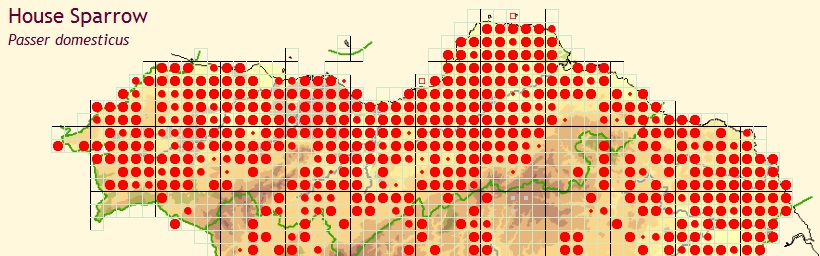
Late summer this year has certainly been superb for Wrens with young families apparent right into the latter half of August, and many late successes also with warblers, more squealing young Buzzards than I can ever remember, but now as we move into September we're down to the core of classic late breeders - waterfowl including Mallard & Moorhen, all gamebirds, all pigeons/doves, hirundines, sparrows and most finches. Below are map comparisons before current season and to date for Woodpigeon, Swallow and House Sparrow. All can be compared with last atlas results online, Woodpigeon, Swallow and House Sparrow. Woodpigeon is certainly improved but still well short of the blanket confirmations achieved last time in the west. Swallow and House Sparrow have come on very well though, the former has dramatically increased within the confines of Edinburgh since our last atlas, whereas the latter is very sparse in many urban areas though with still a few pockets of abundance. Click and toggle images below:

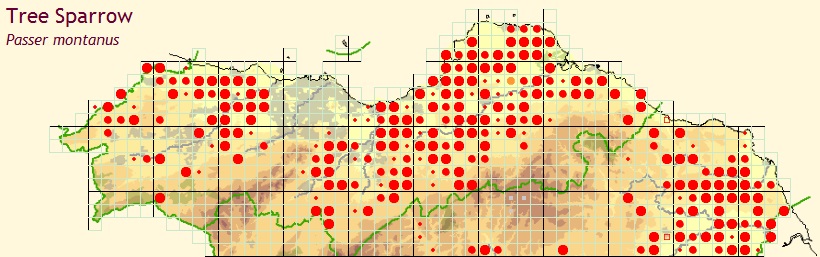
For House Martin we have rather a lot of "possible" codes, particularly in the west, and now is a good time when nest can be more easily located via visiting birds. Another of particular relevance now and coming on well is Tree Sparrow, a lovely little domed nest, "NY", located in a beech hedge at East Fortune last week.

To upgrade Woodpigeon, young birds are now everywhere and an easy means of confirming when small and weak flyers, but also very useful is the used nest "UN" - find some suitable hawthorn or thick scrub and view from inside, there are few places in Lothian where you don't find a nest with a little searching! I tried this today (Sunday) for Bullfinch where I'd seen them recently on Setonhill avenue off the Longniddry railway walk and located 15 nests in 250 m of hawthorn hedge. A couple were Woodpigeon, with one occupied "NY" by a medium sized squab, also a probable Goldfinch, most/all of the rest were thrushes, e.g. Song Thrush first group below and Blackbird, first one a Bullfinch lookalike but too much moss for the latter species. Some Blackbird have very little mud in the cup, but all are deeper than Bullfinch.

Back to the other half of Setonhill on Wednesday added another 10 or so nests, several more thrushes added to group above (upper group Song Thrush, lower group Blackbird), another Goldfinch and 3 more Woodpigeon, including one with two eggs, one freshly hatched, certainly the smallest Woodpigeon I've ever seen:

Another abiding memory of atlassing will unfortunately be the volumes of rubbish deposited in our countryside by thoughtless residents. Especially in the west some have gone to great lengths to fly tip even deep into woods and in the most unlikely places. A classic example round Dalmahoy last week, the black plastic bags of builders waste dumped at intervals of c. 100m along miles of roads, what a job for someone top recover that mess and how more costly to us all in the long run. Worse in some ways, because it is so needless, is the number of bottles and cans, on many smaller roads it is dozens per 100m stretch, way more than the average of 4 plastic/3 drinks on trunk roads, often half drunk - I really struggle to imagine the mentality of these folks for whom it must be routine to heave your waste through the car window, leaving someone else to pay for tidying it up (£20 per person per year in Scotland), instead of the simplest of tasks, putting it in your own recycling box! In course of my atlassing I remove what I can, several recycling boxes full of plastic and drinks cans, added to a couple of sacks of rubbish I clear along the burn in Longniddry - even here the children visiting the community centre seem to thing the best place for their cans and bottles is in the burn outside. You do learn about society in atlassing, the apparent lack of basic education, decency and respect for others that seems to blight so many, maybe a deposit returns scheme would help it could all be so much simpler...

Thursday, 15 August 2013

Cherry Blossom and other darvics

Old friend red-7P8 Mediterranean Gull, aka "Cherry Blossom", back on Seton Sands tonight; this her 10th return, age at least 12 yrs. Tonight with 2 other adults (below) in just a couple of hundred small gulls at pre-roost a while before dusk. Presumably same also amongst 6 birds there last week (3 ads), along with another returnee white-32A4 (Johan's link not updated with last year's records yet) - a very interesting bird now in 3rd-summer but still with some dark in primary tips - per Olsen & Larsson 25% of males and 50% of females have some short dark markings on outer webs in 3rd-win.

Lots of colour-ringed Sandwich Terns reported recently, 3 per Dave at Seton on 15 August were juvs red-UFH, red-ULK from Northumbs (ringed Inner Farne 12 July and 31 July, respectively) and ad white-EVL (colour-ringed on the Ythan on 19/07/11, but originally ringed on Coquet Island, Northumbs on 26/6/05), and also seen there on 17 July this year, so presumably breeding there. Also one of this year's juveniles at Musselburgh on 18 July, yellow-EPK, ringed at Forvie on 13 June, and the first dispersing bird seen away from there. Prior to that we had a lime over dark green at Musselburgh on 15-16 July, this being the first ever resighting from the 2002 cohort at Forvie, and another of the lime over red flavour (2008 cohort) at Seton on 10 August. A colour-ringed adult at Seton red over blue is also a Forvie bird (details awaited). Thanks to Dave Allan for most of these, and ringers Ewan and Chris for prompt details!

A Little Tern at Musselburgh in early July had a blue colour ring, thus may be a South Gare bird.

Going back to last year also recently discovered that the ringed Roseate on Seton rocks then (Rosy special ring 32/V0) had been ringed on Coquet Island on 9 July 2006, by Tom Cadwallender. This might be the fourth Roseate control/recovery from outside Lothian, two previous were local birds from Fife whilst the third was a 1973 recovery near Drem (?) of a bird ringed on Coquet in 1969.

So the usual picture with terns from north and south moving into the Forth; some do continue overland, another common theme here is the nocturnal movement heard every year from mid-August, first heard this time at 22:30hrs on Monday 12 August with a couple of Sandwich Terns move SW over the top of Blindwells. Normally just Sandwich Terns but also occasionally Common Tern, perhaps others also pass over?

Finally ought to mention recent BHG darvics, George spotted Norwegian white-J9J9 on Fisherrow beach on 29 July, Ian had seen it at Eskmouth on 23 July. Also at Musselburgh on 2 August Dave got white-J3CE, an old one first ringed at Rogaland (Norway) in 1994, colour ring added there on 8/4/12.

red-7P8 still present to 19 August, together with 3 ads including the one below, outer primaries already moulted; comparing notes with Norman suggests a minimum of 8 different individuals (5 ad, 2 3rd-yr, 1 2nd-yr) in the last week of so.

Friday, 9 August 2013

The Seton Dipper

Having scoured the Seton tetrad for 6 years now I was initially sceptical when receiving a report of a Dipper at Seton Chapel in early July, seen by persons unknown, however an LBN appeal led to Murray contacting me with concrete info on his sighting - below the bridge in grounds of the Chapel monument when he was looking for the parakeet; I then followed up and found plenty of evidence by way of droppings at the small burn through the Chapel grounds - but no sign of the bird itself! Worse, the stream was running pretty dry and even at the best of times much of it is underground, including the last 500m from the House to the Seton Burn bridge on the coast road, just perhaps 100m of proper flow on that side. Minimum territory size for Dipper in good habitat is 100m, so it looked a bit marginal to support even a single bird for any length of time. Bird-aware residents at Seton House and the Seton Mill House had not seen it either, though there were also a few droppings at later location.

Too busy with atlas to look further in July but then Willie came to the rescue again refinding it at the nearby Blindwells Minewater Treatment Scheme on the other side of the A198 on 6 August. There is even less open watercourse on this side, and the sludge beds are now full of reeds way over head height, but there is a weir-like full length drop between the lower two tanks and exposed flowing water there which may well suit it very well. Photos here from Thursday 8 August, was content to rest a few minutes while I watched it, gently bobbing - NB, it is a juvenile of the species so a recent dispersal!

Why the interest? As far as I'm aware there are no historical records of Dipper here, and the nearest occupied territories are 4-5 miles distant on the lower River Esk and upper River Tyne. There are no waterways in between - and though the initial thought might be a displaced bird moving along the coast from the Esk in winter this seems pretty unlikely as it would need to fly inland at a random location to find the water it has now colonised (not relevant anyway to a juvenile). I'd guess it has more likely dispersed from the Tyne and been drawn in by the larger area of wetland including the adjacent Blindwells pond.

Do Dippers do this? The Price & Bock account of their American Dipper (Cinclus mexicanus) studies* contains some relevant and interesting information (p. 32) with two records of overland flight observed, one historical record in 1922 of a 400m movement across a Y in a river and their own sighting in 1971 of a bird displaced by others flying off overland and climbing to a height of 60m. They also refer to other movements between watersheds from their ringing studies that they attribute to movements overland, other routes along waterways being unfeasibly long and away from typical habitat. More relevant to the current case are references there to the observations in Jost's (1969) paper** on our European Dipper (Cinclus cinclus) documenting movements between watersheds by juveniles in the German Rhoen, and additional finding that adult Dippers make regular migrations across the high Swiss Alps where the lowest passes are over 2000m - Dippers caught in mist nests above the tree line! However all of these studies relate to higher altitude steep terrain, whereas the current case would involve a climb and descent of no more than 50m in 4+ miles. UK vismig records on trektellen show this species has not yet been logged on migration here, the only records being birds appearing at a Redmires reservoir which is connected to a waterway, but how many are we missing? Since posting Stuart has alerted me to his observation of a Dipper on the Cart Water in centre of Paisley flying off high above tenements.

So it turns out it can't be added to atlas as a juvenile. Plenty of genuine breeding activity still underway, thick with young birds along Blindwells margins with young Sedge Warblers (scolding parent below) and Whitethroats, I still live in hope that Tufted ducklings may yet emerge at Blindwells, the female having vanished again and the two drakes resident all summer. Also two families of young Bullfinch seen this week, and plenty gamebirds - see previous blog post. The atlas lives on for now!

* Price, F.E. & Bock, C.E. (1983) "Population ecology of the Dipper (Cinclus mexicanus) in the Front Range of Colorado", Studies in Avian Biolody No. 7. (download link)
** Jost, O. 1969. Über die bedeutung der wassersheiden beim ortswechsel der Wasseramsel (Cinclus cinclus aquaticus). [On the significance of water sheds in the movements of the Dipper (Cinclus cinclus aquaticus).] J. Ornithol. 110:71-78 [English sum.] (download link)

Wednesday, 7 August 2013

Atlas serendipity

Atlas and photos don't normally go so well together but this pure chance encounter (I stopped to check out a Wren) on verge of minor road south of Daneskine (NT56T) was quite remarkable - this bird was crouched very close just by the verge, surrounded by tiny chicks; I thought they would flush so I remained still and they were all like frozen statues for at least a couple of minutes, steadily I got closer and they began to relax, after a few more minutes I had to resort to the macro setting to photograph the chicks; whilst doing so one dozed off and others attempted to climb into the female's body feathers, then she began to nibble grass and commenced clucking calls with hints of the usual "go-chock" call at times. After five minutes a car came down the road and we had to leave, a remarkable encounter albeit with a naturalised species (or perhaps recent release).


Tuesday, 30 July 2013

Wknd 27-28 July

Sunday did the Eider count Port Seton to Craigielaw stretch, total 601 (44% female/juv); also 25+ Red-necked Grebe (many quite distant, but some decent groups off Longniddry beach), 192 Velvet Scoter (ultimately congregated NW off Ferny Ness) and 428 Common Scoter (420 well offshore eventually joining a single group, the rest quite close). 1 Manx Shearwater flew west. In recent years south Forth WeBS July counts in the range 2-4k, so with c. 1200 from Joppa to Craigielaw hopefully we'll have a comparable number this year. Quite a challenge counting and age/sex breakdown with rather variable light, eventually some rain clouds towards dusk as shown.

Also a large mixed flock of terns fishing off Craigielaw, mainly Sandwich but other potential species hard to differentiate at range, certainly Arctic in the mix with 25 of the latter on Aberlady shore amongst a separate gathering towards dusk.

Monday evening saw an unringed adult Med Gull back on Longniddry beach; have not looked for red-7P8 yet but now is about the time she usually reappears. Several recent reports for Forvie-ringed Sandwich Terns and Norwegian BHG, however I shall be concentrating on atlas again for at least the duration of August.

Islay 20-27 July

Another west coast holiday back on Islay, 125 miles pretty much due west of our home in the east but what a difference in habitat and bird life! First the spectacular scenery down the A83 along Loch Fyne, then the wonderful views of the islands from the ferry. A pair of Black-throated Divers overtook the ferry, then several Manx Shearwaters looking stunning over a glassy sea off Gigha.

Down at Port Ellen beach on Sunday got this series of a Ringed Plover, at times perfectly camoflagued. In careful obs I noted that this species is "semi-palmated" between the outer toes, it is only the inner gap that is completely unwebbed. At same location did an experiment with an old boiled egg and an expired fresh egg and found that Hooded Crows can spot eggs from a distance and really don't mind if they are cooked or not!

Usual owling trips failed again to find LEO in the plantation behind Cornabus (rumoured to have been there some years ago, no recent records from Islay), did get Barn Owl and Grasshopper Warbler there.

Some attempts at sea-watching off the Mull of Oa, after the weather broke we did get a bit of wind which produced a steady feeding movement of Manx Shearwaters, 950S/3N, and Gannet 376S/44N, in 3 hours from dawn on Thursday (interrupted by 2 hours fogged out) but other three days had too much fog. On same watch a few Puffins feeding offshore, closest breeding is a fair distance N on Iona/Mull.

Even watching at the farm was pleasure, with juvenile Twite on the garden fence (above), Willow Warbler numerous as ever around the washing line and feeding on ground amongst see-eaters, such as this Chaffinch eating plantain seeds.

A first visit to the west coast, Machir Bay, gave more stunning scenery and 14 Sanderling on the sands, ovipositing Golden-ringed Dragonfly in the burn, and 2 ringtail Hen Harriers inland. Amongst many Ringlets were a few Grayling and Common Blues such as this pair at Lagavulin (logged for the bigbutterflycount):

On the return ferry trip from Port Askaig the sea was literally covered in groups of auks in every direction, many with young, and a conservative count of 1150 nearer the path of the boat were 85% Guillemot, 15% Razorbill - with the latter concentrated closer to the coasts of Jura and Gigha; also 2 more adult Puffins. Again Manx Shearwaters over a glassy sea, these two with Gigha behind and an evening view of Islay+Jura: