Saturday, 6 November 2010

Wknd 6-7 November

A brief look out to sea from Seton harbour on Friday afternoon produced a Little Auk W past, which in characteristic fashion almost stalled and fell down onto the surface of the sea.

Saturday did tetrad NT47J, mainly offshore NW from Ferny Ness but with a strip of beach at low tide (hence a "low priority" tetrad); but worthwhile with 21 species logged, 300+ waders (115 Barwit, 90+ Knot, 40 Sanderling, 30 Grey Plover, etc.), 100 gulls and 100 sea duck, crow the only passerine. Just after concluding a dark skua appeared, Pom or Arctic, but departed rapidly NE before it could be confirmed! Returned after lunch when sea flat calm, totals visible then included one Black-throated Diver, 5 Red-throated Diver, 32 Slavonian Grebe, 330+ Velvet Scoter. Michael (age 4 yrs) disappeared into buckthorn and emerged to report a dead bird, a metal-ringed Shag #1416986 [chick banded 20/6/2009 on Fidra], probably dead since last winter.

Afternoon ventured to New Winton where plugged last gap in NT47 for Wren; 65 Linnets were feeding on larch cones. A Dipper showed well nearby on the Tyne at Spilmersford.

Sunday saw Tree Sparrows whirring around again and also 6 more Waxwing SW over house at 11:30hrs. On grey goose survey, Kingfisher @Gosford ponds (flew into boathouse), plus the usuals, Nutch, Jay, Redpoll, Treep, Goldcrest, Bullfinch, etc; 96 Whoopers (23 juv, including b5, b3, b2, b2, darvics file now updated) in stubble north of Chapel farm; 2 sawbills W over Fenton Barns and 2 redhead Goosander at Chapel resr; at East Fortune, 277 Greylags including an all-white domestic bird and 3 grey hybrids (above), plus f/imm Scaup on the resr. Greylags flew to Redside at dusk.

Wednesday, 3 November 2010

Another LEO

Sadly, another Long-eared Owl road-kill, found fresh dead (still warm and fresh blood on side of face) on the B6363 by Longniddry Farm, c. 300m SE of the Lorne Bridge, 03:45hrs on 3 November. Seems to be a juvenile (6 clear bars on secondaries, 5 on primaries) and might be a male based on various features, including alula bars and underwing primary coverts dark tips of c. 20mm (though uncertain as to how these differ on juv and got this wrong on last specimen, LBN post for 7/3/09!). Will assess more carefully later.


While out also collected another Barn Owl, reported by Colin Davison on the Haddington A1 exit slip (below); seems to be another juvenile female (analysis confirmed young female, mature inactive ovary, uterus pregravida). Part of a recent spate of reports, presumably post-juvenile dispersal, this is the 100th Barn Owl casualty logged since start of study in October 2004 (6 yrs, average 16 per yr). It will be the 42nd post mortem.

Sunday, 31 October 2010

Wknd 30-31 October

A frustrating wknd with no internet access due to broadband fault from Friday pm until Sunday evening. No time for proper post so below is expanded from LBN message:

vismig both days, fortunately overlapping Ian's counts at Muss, confirms Musselburgh is a much better location, or Ian a better counter! My Saturday totals from Longniddry were less than a half for same period, much fewer Chaffinch, and Sunday even lower; nevertheless ystdy in total:

209 Siskin, 35 Crossbill, 18 Waxwing, 1 Brambling, 1 Rock Pipit

Siskins still moving mid-afternoon in Aberlady when another 12 Waxwing plus another extended flock (c. 200) distantly SW almost certainly Waxwing too. Full counts on trektellen. A female Peregrine was out on the mud.

Also ystdy, c. 1780 Golden Plover on the rocky shore at Port Seton, Long Craigs.

This afternoon, 89 Whoopers (17 juv, including one b5) in stubble by Rattlebags quarry (near East Fenton) included 3 new darvics, E7B, G4F and S55; latter was ringed as a juv by Allan Brown on the River Tay at Flukie Fishing Lodge, Kinfauns, near Perth on 29/1/10, last seen there 19/3/10. Also one metal only (right, perhaps same as last winter). Unusually two flew to roost towards Aberlady, passing over Fenton Barns at dusk.

Also at East Fenton, 17 Waxwings flycatching and at dusk 24 arrived at the entrance track to the main house at Fenton Barns and probably went to roost there.

Best sight of the weekend was a Tree Sparrow in our tiny garden amongst the usual House Sparrows - common enough elsewhere in the neighbourhood but our first in 7 years.

The Brambling ystdy was also new for the garden list, these being species 91 & species 92. vismig ought to eventually yield 100 species - some obvious targets still left with Reed Bunting, Tree Pipit, Twite and Yellowhammer, all regular on vis on the coast, and a few more optimistic ones needed for the final gap - Yellow Wagtail, Lap Bunt (will there ever be a better opportunity than this winter?), Snow Bunt and Rock Pipit (last three all seen passing Ferny Ness). My previous speculation on garden list targets now looks rather redundant, though one or two others may still be realistic, certainly a few more common ducks (Teal, Wigeon) and waders (Snipe, Woodcock).

Sunday, 24 October 2010

Wknd 23-24 October

Did the final BigVis count on Sunday (too much rain Saturday); on arrival at Ferny Ness 25 Waxwings were approaching from south, continued high N over the Forth, plus one heard soon after. A good passage of Fieldfare with 7 flocks totalling 335, all arriving from SW or coasting, continuing W. 69 Siskin SW in one hour. Full counts on trektellen.

Sunday afternoon, Kittiwakes spotted moving into Forth, 2 flocks totalling 105 SW, and a single juv Gannet. Immediately following another beautiful sunset all the Pinks and more came back at dusk, a flock of c. 6470 NE over Ferny Ness at 18:20hrs (updated counts)

Saturday morning - 3 Barnacle Geese out on Aberlady mud after the Pinks had departed (and 302+ Shelduck); later noted two Jays near the Tyne at Lennoxlove.

Friday, 22 October 2010

Surprise Hobby


Spotted this bird, sadly a road-kill, on the A1 at Whitecraig, by Inveresk, late last week (14/10); had been puzzled about species, roughly Kestrel sized but brown like a Buzzard and many bars seemingly ruling out all usual possibilities; so collected in early hours of Friday and despite having been squashed flat it was obviously a Hobby, quite a surprise.

As per pics above age and sex seems quite straightforward: dark brown upperparts, uniform flight feathers fringed buff, undertail coverts and thighs both well-marked all point to juv; big tear drop brown marks on thighs, and short bars on undertail (not extending to feather shaft as on juv male) confirm female. Sad end to a beautiful bird.

Nearby, remains of a Tawny Owl recovered from the Esk bridge, freshly dead on Wednesday morning, apparently juv too but need to dry out feathers.

Postscript - this bird was accepted by LBRC as the 32nd confirmed record for Lothian, remains retained at National Museums Scotland - it is interesting to note that the third record of Hobby (and last until 1975) was one found dead at Goshen, Musselburgh on 14 October 1912, 98 years to the day and just about a mile from the current bird, remarkable coincidence!

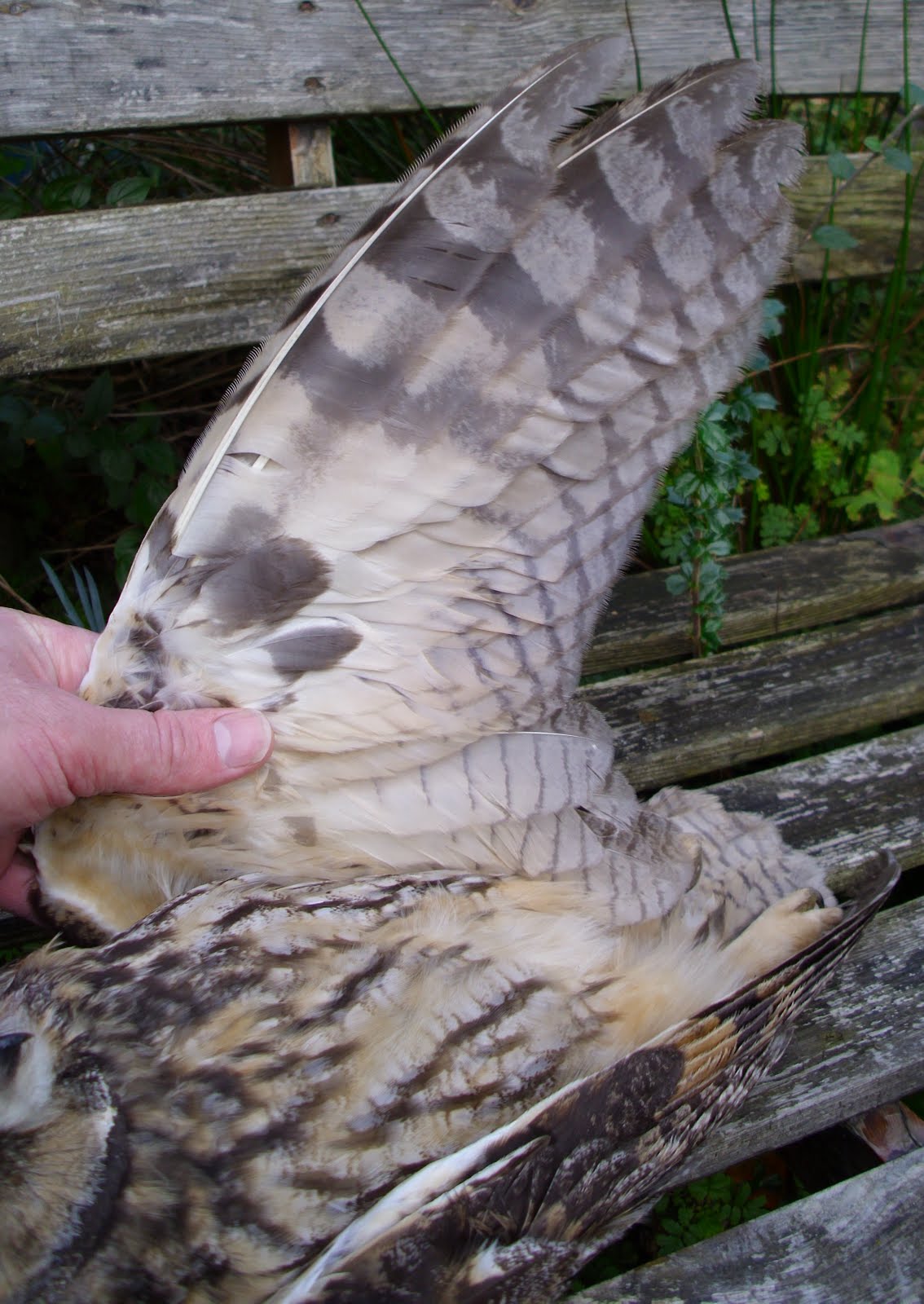
Also recently, feathers above of a dead owl recovered from Vaults Wood at White Sands, early October (per Kris Gibb, Ian Andrews) turn out to be from a Short-eared Owl, very probably an adult female; my guess is an expired migrant, just possibly a bird which expired in last winter's cold weather.

Wednesday, 20 October 2010

Wk 18-22 October

Med Gulls in Seton roost - ad + 2nd-win (above) on shore before sunset on Monday, at sunset on Tuesday, and 3 adults out in roost on Long Craigs rocks 45 mins after sunset on Wednesday (amongst c. 4250 gulls).

NB - all of these are very much minimum counts, this time of year there are often too many birds to properly scan them all and even on the last count with most birds arrived a few were still arriving from 18:30hrs onwards; was surprised I could distinguish any Meds at all in the gloom but once you get one they are usually unmistakable. More observers would be good, last saw birders at this site over a year ago when the "yellow-legged" Gull drew a few out one night (and failed to show). This visit also accompanied by the curious sounds of 2+ Snipe calling to each other continuously out on the rocky shore, and the melodious conversation of Golden and Ringed Plovers. Immediately beforehand at Eskside in Musselburgh one female Pintail on the river, and early morning 22 Fieldfare SW along the coast road (with reports on vismig of many thousands pouring over some sites in the Pennines - trektellen overview).


At least 5 Med Gulls (4+ ads and the 2nd-win) on rocky shore by Long Craigs at dusk on Thursday - image shows 3 adults within 100 birds in west of roost; 4th adult was further east, and the 2nd-win seen well in flight over. This equals my previous best count at the site on 13 November 2006 but that included 2x 1st-win, this is the most adults together; 5 adults were present at Buckhaven in Fife 13-16 August 2009, the only other report of 5 I'm aware of being at Eastfield on 26 March this year (no info on this but one adult in four there same day).

Only 2 adult Med Gulls found on Friday, but roost patchy and spread along shore from Wrecked Craigs (Seton prom) to opposite the caravan park, more than a kilometre.

20 Fieldfare again over SW at Cockenzie and Prestonpans on Thursday morning, 15 SW over Liberton school on Friday evening.

Also this week, ringing info on Sandwich Tern photographed by Abbie on Longniddry beach on 4/10 (right front in pic); this was one of 200 individually colour-ringed by Grampian Ringing Group (left leg white ring with black letter reading down, commencing E) on the Ythan Estuary this autumn (12/9 for this bird, EVD). Perhaps a bit late for seeing any more here now (3 others reported from Normandy around same date) but worth looking out for more of these in future. Reading the rings will be fun, quite a challenge on this image!

Sunday, 17 October 2010

Wknd 16-17 October

Friday afternoon saw Herring Gull orange-1787 back on the Seton Burn (present here last year late Aug to late Oct, originally ringed as an adult at Seamer Carr landfill, near Scarborough, on 30/11/07).

Saturday we were at the zoo, disappointed not to see the Night Herons after a report of their presence again at the sea-lion enclosure just last wknd, per Mark Holling. En route home a quick look at the Seton roost produced just a single unringed adult Med Gull.

Sunday afternoon, at Cottyburn on the Longniddry Railway Walk, Brambling calling and another over with Redwings. Covey 10 Grey Partridge at their regular spot by Setonhill cottages. Large gull roost on Seton shore, estimated 5100 small gulls, including a minimum of 4 Meds, 3 adults and a 2nd-winter, all unringed. A fair number not properly checked, tightly packed and hunkered down on the rocky shore, so may well have been more hiding in there.